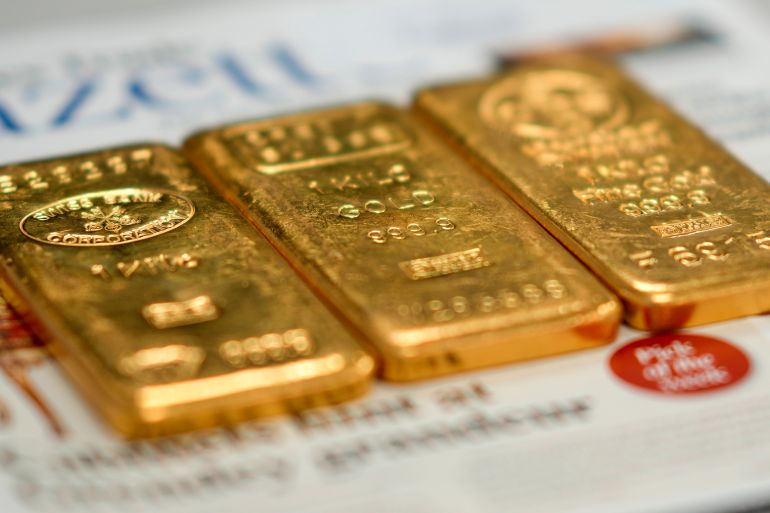
Despite stabilizing in morning trading today, Tuesday, at $4,330 per ounce compared to yesterday’s trading, the precious metal’s prices remain far from the record levels recorded in January of this year at around $5,600.
Gold prices yesterday, Monday, hit their lowest level in more than two months when they closed at $4,318, amid strong US jobs data released last week that strengthened expectations that the US Federal Reserve would raise interest rates.
Gold has fallen by about 8% over the past month, and 16% over the past three months, that is, since the start of the Iran war at the end of last February.
Reasons for Gold’s Decline
A report released by the Bureau of Labor Statistics of the US Department of Labor last Friday showed that non-farm payrolls in the United States rose by 172,000 jobs in May.
According to market tools, markets expect a probability of over 70% that the US central bank will raise interest rates next December, compared to expectations of 45% a week ago.
The yield on the benchmark 10-year US Treasury note rose after jumping to its highest level in two weeks in the previous session, increasing the opportunity cost of holding gold.
A rise in US Treasury yields leads investors to shift towards buying them, resulting in a decline in demand for gold, which does not yield a return, thus contributing to lowering its prices.
Brent crude oil prices also jumped by more than four dollars per barrel yesterday, Monday, after Israel launched new raids on … in addition to renewed attacks on … the day before, increasing concerns about inflation, before retreating today to settle above $93 due to the fragile truce between Tehran and Tel Aviv.
The rise in oil increases transportation and manufacturing costs, and raises the general price level, which increases pressure on central banks in major economies, such as the US Federal Reserve, the European Central Bank, and the Bank of England, to raise interest rates to control inflation.
In summary, the following reasons for the decline in gold prices were identified:
- Rising employment levels in the United States.
- Increased yield on 10-year US Treasury bonds.
- Rise in the US dollar exchange rate, which increases the cost of gold for holders of other currencies.
- Rising oil prices.
What are the Experts’ Tips for Gold Investors?
The decline in gold prices is an investment opportunity, and experts have provided many tips for those wishing to engage in this type of investment.
Economic analysts offered the following tips:
- When you have surplus funds after meeting all essential monthly obligations, you can turn to gradual and simple investment in gold or other safe assets, but on the condition that the investment is made after financial stability so that it does not become a burden or financial pressure.
- It is important to avoid rushing and daily price monitoring, because gold is affected by complex economic and geopolitical factors that a small investor cannot fully grasp.
- If the goal is to preserve the value of money in the long term, the investor must be patient and not feel anxious if they buy at a certain price and gold subsequently falls; the purpose of investment is not quick profit but preserving the purchasing power of money.
- Speculating in gold is never recommended, as it mostly leads to loss, while real success in this market is achieved through calm, long-term investment.
<div class="my-4 p-4 rounded-lg shadow-md bg-blue-50 border-l-4 border-blue-400