Resident highlights garbage outside Bengaluru tech parks, saying “I can’t call this my city.”
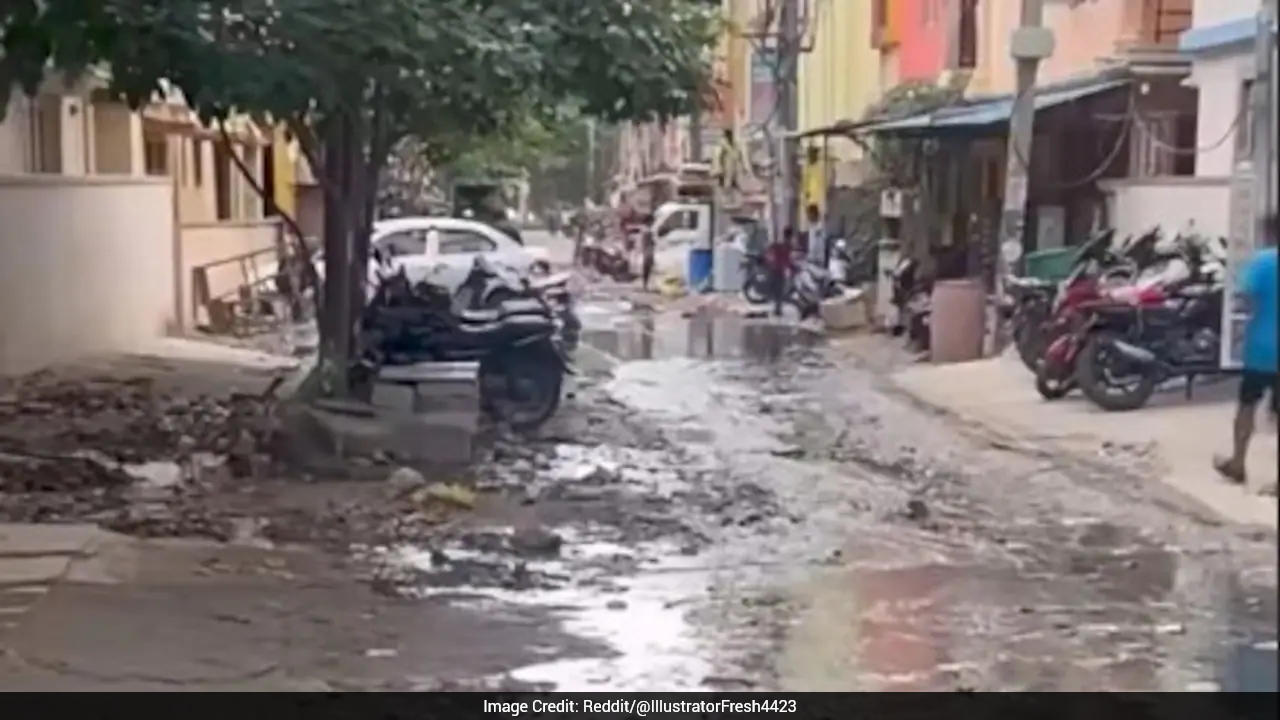
A resident posts a picture showing a dilapidated road and sewage in Munnekolala, urging a protest.
A Bengaluru resident has called on others living in affluent areas to speak out and pressure politicians to improve the poor infrastructure in newly developed neighborhoods. In a now-viral social media post, the resident shared a picture of a damaged road in Munnekolala, located next to tech parks that house Fortune 500 companies. The image shows garbage and sewage on the street as residents navigate around the dirt to reach their destinations.
The resident stated that living in such conditions as a taxpayer is completely unacceptable. “Old Bangaloreans living in privileged areas like Jayanagar, Basavanagudi, Malleshwaram, etc., open your eyes and see the state of roads in the other part of the city you don’t even care about,” the user wrote in a Reddit post.
“As an old Bangalorean myself, I can’t even step into this place and call it ‘My city.’ We are all living in the heavens built by our ancestors or the old city planners.”
Highlighting that rent in such areas is extremely high, the resident urged others to come out and protest the lack of planning and maintenance from authorities.
“It is also the duty of our current politicians to keep up with what our ancestors built. What have the corrupt politicians achieved now? This! Rent here is incredibly expensive; some people are paying 40-50 percent of their monthly salary just to live here. It’s high time we protest for the betterment of our own city.”
Check the viral post here:
by in
‘Sad Reality’
As the post gained traction, social media users said it was unfortunately the reality for the entire city, where infrastructure quality has consistently declined.
“I bet the entire stretch has illegal paying guest accommodations that are disposing sewage into storm water drains, if one exists,” said one user, while another added: “Zero sympathy for this place. While you feel for locals in other areas, but here the locals who have erected all these illegal PGs. It’s their creation.”
A third commented: “You might be living there as a taxpayer, but if you don’t qualify as a vote bank, any government will not care. That’s the sad reality of most such areas.”
A fourth said: “Most buildings there are flouting rules. But with the current government coming up with so many ways of regularizing such buildings with very small fees, areas worse than this are going to multiply.”
Munnekolala
Munnekolala is a locality in the southeastern part of Bengaluru, India, known for its historic Maruthi Mandir (Hanuman temple), which is believed to date back several centuries. The area’s name is derived from “Munnuru Kola” (three hundred pillars), referring to an ancient temple tank or structure that once existed there. Today, it is a bustling residential and commercial neighborhood, blending its cultural heritage with modern urban development.
Jayanagar
Jayanagar is a prominent neighborhood in Bangalore, India, known for its planned layout, tree-lined avenues, and vibrant commercial and cultural life. Developed in the mid-20th century, it was one of the city’s first post-independence extensions, designed to provide organized housing and amenities. Today, it remains a bustling hub, featuring landmarks like the iconic Ragigudda Anjaneya Temple and the historic Bangalore South Taluk Office.
Munnekolala
<div
Jayanagar
Jayanagar is a prominent residential and commercial neighborhood in Bangalore, India, known for its tree-lined avenues and well-planned layout. Developed in the mid-20th century, it was one of the city’s first planned extensions, designed by the noted architect Sir M. Visvesvaraya to accommodate Bangalore’s growing population. Today, it remains a vibrant cultural hub, famous for its markets, parks, and historic temples.
Basavanagudi
Basavanagudi is a historic neighborhood in Bangalore, India, named after the Bull Temple (Basavanna Temple), which houses a massive monolith of Nandi, the bull of Lord Shiva. The area was developed in the late 19th century and is known for its cultural heritage, including the famous Kadalekai Parishe (groundnut fair) that dates back over a century. Its tree-lined streets and traditional architecture reflect the city’s old-world charm, making it a beloved landmark for locals and visitors alike.
Malleshwaram
Malleshwaram is a historic neighborhood in Bangalore, India, established in the late 19th century as one of the city’s earliest planned suburbs. Named after the Malleshwara Temple, dedicated to Lord Shiva, the area developed around the former railway line and retains a blend of traditional architecture, tree-lined streets, and vibrant local markets. It is known for its cultural heritage, including the iconic 17th-century Kadu Malleshwara Temple and its role in Bangalore’s growth during the British colonial era.
Munnekolala
Munnekolala is a locality in the southeastern part of Bengaluru, India, known for its rapid urbanization and residential development. Historically, the area was part of the larger village landscape of the Bengaluru region, with its name possibly derived from local Kannada terms referring to a “three-stone” landmark or a historical boundary marker. Today, it is recognized for its proximity to tech hubs and cultural landmarks like the Shiva temple.
Maruthi Mandir
Maruthi Mandir is a prominent Hindu temple dedicated to Lord Hanuman, located in the city of Pune, Maharashtra, India. Built in the 17th century during the Maratha Empire under the patronage of the Peshwas, it holds historical significance as a place of worship for the Maratha warriors. The temple features a distinctive black stone idol of Hanuman and remains an active spiritual site for devotees.
Ragigudda Anjaneya Temple
Ragigudda Anjaneya Temple is a prominent Hindu temple located in Bangalore, India, dedicated to Lord Hanuman (Anjaneya). Built atop a hill known as “Ragigudda” (Ragi Hill), the temple’s history traces back to the 16th century, when it was established by the Vijayanagara Empire. It is a popular pilgrimage site, known for its unique rock-cut architecture and a serene atmosphere, attracting devotees seeking blessings and spiritual solace.
Bangalore South Taluk Office
The Bangalore South Taluk Office is a key administrative hub located in the southern part of Bangalore, India. It serves as the local government office for the Bangalore South taluk, overseeing revenue collection, land records, and civic services for the surrounding areas. Historically, the office has played a central role in managing the region’s rapid urbanization and demographic changes since Bangalore’s expansion in the late 20th century.