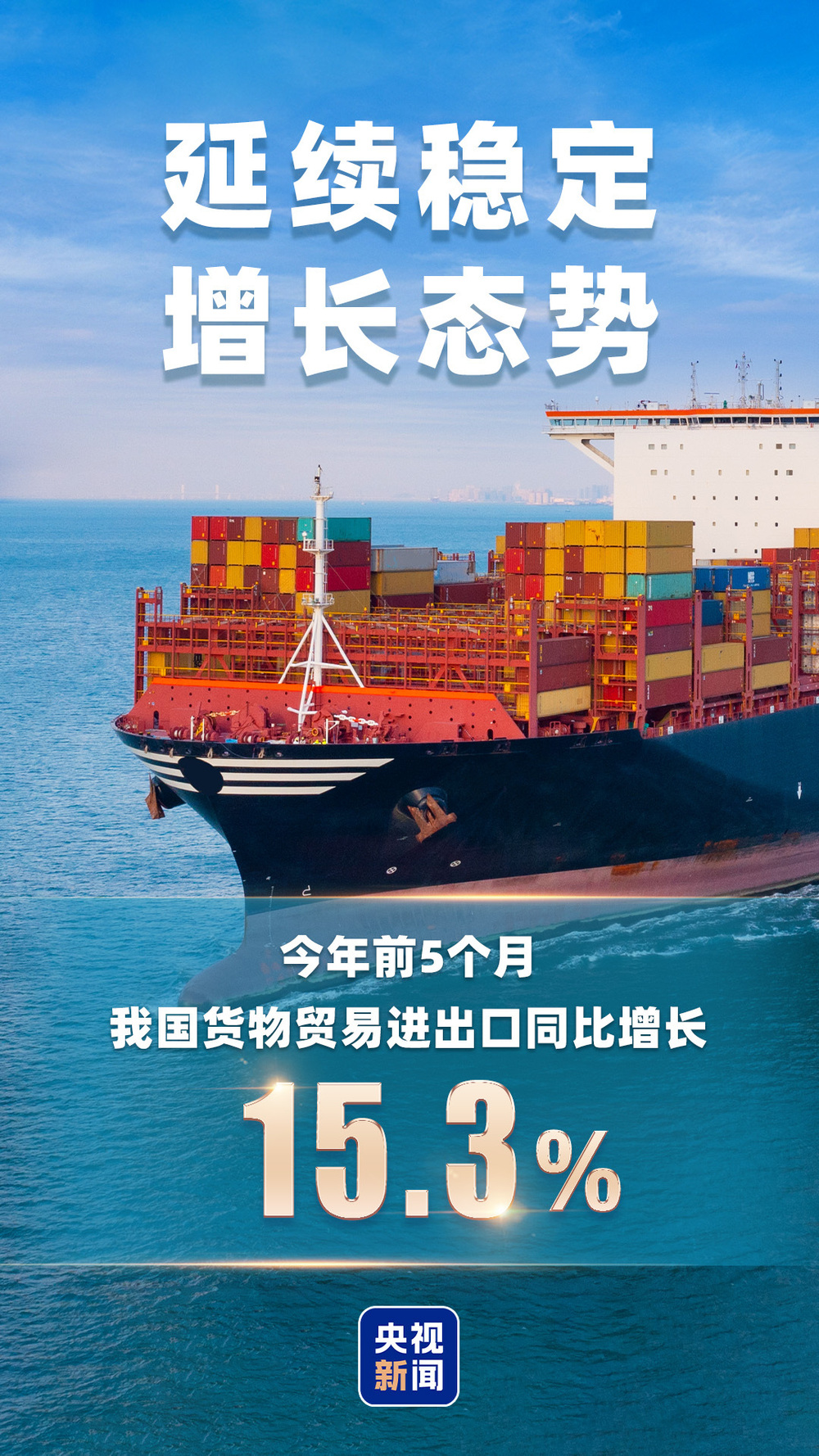
According to customs statistics, in the first five months of this year, China’s total import and export of goods trade reached 20.68 trillion yuan, a year-on-year increase of 15.3%, maintaining stable growth momentum.
Customs data shows that in the first five months, imports and exports with ASEAN, the EU, and Africa increased by 16.6%, 10.3%, and 18.2% respectively. Trade with countries involved in the Belt and Road Initiative reached 10.57 trillion yuan, up 13.6%.
In May alone, China’s foreign trade reached 4.45 trillion yuan, a year-on-year increase of 16.9%, with exports and imports rising by 13.8% and 21.5% respectively.
A spokesperson from the General Administration of Customs stated that since the beginning of this year, under the strategic guidance of head-of-state diplomacy, China has actively deepened practical cooperation with global trade partners, injecting stability into international trade operations. As of May, monthly imports and exports have exceeded 4 trillion yuan for three consecutive months, maintaining a good operational trend.
Starting from May, China has fully implemented a zero-tariff policy for African countries with diplomatic relations. In the first five months, China’s imports and exports with African nations reached 1.14 trillion yuan, surpassing 1 trillion yuan for the first time during this historical period, a year-on-year increase of 18.2%. In May alone, China’s imports from Africa amounted to 95.13 billion yuan, up 15% year-on-year, marking nine consecutive months of growth.
This year is the APEC China Year. In the first five months, China’s trade with other APEC economies reached 12.31 trillion yuan, a year-on-year increase of 17.4%, accounting for nearly 60% of China’s total foreign trade. Asia-Pacific economic cooperation remains active.
Belt and Road Initiative
The Belt and Road Initiative (BRI) is a global development strategy launched by China in 2013, aimed at enhancing regional connectivity and economic cooperation across Asia, Europe, and Africa. It consists of two main components: the Silk Road Economic Belt, a land-based network, and the 21st Century Maritime Silk Road, focusing on sea routes. The initiative draws inspiration from the ancient Silk Road trade routes and has since funded infrastructure projects such as ports, railways, and roads in over 140 countries.
ASEAN
ASEAN, or the Association of Southeast Asian Nations, is a regional intergovernmental organization founded in 1967 by five original members—Indonesia, Malaysia, the Philippines, Singapore, and Thailand—to promote political and economic cooperation and regional stability. Its history includes expanding to include Brunei, Vietnam, Laos, Myanmar, and Cambodia, and it has since become a key platform for dialogue and integration in Southeast Asia. Today, ASEAN works to foster economic growth, social progress, and cultural exchange among its member states.
EU
The European Union (EU) is a unique political and economic union of 27 European countries, established after World War II to foster peace, stability, and prosperity. Its origins trace back to the European Coal and Steel Community in 1951, evolving through treaties like the Maastricht Treaty (1993), which created the single market and the euro currency. Today, the EU promotes cooperation in trade, law, and human rights, with its main institutions headquartered in Brussels, Belgium.
Africa
<div class="text
Belt and Road Initiative
The Belt and Road Initiative (BRI) is a global infrastructure and economic development strategy launched by China in 2013, aiming to enhance connectivity and cooperation between Asia, Europe, and beyond. It revives the ancient Silk Road spirit by funding projects like railways, ports, and energy pipelines, while fostering trade and cultural exchange. The initiative has since expanded to involve over 150 countries, though it has faced both praise for development and criticism over debt and geopolitical concerns.
Silk Road Economic Belt
The Silk Road Economic Belt is a modern development initiative proposed by China in 2013 as part of the larger Belt and Road Initiative. It aims to revive and enhance the historical Silk Road trade routes that connected China with Central Asia, the Middle East, and Europe, fostering economic cooperation, infrastructure development, and cultural exchange. Historically, the ancient Silk Road facilitated trade in silk, spices, and ideas between civilizations for over 1,500 years, and this contemporary version seeks to re-establish those connections in a new era of global partnership.
21st Century Maritime Silk Road
The 21st Century Maritime Silk Road is a key component of China’s Belt and Road Initiative, launched in 2013 to enhance maritime cooperation and economic integration across Asia, Africa, and Europe. It revives the historic maritime trade routes that connected China to Southeast Asia, the Indian Ocean, and beyond, dating back to the Han and Tang dynasties. Through investments in ports, infrastructure, and trade partnerships, the initiative aims to foster shared development and cultural exchange among participating nations.
ancient Silk Road
The ancient Silk Road was a network of trade routes that connected China to the Mediterranean, facilitating the exchange of goods, cultures, and ideas for over 1,500 years. Established during the Han Dynasty around 130 BCE, it was named for the lucrative silk trade that flourished along its path. This historic route not only boosted economic prosperity but also fostered significant cultural and technological diffusion between East and West.
ASEAN
ASEAN, or the Association of Southeast Asian Nations, is a regional intergovernmental organization founded on August 8, 1967, in Bangkok, Thailand, by five original members: Indonesia, Malaysia, the Philippines, Singapore, and Thailand. Its primary goals are to promote economic growth, social progress, cultural development, and political stability among its member states. Today, ASEAN includes ten member countries and plays a key role in fostering cooperation and dialogue in Southeast Asia and with global partners.
EU
The European Union (EU) is a political and economic union of 27 European countries, established after World War II to foster peace, stability, and prosperity through cooperation. Its origins trace back to the European Coal and Steel Community in 1951, evolving with the Maastricht Treaty in 1993 to create a single market and common currency, the euro. Today, the EU promotes shared values and policies across member states, influencing global trade, law, and diplomacy.
Africa
Africa is the world’s second-largest continent, renowned for its vast cultural, linguistic, and ecological diversity. It is widely considered the cradle of humankind, with the earliest fossil evidence of human ancestors found in places like the Great Rift Valley in East Africa, dating back millions of years. The continent’s history includes powerful ancient civilizations such as Egypt and Kush, followed by periods of trade, colonization, and a complex post-colonial era that continues to shape its modern identity.
APEC
APEC, or the Asia-Pacific Economic Cooperation, is a regional economic forum established in 1989 to promote free trade and economic cooperation among 21 member economies bordering the Pacific Ocean. It was founded in response to the growing interdependence of Asia-Pacific economies and the need for a platform to discuss trade liberalization and sustainable development. APEC operates on a consensus basis and has no binding treaty obligations, focusing instead on voluntary commitments and policy dialogue.