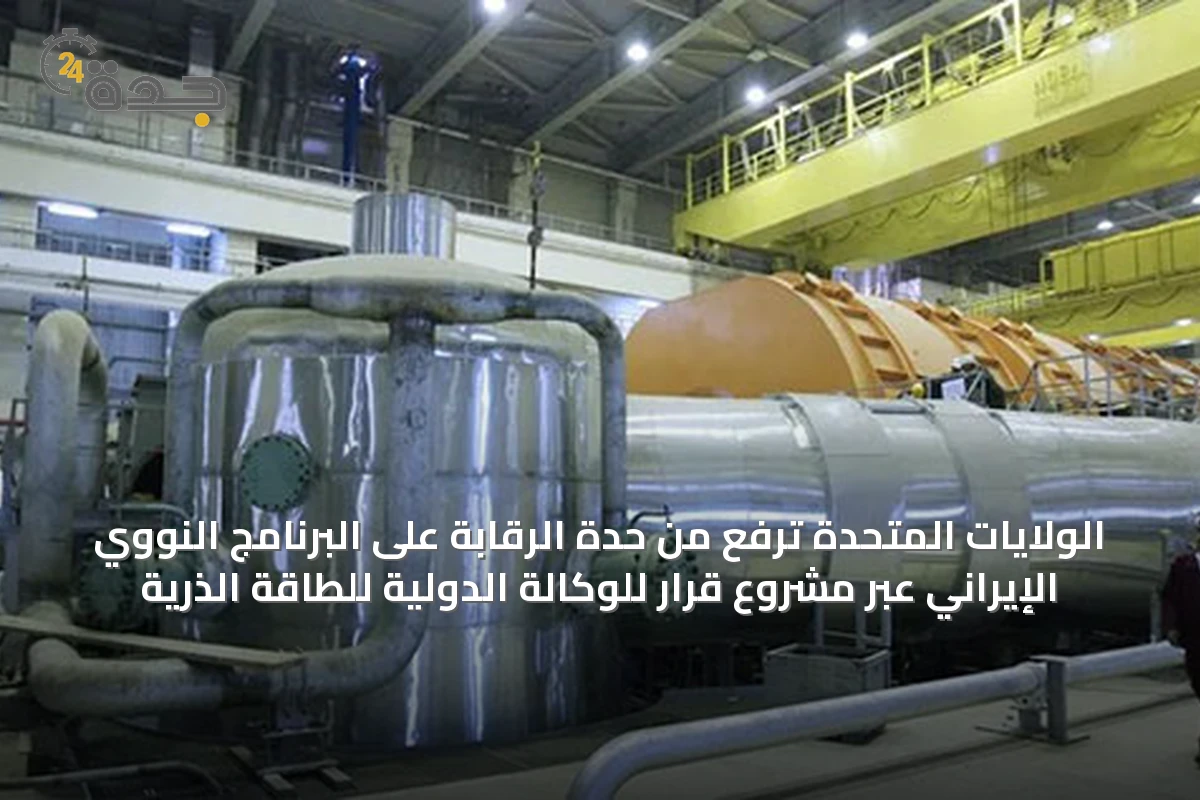
Washington has submitted a draft resolution to the International Atomic Energy Agency aimed at enhancing supervision of Iran’s nuclear activity, a move that reflects diplomatic escalation alongside ongoing military and political pressures directed at Tehran.

Demands of the Draft from Tehran

The text presented to the Agency’s Board of Governors includes a clear request from the United States to compel Iran to provide “accurate information” about nuclear sites that have been struck, as well as details on its stocks of highly enriched uranium. The draft also demands that the Agency be granted unrestricted and immediate access to verify this data without any delay.

Need for Transparency and Compliance with International Standards

The draft emphasizes that Iran must provide the International Atomic Energy Agency with detailed data on monitored materials and facilities, allowing verification of its compliance with agreed standards. This request comes amid growing international concern over a lack of transparency regarding certain Iranian nuclear activities.

Agency Warning on Proliferation Risks

A confidential report from the Agency indicated that inspectors’ inability to access some facilities in Iran raises “proliferation concerns,” and called on Tehran to cooperate fully and constructively with international inspections. The report noted that the Agency has been unable to verify Iran’s enriched uranium stocks for about a year, a period that exceeds normal oversight limits.

Enrichment Levels and Previous Agreements

The report stated that uranium enrichment levels in Iran have reached about 60%, a level close to that needed for manufacturing a nuclear weapon. In contrast, the permitted limit under the 2015 agreement was 3.67%, and implementation of that agreement has effectively halted since the United States withdrew from it in 2018.

Previous Agency data indicates that Iran possessed about 440 kilograms of highly enriched uranium before the recent escalation, amid ongoing restrictions on inspector work that hinder verification of actual stocks.

Future and Discussion Expectations

The Agency’s Board of Governors is expected to discuss the draft resolution during its upcoming meetings in Vienna, amid international division over the most appropriate approach to handling the Iranian nuclear file. Washington continues to insist on stricter oversight to avoid any possibility of nuclear weapon development, while Tehran maintains that its program is solely for peaceful purposes.

International Atomic Energy Agency

The International Atomic Energy Agency (IAEA) is an intergovernmental organization established in 1957 under the United Nations to promote the peaceful use of nuclear energy and prevent its military application. Headquartered in Vienna, Austria, it was created in response to U.S. President Eisenhower’s “Atoms for Peace” speech, which aimed to harness nuclear technology for global development while curbing proliferation. Today, the IAEA plays a crucial role in nuclear safety, security, and verification, including monitoring nuclear programs in countries like Iran and North Korea.

Iran

Iran, historically known as Persia, is a country in West Asia with a rich cultural heritage dating back thousands of years. It was the center of the ancient Persian Empire, one of the world’s greatest civilizations, and later became a major hub of Islamic art, science, and philosophy. Today, Iran is known for its stunning architecture, such as Persepolis and the mosques of Isfahan, as well as its influential contributions to literature, poetry, and cinema.

Tehran

Tehran, the capital of Iran, has a history that dates back to ancient times but rose to prominence in the late 18th century when it became the capital of the Qajar dynasty. Today, it is a sprawling metropolis blending modern skyscrapers with historic landmarks like the Golestan Palace and the Azadi Tower. The city serves as Iran’s political, economic, and cultural hub, reflecting a rich

International Atomic Energy Agency

The International Atomic Energy Agency (IAEA) is an autonomous international organization founded in 1957, headquartered in Vienna, Austria, to promote the peaceful use of nuclear energy and prevent its military application. Established in response to U.S. President Eisenhower’s “Atoms for Peace” speech, it serves as the world’s central intergovernmental forum for scientific and technical cooperation in the nuclear field. The agency is best known for its safeguards and inspection programs that verify compliance with the Nuclear Non-Proliferation Treaty.

Iran

Iran, historically known as Persia, is a country in West Asia with a rich cultural heritage spanning over 2,500 years. It was the center of the powerful Achaemenid Empire, and later saw the rise of influential dynasties like the Safavids, who established Shia Islam as the state religion. Today, Iran is known for its stunning architecture, such as Persepolis and Isfahan’s mosques, as well as its profound contributions to art, literature, and science.

Tehran

Tehran, the capital of Iran, has a rich history that dates back to ancient times but rose to prominence in the late 18th century when it became the capital of the Qajar dynasty. The city blends modernity with tradition, featuring landmarks like the grand Golestan Palace and the Azadi Tower, which symbolize its historical and cultural evolution. Today, Tehran is a bustling metropolis, serving as the political, economic, and cultural heart of Iran.

Persepolis

Persepolis was the ceremonial capital of the Achaemenid Empire, founded by Darius I in the 6th century BCE. Located in modern-day Iran, it served as a grand center for royal ceremonies and the celebration of Nowruz, the Persian New Year. The site was largely destroyed by Alexander the Great in 330 BCE, but its impressive ruins, including the Gate of All Nations and the Apadana Palace, remain a UNESCO World Heritage site.

Isfahan

Isfahan, a historic city in central Iran, was once a major crossroads of trade and culture, flourishing as the capital of the Safavid Empire in the 16th and 17th centuries. Under Shah Abbas I, it was transformed into a magnificent urban center, renowned for its stunning Islamic architecture, including the Naqsh-e Jahan Square, the Shah Mosque, and the Ali Qapu Palace. Today, it remains a treasure of Persian art and history, often celebrated with the saying “Isfahan is half the world.”

Golestan Palace

The Golestan Palace in Tehran, Iran, is a historic royal complex that served as the seat of power for the Qajar dynasty (1789–1925). Its construction began in the 16th century during the Safavid era, but it was extensively renovated and expanded in the 19th century, blending traditional Persian architecture with European influences. Today, it is a UNESCO World Heritage Site, renowned for its lavish halls, mirror work, and gardens.

Azadi Tower

The Azadi Tower, located in Tehran, Iran, is a prominent landmark built in 1971 to commemorate the 2,500th anniversary of the Persian Empire. Originally named the Shahyad Tower, it symbolizes modern Iran and combines elements of Achaemenid, Sassanid, and Islamic architecture. Following the 1979 Islamic Revolution, it was renamed Azadi, meaning “Freedom,” reflecting the country’s shift in political identity.

Vienna

Vienna is the capital of Austria and a city renowned for its rich cultural and musical heritage, having been home to legendary composers like Mozart, Beethoven, and Strauss. Historically, it served as the center of the Habsburg monarchy and the Austro-Hungarian Empire, leaving behind grand architecture such as Schönbrunn Palace and St. Stephen’s Cathedral. Today, Vienna is celebrated for its vibrant arts scene, coffeehouse culture, and as a hub for international diplomacy.

Related news

محليات

New regulatory framework for tourist guidance in Saudi Arabia.

Professionalism and Neutrality in Guidance The reg...
"تمهيدا لاكتساح بري".. ترامب يعلن إغلاق المجال الجوي فوق فنزويلا 3

Brazil and Mexico offer to mediate in the crisis between Washington and Caracas.

Brazil and Mexico offer mediation in the crisis be...
صور.. انطلاق منطقة "بوليفارد وورلد" بتصميم جديد و3 وجهات جديدة 3

Boulevard World: A Rich Window into Indonesia’s Heritage and Traditional Arts
Boulevard World. A rich window into Indonesia's he...
أردوغان يحذر من أن حرب الشرق الأوسط بدأت تُضعف أوروبا 1

Erdogan warns that the Middle East war is beginning to weaken Europe.

Erdogan warns that the Middle East war has begun t...