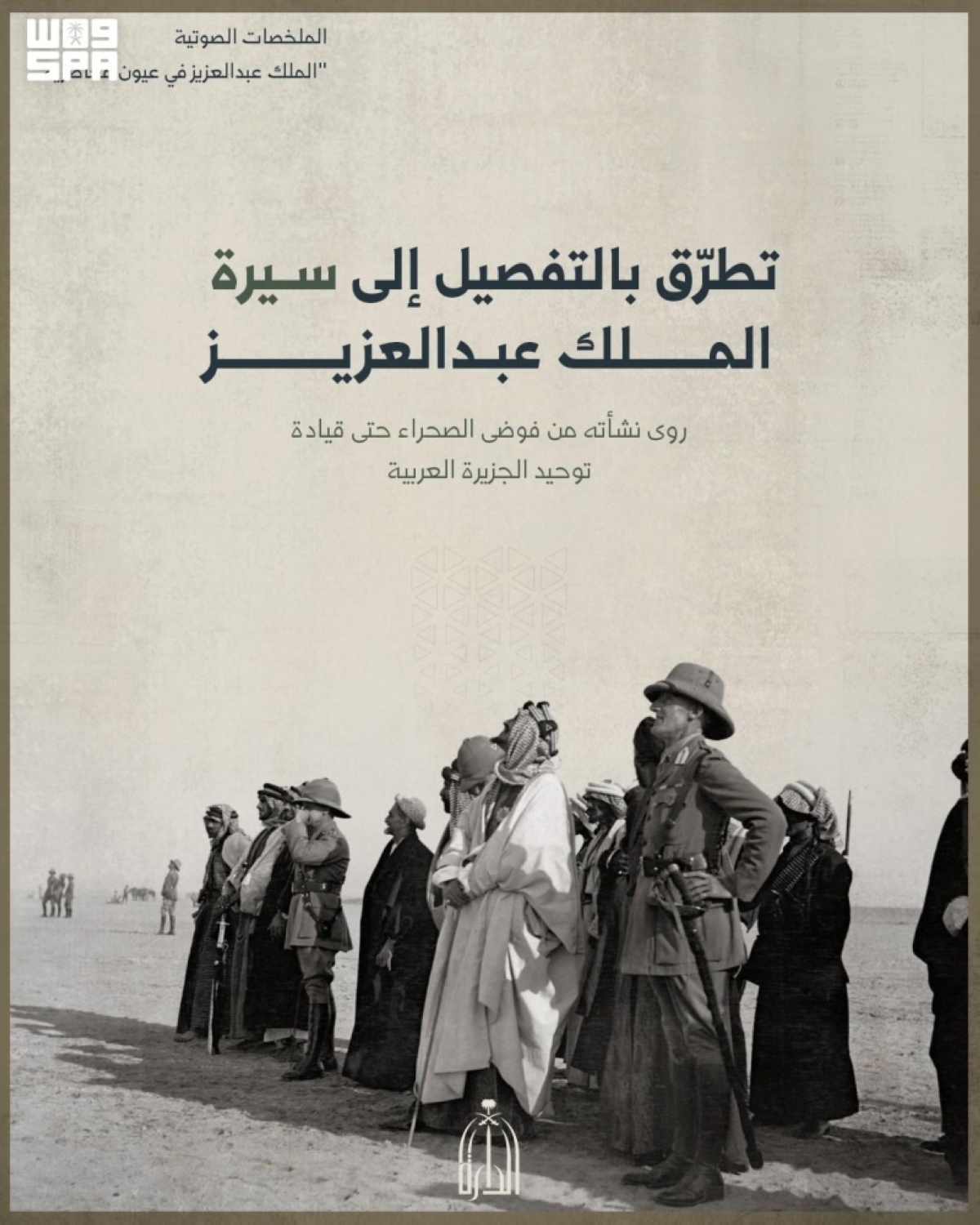
The King Abdulaziz Foundation has released an audio summary of the book “Master of Arabia: Abdulaziz Al Saud” by British author Harold Armstrong, as part of the “King Abdulaziz Through the Eyes of His Contemporaries” initiative. This aims to provide concise and documented audio readings of the most prominent works covering the biography of the founding King Abdulaziz bin Abdulrahman Al Saud, based on the testimonies and historical insights of his contemporaries.
The book is one of the most notable foreign works documenting the life of King Abdulaziz. It reviews his upbringing, the journey to recapture Riyadh, and his efforts to unify Saudi Arabia, alongside an account of the political and military transformations in the Arabian Peninsula during the founding period. It also highlights his leadership, wisdom, and closeness to society. The book holds special documentary significance due to the standing of its author, Harold Armstrong, as one of the leading British writers interested in the history of the Middle East at that time, working as a journalist and researcher specializing in Arab affairs. He also visited the Kingdom and met King Abdulaziz in 1932, which gave the book a historical value based on direct observation and close impressions of the era of building the modern Saudi state.
The audio summary reviews the main topics covered in the book, including the upbringing of King Abdulaziz, his journey in unifying the country, his military and political roles, as well as his approach to governance and establishing the foundations of the state. This is presented in a concise audio style that allows listeners to access the book’s content in an easy and engaging way.
The initiative is part of the King Abdulaziz Foundation’s efforts to utilize digital media and audio products to enrich national historical content and enhance access to historical knowledge through modern formats that help expand the circle of beneficiaries inside and outside the Kingdom. The foundation has made the audio summaries available for listening on its official YouTube channel.
Riyadh
Riyadh is the capital and largest city of Saudi Arabia, evolving from a small, walled desert settlement into a modern global metropolis. Historically, it was a key stronghold for the Al Saud dynasty, and in 1902, Abdulaziz Ibn Saud recaptured the city, which later became the center of the unified Kingdom of Saudi Arabia in 1932. Today, Riyadh is a hub of government, commerce, and culture, blending its ancient heritage with futuristic architecture and rapid development.
Saudi Arabia
Saudi Arabia is a country on the Arabian Peninsula, known as the birthplace of Islam and home to its two holiest cities, Mecca and Medina. Historically, it was a collection of tribal regions until the early 20th century, when Abdulaziz Ibn Saud unified the kingdom in 1932. Today, it is a major global oil producer and has recently undergone rapid social and economic transformation under its Vision 2030 plan.
Arabian Peninsula
The Arabian Peninsula is a historically significant region in Southwest Asia, known as the birthplace of Islam and the location of its holiest cities, Mecca and Medina. For centuries, it was a crossroads for trade and cultural exchange, with ancient kingdoms like Saba and later the rise of the Rashidun and Umayyad caliphates shaping its legacy. Today, the peninsula is dominated by modern nations such as Saudi Arabia, Yemen, Oman, and the United Arab Emirates, with its vast deserts and oil reserves playing a crucial role in global history and economy.
Middle East
The Middle East is a historically and culturally rich region spanning from Egypt to Iran, often considered the cradle of civilization due to its ancient Mesopotamian, Persian, and Levantine empires. It is the birthplace of three major monotheistic religions—Judaism, Christianity, and Islam—and has been a crossroads for trade, conflict, and cultural exchange for millennia. Today, the region is known for its diverse societies, vast oil reserves, and ongoing political complexities that shape global affairs.
Kingdom
The term “Kingdom” broadly refers to a sovereign state or territory ruled by a monarch, such as a king or queen. Historically, kingdoms have been a dominant form of government across the world, from ancient Egypt and Mesopotamia to medieval Europe and Asia, often shaping cultural identity, laws, and borders. Today, some kingdoms remain as constitutional monarchies, preserving their historical traditions while functioning within modern democratic systems.
King Abdulaziz Foundation
The King Abdulaziz Foundation, also known as Darah, is a prominent Saudi Arabian cultural and historical institution established in 1972. It is dedicated to documenting and preserving the history, heritage, and development of Saudi Arabia, with a particular focus on the era of King Abdulaziz Al Saud. The foundation manages extensive archives, research projects, and publications to promote national identity and historical awareness.
YouTube
YouTube is a global online video-sharing platform founded in 2005 by three former PayPal employees. It was acquired by Google in 2006 for $1.65 billion and has since grown into one of the world’s most visited websites, allowing users to upload, share, and view a vast array of content. The platform revolutionized media consumption by enabling anyone to become a creator, fostering communities around diverse topics from education to entertainment.