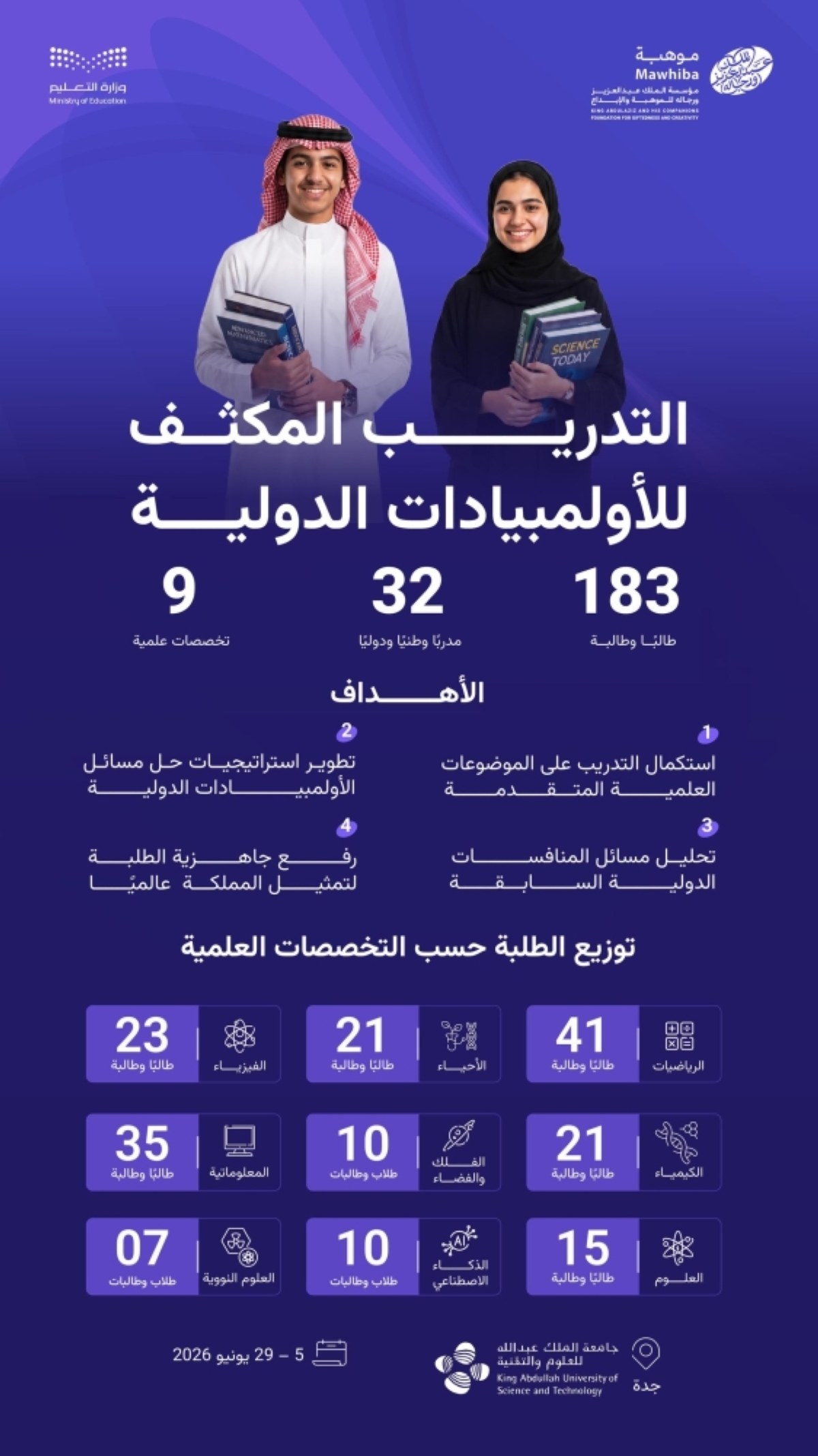
The King Abdulaziz and His Companions Foundation for Giftedness and Creativity “Mawhiba” launched the second phase of the intensive training program at King Abdullah University of Science and Technology “KAUST” in Jeddah, to prepare and qualify 183 male and female students for international scientific competitions in 2026, as part of the Mawhiba International Olympiads Program.
The training aims to enhance students’ readiness to compete in international Olympiads and scientific competitions in 2026, across 9 scientific disciplines, through training programs implemented over several stages, levels, and time periods, to deepen scientific knowledge and strengthen the advanced skills needed for global competitions.
The training includes reviewing scientific material in both theoretical and practical aspects for disciplines that involve practical tests, presenting advanced strategies for solving complex problems posed in international competitions, in addition to discussing and analyzing sample problems from previous international Olympiads.
The trainee students are distributed across the targeted disciplines as follows: 41 students in mathematics, 21 in biology, 23 in physics, 21 in chemistry, 10 in astronomy and space, 35 in computer science, 15 in science, 10 in artificial intelligence, and 7 in nuclear science.
The second phase of the intensive training is supervised by 32 trainers, including national trainers and international experts specialized in various scientific fields. Each trainee student receives 160 hours of specialized training, followed by international camps covering the disciplines of chemistry, biology, astronomy, and space.
Last January, “Mawhiba” implemented the first elite camp in the cities of Riyadh and Jeddah, in addition to Indonesia, to train and prepare 214 male and female students. This was followed by the first phase of intensive training, which took place from April 26 to May 21 at “KAUST” University, with the participation of 194 male and female students, aiming to prepare them early and raise their competitive readiness for international competitions according to the highest standards.
The Kingdom participates annually, represented by the “Mawhiba” Foundation, in about 30 international and regional Olympiads held in various countries around the world, with the participation of more than 120 countries represented by thousands of students, as part of the Mawhiba International Olympiads Program, which provides an integrated training path focused on building students’ capabilities at various levels, contributing to their advanced scientific and methodological preparation.