Alan Cayetano will face legal action for the ‘Baligod 18’ case.
Those who gave “testimonies” and others who participated in the alleged fake Blue Ribbon Committee hearing led by Senator Alan Peter Cayetano on Thursday may face legal charges.
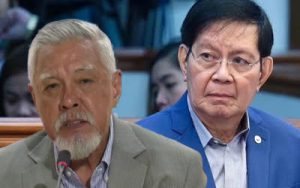
This was stated by Senator Panfilo Lacson in a statement on Friday. He said that no parliamentary immunity can be used by those who participated in the hearing, including senators from the minority bloc, because it was not an official Senate hearing.
“They can be charged, possibly for cyber libel and other crimes since it was a bogus hearing and no parliamentary immunity may be invoked, not even the senators who participated,” Lacson said.
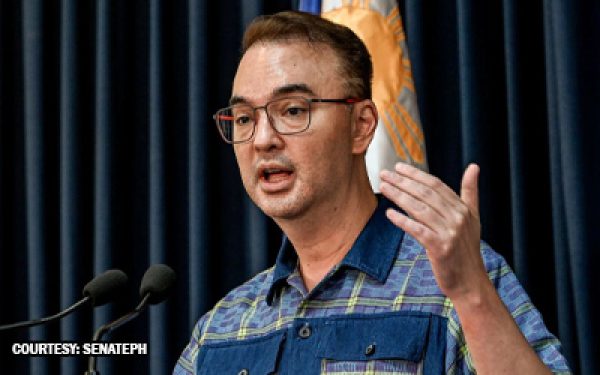
Earlier, Senators Alan Peter Cayetano, Pia Cayetano, Imee Marcos, and Rodante Marcoleta conducted a hearing in the Senate session hall, attended by 18 individuals who claimed they delivered suitcases containing money to certain personalities.
Attorney Levi Baligod claimed the 18 individuals were former Marines, but four of them turned out not to be actual members of the Armed Forces of the Philippines (AFP). Most of the former soldiers were also dishonorably discharged.
According to Lacson, cyber libel is among the possible charges that could be filed against those who gave testimony.
Meanwhile, he added that government officials who participated in the gathering could also face charges of usurpation of authority or official functions, citing Article 177 of the Revised Penal Code.
“Only if the SC will overturn the Avelino vs Cuenco ruling and invalidate the action taken by the 12 senators last Wednesday, those who were offended in yesterday’s event have a good case,” he added.
Blue Ribbon Committee
The “Blue Ribbon Committee” is not a physical place or cultural site, but rather a term used to describe a group of highly qualified experts selected to investigate a specific issue or problem. Historically, the phrase originated in the 19th century, referring to committees formed to examine matters of public concern with impartiality and authority. Such committees are often convened by governments or organizations to produce recommendations on complex topics like policy reform or crisis management.
Senate session hall
The Senate session hall is the primary chamber where the upper house of a legislature, such as the U.S. Senate, convenes to debate and pass laws. Historically, these halls are designed to reflect democratic principles, often featuring a central rostrum, members’ desks arranged in a semicircle, and galleries for public observation. For example, the U.S. Senate chamber in the Capitol building has been the site of landmark debates and decisions since 1859, shaping national policy throughout American history.
Armed Forces of the Philippines (AFP)
The Armed Forces of the Philippines (AFP) is the military organization responsible for defending the country’s sovereignty and territorial integrity. Established in 1935 through the National Defense Act, its roots trace back to earlier revolutionary armies, and it played a key role in World War II, the post-independence era, and internal security operations. Today, the AFP comprises the Army, Navy, and Air Force, with a mission to protect the nation and support civilian authorities during disasters.
Revised Penal Code
The Revised Penal Code of the Philippines, enacted in 1930 as Act No. 3815, is the primary criminal law governing criminal offenses and penalties in the country. It replaced the old Spanish Penal Code and was heavily influenced by the Napoleonic Code and Spanish legal traditions, incorporating principles of criminal liability, justifications, and exemptions. The code has undergone several amendments over the decades to address modern legal issues, but it remains the foundational legal document for Philippine criminal justice.
Avelino vs Cuenco ruling
The “Avelino vs Cuenco” ruling refers to a 1949 Supreme Court case in the Philippines that addressed a leadership dispute within the Philippine Senate. The case arose when Senate President José Avelino refused to recognize the election of Mariano Cuenco as his successor, leading to a legal battle over the Senate’s power to choose its own leader. The Court ultimately ruled that the Senate had the constitutional authority to elect its presiding officer, affirming legislative independence from executive interference.