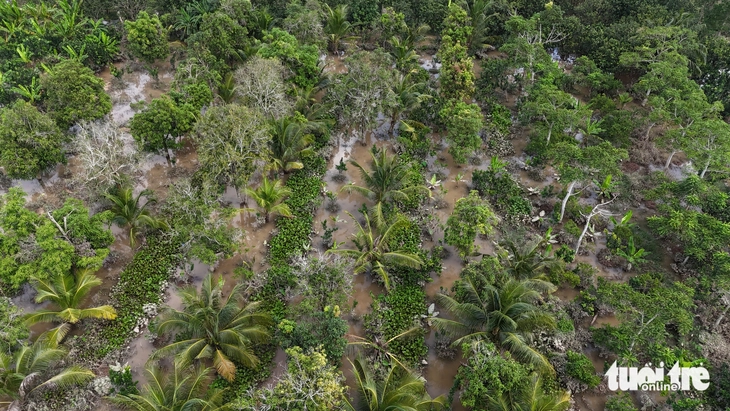
The plan to convert over 30 hectares of Thanh Long sandbar on the Co Chien River in Vinh Long province into a sand mine for construction materials is facing mixed opinions.
This is not just a story about handling a eroding sandbar, but also a puzzle about how to manage resources in the context of climate change, declining sediment, infrastructure development pressures, and the need to implement a major directive from the Politburo on preventing and combating subsidence, erosion, flooding, drought, and saltwater intrusion in the region, as outlined in Conclusion No. 26.
A decision based on reality?
The conversion of Thanh Long sandbar, located on the Co Chien River in Quoi Thien commune, from a natural sandbar into a sand mine for extraction is drawing significant public attention.
There have been many opposing views. Supporters argue that the authorities’ decision stems from the ongoing erosion at the site, and that “trying to preserve it” would be a waste of money and resources. They suggest going with the natural flow and that sand extraction could supplement the scarce construction materials on the market.
For many years, the Mekong Delta has continuously faced increasingly severe erosion. The Tien and Hau rivers have developed deep whirlpools, changing flow patterns, and erosion frequently occurs, sweeping away homes and property.
Meanwhile, the demand for construction sand and fill material for the region’s key transportation projects is rising rapidly.
The expressways being built in the Mekong region require enormous amounts of fill sand. With limited supply and soaring prices, many localities struggle to find materials for their projects.
In this context, utilizing sand from Thanh Long sandbar could be seen as a temporary solution, both addressing the erosion area and helping to supplement construction materials.
But the question is whether this is the optimal solution for the delta’s long-term future. Scientists describe subsidence and erosion as a condition of “thirsty rivers and hungry water.” It is an inevitable consequence of many accumulated negative factors.
A delta starved of sediment
A major concern is that the Mekong Delta is no longer in its natural state. Hydropower systems upstream on the Mekong River have drastically reduced the amount of sediment reaching the delta. Prolonged sand mining has deepened many riverbeds.
Erosion is occurring more frequently, on a larger scale, and is harder to predict. The delta is gradually losing the very material that once formed this fertile region.
In this state, every intervention in the riverbed requires careful consideration. Sandbars, islets, and alluvial deposits on the Mekong system are not just patches of land rising from the river. They are part of the natural dynamic structure, helping to disperse flow, retain sediment, and relatively stabilize the river’s morphology.
Of course, not every sandbar needs to be preserved at all costs. Some may continue to erode or disappear through natural processes. But the point worth considering is that their disappearance is no longer purely “natural”; it is influenced by a combination of factors: lack of sediment, sand mining, climate change, and infrastructure development pressures.
This is why many experts fear that if eroding sandbars continue to be viewed as “available sand sources,” the delta could fall into a vicious cycle: sand shortage leads to
Thanh Long sandbar
Thanh Long sandbar, located in Binh Thuan province, Vietnam, is a scenic stretch of coastline known for its unique red sand dunes and pristine beaches. Historically, the area was a quiet fishing village, but it has gained popularity in recent years as a tourist destination for activities like sandboarding and watching stunning sunsets. The sandbar’s vibrant landscape and cultural significance reflect the rich natural heritage of the region.
Co Chien River
The Co Chien River is a significant waterway in southern Vietnam, flowing through the Mekong Delta region. Historically, it served as a vital transportation and trade route for local communities, particularly during the era of the Khmer Empire and later under Vietnamese settlement. Today, it remains important for agriculture and fishing, supporting the livelihoods of people in provinces like Vinh Long and Tra Vinh.
Vinh Long province
Vinh Long is a province in the Mekong Delta region of southern Vietnam, known for its lush orchards, floating markets, and intricate canal systems. Historically, it was a key area during the Khmer Empire and later became a prominent settlement under the Nguyen dynasty, playing a significant role in the region’s agricultural development. Today, it offers visitors a glimpse into traditional river life and local culture, with sites like the Vinh Long ancient house and Cai Be floating market.
Mekong Delta
The Mekong Delta in southern Vietnam is a vast, fertile region formed by the Mekong River’s network of tributaries, often called the “Rice Bowl” of the country. Historically, it was part of the Khmer Empire before being settled by Vietnamese in the 17th and 18th centuries, and it later became a key battleground during the Vietnam War. Today, it is renowned for its floating markets, lush orchards, and intricate canal systems that sustain a vibrant agricultural and aquatic culture.
Tien River
The Tien River is a major branch of the Mekong River in southern Vietnam, flowing through the provinces of Dong Thap, Tien Giang, and Ben Tre before reaching the East Sea. Historically, it has served as a vital waterway for trade and transportation, supporting the region’s agricultural development and cultural exchange. The river is also closely tied to the history of the Mekong Delta, which was settled and cultivated by Vietnamese migrants from the 17th century onward.
Hau River
The Hau River, also known as the Bassac River, is a major distributary of the Mekong River in southern Vietnam, flowing through the Mekong Delta region. Historically, it has served as a vital waterway for transportation, agriculture, and trade for the Khmer and Vietnamese communities, particularly during the expansion of the Nguyen dynasty into the delta in the 18th and 19th centuries. Today, it remains a crucial economic and cultural artery, supporting local livelihoods and ecosystems.
Politburo
The Politburo is the principal executive and policymaking committee of a communist party, most notably in China and the former Soviet Union. Its origins trace back to the Bolsheviks in 1917, where it was established as a small, secretive body to lead the Russian Revolution. Today, the Chinese Politburo, led by the Communist Party of China, serves as the highest decision-making authority in the country.
Quoi Thien commune
Quoi Thien commune is a rural area in Vietnam, historically known for its agricultural roots and traditional village life. The commune has been shaped by centuries of farming and local customs, though much of its recorded history is tied to the broader development of the region. Today, it remains a quiet, community-focused area that preserves elements of Vietnam’s countryside heritage.