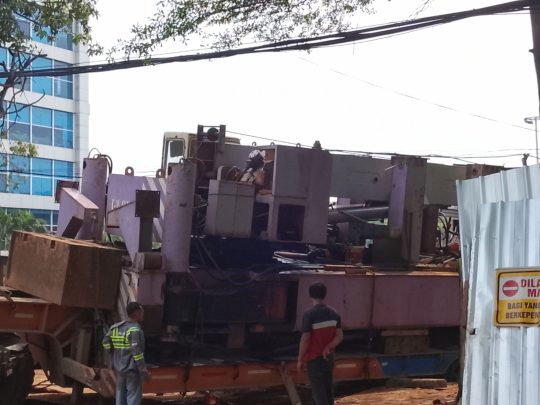
KOTA BEKASI – The construction project of the Patriot Hall located in the Bekasi City Government Office complex is facing a serious problem. A container truck carrying an earth nail installation machine sank and partially blocked Jalan Rawa Tembaga 1, Margajaya Village, South Bekasi District, on Thursday (4/6/2026).
According to a witness named Agus, the incident occurred since Wednesday (3/6/2026) evening. As of Thursday morning, the situation on site had not yet been addressed.
“The incident happened last night, sir. Until now, there has been no repair and it is still blocking part of the road,” he said.
Agus emphasized the importance of immediate handling to avoid disrupting community activities.
“Just imagine, this road is frequently used by residents heading to the Bekasi City Government Office, the Religious Court, and other places. It must be handled immediately, not left like this,” he added.
Observations at the location until 11:00 AM local time showed the container still in its original position with no action from the project supervisor or related parties. Several project workers were still at the scene where the large-tonnage truck had sunk.
Patriot Hall
Patriot Hall is a historic community venue located in Sumter, South Carolina, originally built in the 1930s as a Works Progress Administration project during the Great Depression. Over the decades, it has served as a hub for civic gatherings, performances, and cultural events, reflecting the area’s heritage and community spirit. Today, it continues to host local activities and is recognized for its architectural and historical significance in the region.
Bekasi City Government Office
The Bekasi City Government Office serves as the administrative center for Bekasi, a city in West Java, Indonesia. Historically, the building represents the city’s rapid urbanization and development since Bekasi was officially designated as a city in 1996. It houses the mayor’s office and various municipal departments, playing a key role in local governance and public services.
Jalan Rawa Tembaga 1
Jalan Rawa Tembaga 1 is a street located in the Rawa Tembaga area of Jakarta, Indonesia, known for its historical significance as part of the city’s older industrial and commercial zones. The area developed during the Dutch colonial era, when it was used for warehouses and trading activities due to its proximity to Tanjung Priok port. Today, it remains a bustling hub for small businesses and local trade, reflecting Jakarta’s layered urban history.
Margajaya Village
Margajaya Village is a traditional village located in West Java, Indonesia, known for its preserved Sundanese cultural heritage and natural surroundings. Historically, it has served as a rural settlement where local customs, such as traditional farming and art performances, have been maintained for generations. Today, the village is also a popular ecotourism destination, offering visitors a glimpse into authentic village life and the region’s historical way of living.
South Bekasi District
South Bekasi District is a rapidly developing area in West Java, Indonesia, known for its mix of residential communities and industrial zones. Historically, it was part of the larger Bekasi region, which evolved from agricultural land into a major satellite city of Jakarta following Indonesia’s urbanization boom in the late 20th century. Today, it serves as a key hub for commuters and businesses, featuring modern infrastructure and ongoing expansion.
Religious Court
The Religious Court is a judicial institution in many Muslim-majority countries, including Indonesia, that handles cases based on Islamic law, such as marriage, divorce, and inheritance. Its modern form in Indonesia was established after the country’s independence, evolving from earlier Islamic legal systems that existed during colonial and pre-colonial times. The court serves as a bridge between state law and religious principles, reflecting the nation’s pluralistic legal framework.