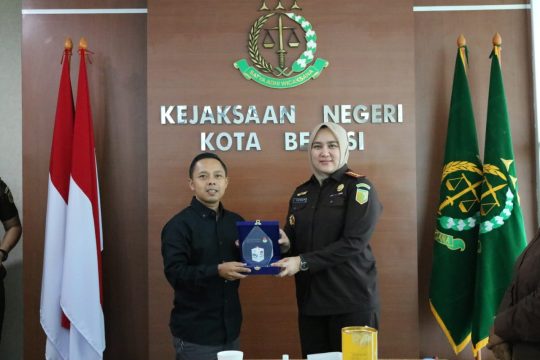
BEKASI – The Chairman of the Bekasi City General Election Commission (KPU), Ali Syaifa, made an official working visit to the Bekasi City District Attorney’s Office (Kejari). This meeting was held to build cross-institutional synergy in support of the National Strategic Program, particularly in strengthening the ideology of Pancasila, democracy, and human rights.
During the meeting, Ali Syaifa stated that the Bekasi City KPU is preparing a series of program activities for 2027. The main focus of this program is to realize comprehensive voter education on elections and democracy for all levels of society in Bekasi City.
“To realize healthy political and democratic education in 2027, we need full cooperation and support from the Government and Regional Government elements,” said Ali Syaifa.
He explained that this collaborative step has a strong legal basis, namely Article 434 of Law Number 7 of 2017 concerning General Elections. This regulation emphasizes the obligation of the Government and Regional Government to provide assistance and facilities for the smooth implementation of elections, including involving broad public participation.
Meanwhile, the Head of the Bekasi City District Attorney’s Office, Dr. Sulvia Triana Hapsari, S.H., M.Hum., expressed high appreciation for the working visit of the Bekasi City KPU Chairman, Ali Syaifa, to her office. In the meeting, Sulvia affirmed the Prosecutor’s Office’s commitment to overseeing all stages of democracy as a strategic partner of election organizers.
Sulvia stated that the role of the Prosecutor’s Office cannot be separated from efforts to support the smooth running of the national agenda. She emphasized that the relationship between these two institutions is a form of real collaboration in upholding the dignity of democracy in Indonesia.
“The KPU is a strategic partner of the Prosecutor’s Office. Going forward, we will collaborate together to ensure the successful implementation of elections in Indonesia, especially in the Bekasi City area,” Sulvia asserted.
Furthermore, the Head of the District Attorney’s Office explained that this support is not only coordinative but will be formalized into a written commitment. This is done so that the cooperation established has a clear and strong operational basis.
“The Bekasi City District Attorney’s Office will work together with the KPU to organize cooperation implemented through a Cooperation Agreement between the Bekasi City KPU and the Bekasi City District Attorney’s Office,” she added.
Through the memorandum of understanding to be prepared soon, the Bekasi City District Attorney’s Office is ready to provide legal assistance, legal considerations, and other legal actions to mitigate potential obstacles during preparations leading up to 2027. This synergy is expected to create a safe, accountable election climate in accordance with applicable law enforcement principles.
Bekasi City
Bekasi City is a major satellite city east of Jakarta, Indonesia, that has transformed from a small agricultural area into a densely populated industrial and commercial hub. Historically, it was part of the ancient Tarumanagara Kingdom, and during the colonial era, it served as a strategic location for Dutch plantations. Today, Bekasi is known for its rapid urbanization, large industrial estates, and its role as a key commuter base for workers in Jakarta.
Bekasi City General Election Commission (KPU)
The Bekasi City General Election Commission (KPU) is the local branch of Indonesia’s national election authority, responsible for organizing and overseeing elections in Bekasi, West Java. It manages voter registration, candidate nominations, and vote counting for local and national elections, ensuring the process is fair and transparent. The office operates under the legal framework established after Indonesia’s democratic reforms in the late 1990s, playing a key role in the city’s evolving electoral history.
Bekasi City District Attorney’s Office (Kejari)
<div class
Bekasi City
Bekasi City, located in West Java, Indonesia, is a rapidly growing satellite city of Jakarta with a history dating back to the 5th century as part of the Tarumanagara Kingdom. It became a significant administrative and trade hub during the Dutch colonial era and played a role in Indonesia’s struggle for independence. Today, Bekasi is known for its industrial zones, residential areas, and as a key commuter city within the Greater Jakarta metropolitan region.
Tarumanagara Kingdom
The Tarumanagara Kingdom was one of the earliest known Hindu-Buddhist kingdoms in Indonesia, flourishing in the 4th to 7th centuries CE in what is now West Java. Its existence is primarily documented through several stone inscriptions, such as the Tugu and Ciaruteun inscriptions, which describe King Purnawarman’s construction of canals and irrigation systems. This early kingdom played a key role in the region’s cultural and political development before its decline and eventual absorption into later Javanese kingdoms.
Bekasi City General Election Commission (KPU)
The Bekasi City General Election Commission (KPU) is the local branch of Indonesia’s national election body responsible for organizing and overseeing elections in Bekasi, West Java. Established as part of Indonesia’s post-Reformasi democratic framework, the KPU ensures fair and transparent electoral processes for local and national elections. Its history reflects Indonesia’s transition to democracy, with the commission playing a key role in administering elections since the early 2000s.
Bekasi City District Attorney’s Office (Kejari)
The Bekasi City District Attorney’s Office (Kejari) is a government institution responsible for prosecuting criminal cases and upholding the law in Bekasi, Indonesia. Established as part of Indonesia’s legal system, it operates under the Attorney General’s Office, handling a wide range of legal matters from corruption to public order. Its history reflects the broader development of Bekasi from a suburban area into a major industrial city, with the office playing a key role in enforcing justice amid rapid urbanization.