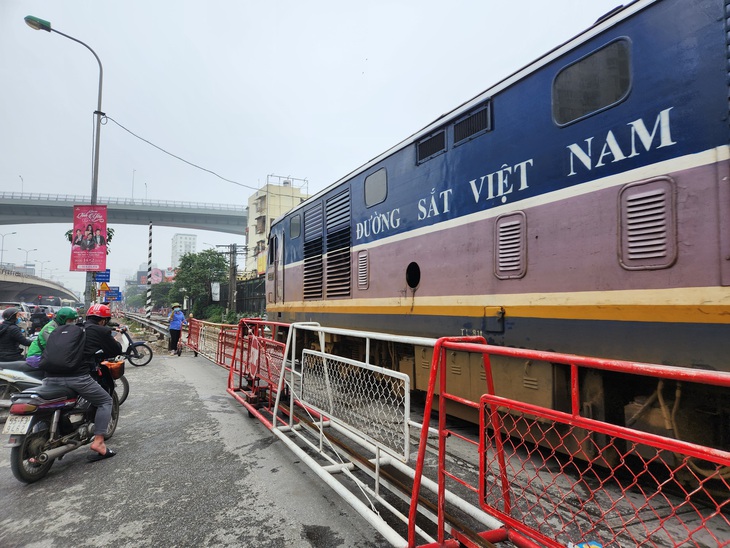
The Ministry of Construction proposes early investment in two national railway projects to ensure the progress of key projects in Hanoi without disrupting national railway transport.

This is the content of a document that the Ministry of Construction has just reported to the Prime Minister regarding the assignment of the Hanoi People’s Committee as the governing body for investment in several national projects within the capital area.

According to the Ministry of Construction, the national railway hub in Hanoi transports about 3 million passengers and 2.9 million tons of goods annually. Daily, there are about 9,000 train passengers, and during Tet and summer holidays, there are nearly 20,000 train passengers per day.

Passenger transport from northern and southern provinces to Hanoi or transiting through Hanoi is carried out here. Goods transport by rail from northern and southern provinces to Hanoi is handled at Giap Bat and Yen Vien stations; international or cross-Hanoi intermodal transport follows the Ngoc Hoi – Yen Vien route or the western ring road section from Bac Hong to Van Dien.

Hanoi is currently investing in Metro Line 1, the Ngoc Hoi – Yen Vien section, and Metro Line 6, the Ngoc Hoi – Noi Bai section. Line 1 overlaps with the national railway corridor from Ngoc Hoi to Yen Vien, while Line 2 overlaps with the Bac Hong – Van Dien railway corridor.

Additionally, Hanoi has launched projects that need early completion, such as the Hanoi International Sports City project covering 9,171 hectares and the National Highway 1A spatial axis project with 16 lanes. These projects require relocating the national railway infrastructure south of Hanoi to proceed.

Therefore, the Ministry of Construction sees the need to soon implement investment in the Eastern Ring Railway line, the Ngoc Hoi – Kim Son section (replacing the central railway through Hanoi station); to realign the existing North-South railway section from Phu Xuyen station to Ngoc Hoi station, and to build a new Thuong Tin station and the National Railway Transport Operations Center.

Early investment and completion of these two railway projects are necessary and urgent for Hanoi to synchronously complete the National Highway 1A spatial axis project (expected by 2027), ensure the implementation of the Hanoi International Sports City project, and simultaneously begin investment in Metro Lines 1 and 6 by 2027.

The Ministry of Construction stated that Hanoi is clearing land to implement the National Highway 1A expansion project, which will require relocating the existing national railway section from Ngoc Hoi to Hanoi station.

Therefore, after synthesizing opinions from relevant ministries, the Ministry of Construction proposes that the Prime Minister assign Hanoi as the governing body for investment in the aforementioned national railway projects using central budget funds to ensure synchronized implementation.

Thus, the project will apply mechanisms from Resolution No. 258/2025/QH15 on piloting certain specific mechanisms and policies to ensure completion by 2027 and 2028, as proposed by Hanoi.

However, in the document sent to the Prime Minister, the Ministry of Construction emphasized that the handover of the Ngoc Hoi – Yen Vien railway section (the existing national railway running through central Hanoi) can only proceed after the Hanoi People’s Committee
Ngoc Hoi

Ngoc Hoi is a historic district in Hanoi, Vietnam, best known for the Battle of Ngoc Hoi–Dong Da in 1789, where the Tay Son forces led by Emperor Quang Trung defeated a Qing Chinese invasion. This victory is celebrated annually during the Dong Da Festival at the Dong Da Mound, a memorial site built on the battlefield. Today, Ngoc Hoi is a bustling urban area that blends modern development with deep cultural heritage.

Hanoi station

Hanoi Station, also known as Ga Hà Nội, is a historic railway hub in the heart of Vietnam’s capital, originally built by French colonial authorities in 1902. It served as a key transportation link during the Indochina era and was heavily bombed during the Vietnam War, later being rebuilt and modernized. Today, it remains a bustling gateway for travelers, notably as the departure point for the famous Reunification Express train to Ho Chi Minh City.

Giap Bat station

Giap Bat Station is a major railway junction in Hanoi, Vietnam, located in the Hoang Mai District. Originally built during the French colonial period, it serves as a critical hub connecting the north-south Reunification Express line with routes to the eastern provinces. Today, it functions primarily as a cargo and transit station, playing a key role in the region’s transportation network.

Yen Vien station

Yên Viên station is a major railway junction in Hanoi, Vietnam, located in the Gia Lâm district. It was built during the French colonial period and serves as a key connection point for the Hanoi–Lào Cai and Hanoi–Hải Phòng railway lines. Today, it remains an important hub for both passenger and freight transport in northern Vietnam.

Bac Hong

Bac Hong is a traditional Vietnamese folk painting village located in Bac Ninh Province, with a history dating back to the 18th century. Known for its woodblock prints and vibrant depictions of daily life, festivals, and historical scenes, the village once thrived as a cultural hub. Today, efforts to preserve this heritage continue, as Bac Hong paintings remain a cherished symbol of Vietnamese folk art.

Van Dien

Van Dien is a district in Hanoi, Vietnam, historically known for its role as a major industrial and manufacturing hub. It was once home to the Van Dien Battery Factory, established during the French colonial period, which contributed to the area’s development. Today, it is a mixed residential and industrial area, reflecting Hanoi’s urban expansion and modernization.

Thuong Tin station

Thuong Tin station is a railway station located in Thuong Tin District, Hanoi, Vietnam, situated on the North–South railway line. Originally built during the French colonial period, it served as an important stop connecting the capital to southern provinces. Today, the station continues to operate as a local transit hub for passenger and freight trains.

Hanoi International Sports City

Hanoi International Sports City is a large-scale, multi-purpose sports and entertainment complex located in the Nam Từ Liêm district of Hanoi, Vietnam. Developed as a flagship project to modernize the city’s sports infrastructure, it features a major stadium, indoor arenas, and training facilities designed to host international events. The complex was constructed in the early 2020s and represents a key step in Vietnam’s efforts to boost sports tourism and prepare for hosting major regional competitions.