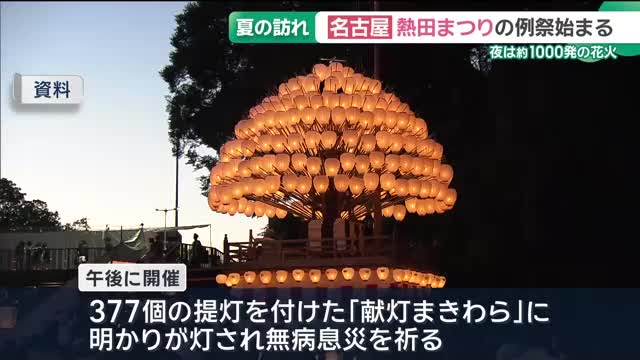
The Atsuta Festival, which announces the arrival of summer in Nagoya, has begun, and at night about 1,000 fireworks will be launched.
The Atsuta Festival is considered the most important of the year’s festivals and events at Atsuta Shrine, and this year 200,000 visitors are expected.
At 10 a.m. on the 5th, an imperial envoy offered sacred offerings.
From the afternoon, 377 lanterns, representing the total number of days and months in a year, are lit on a “dedicated lantern straw rope” to pray for good health and freedom from illness.
The highlight of the Atsuta Festival, the fireworks display, begins at 7:50 p.m., with about 1,000 fireworks launched.
Atsuta Shrine is calling for the use of public transportation.
Atsuta Festival
The Atsuta Festival is a major Shinto event held annually in June at Atsuta Jingu, one of Japan’s most sacred shrines in Nagoya. Its history dates back over 1,900 years, honoring the shrine’s enshrinement of the Imperial sword, Kusanagi-no-Tsurugi, and featuring traditional processions, music, and dance. The festival celebrates the shrine’s founding and its deep connection to Japanese imperial heritage.
Nagoya
Nagoya is a major city in Japan’s Aichi Prefecture, historically significant as the home of the powerful Owari branch of the Tokugawa clan during the Edo period. Its most famous landmark, Nagoya Castle, was originally built in 1612 and largely rebuilt after World War II, symbolizing the city’s resilience. Today, Nagoya is a thriving industrial and cultural hub, known for its automotive industry and traditional crafts like Shippo-yaki cloisonné.
Atsuta Shrine
Atsuta Shrine is one of Japan’s most important Shinto shrines, located in Nagoya. With a history spanning over 1,900 years, it is renowned for housing the sacred sword Kusanagi-no-Tsurugi, one of the three Imperial Regalia of Japan. The shrine has been rebuilt several times after fires and war damage, most recently after World War II, and remains a major spiritual and cultural center.