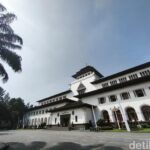
Sushma Swaraj maintains that India did not address the Bandung Conference.
New Delhi: The Congress party, along with other opposition parties, has filed a privilege motion against External Affairs Minister Sushma Swaraj in the Rajya Sabha for allegedly misleading the House on two issues: Prime Minister Narendra Modi’s 2015 visit to Lahore and the Bandung Conference in Indonesia that same year.
Leaders from various political parties have accused Swaraj of “providing incorrect information about the Bandung Asia-Africa relations conference.” They added that while Swaraj claimed she did not deliver any speech at the Bandung conference, the opposition parties have downloaded a purported speech and will submit it as evidence.
The government and opposition engaged in a verbal clash in the Rajya Sabha yesterday over India’s statement at the Bandung Conference. Senior Congress member Anand Sharma alleged that the name of first Prime Minister Jawaharlal Nehru was omitted from the address delivered by Minister of State for External Affairs VK Singh at the conference.
Trinamool Congress’s Derek O’Brien supported Sharma in criticizing the government. However, Swaraj stated that India did not address the Bandung Conference. She said the speech Sharma referred to was delivered at another Afro-Asian Conference held separately.
“These were two different conferences,” she asserted.
Pandit Nehru was one of the founding members of the Bandung Conference in 1955.
The second privilege motion concerns allegedly “misinforming the House about PM Modi’s 2015 Lahore visit, claiming there was no terrorist incident after that.”
The opposition, however, pointed out that the Pathankot terrorist attack occurred immediately after PM Modi’s visit, along with five other terror-related incidents after that as well.
Sharma also demanded to know why PM Modi made that visit to Pakistan and “why, to this day, no one knows the details of the meeting.”
“You were going to Afghanistan and stopped in Lahore midway; to this day, the Prime Minister has not told the nation what discussions took place. On one hand, you get upset and cancel talks after Pakistan invites separatists to a tea party, and on the other hand, you make a dramatic visit breaking all protocols,” he said.
In December 2015, PM Modi’s spontaneous decision to “drop by” Lahore to extend greetings to Nawaz Sharif on his birthday drew criticism from opposition parties. PM Modi was on his way back to Delhi after a day-long trip to Afghanistan.
Bandung Conference
The Bandung Conference, officially the Asian-African Conference, was a historic meeting held in Bandung, Indonesia, in 1955. It brought together newly independent nations from Asia and Africa to promote economic and cultural cooperation and to oppose colonialism and neocolonialism. This landmark event laid the foundation for the Non-Aligned Movement and symbolized the rise of the Global South on the world stage.
Rajya Sabha
The Rajya Sabha, or Council of States, is the upper house of India’s bicameral Parliament, established in 1952 following the country’s adoption of its Constitution in 1950. It represents the states and union territories, with members elected by state legislatures and appointed by the President, ensuring a federal balance. Unlike the Lok Sabha, it is a permanent body not subject to dissolution, with one-third of its members retiring every two years.
Lahore
Lahore, the cultural capital of Pakistan, is a historic city known for its rich Mughal heritage, including landmarks like the Badshahi Mosque and Lahore Fort. Its history dates back over a millennium, with significant development under the Mughal Empire in the 16th and 17th centuries, followed by periods of Sikh and British rule. Today, it remains a vibrant center of art, food, and education, blending ancient traditions with modern life.
Indonesia
Indonesia is a Southeast Asian archipelago nation comprising thousands of volcanic islands, with a rich history shaped by ancient Hindu-Buddhist kingdoms, such as Srivijaya and Majapahit, and later by European colonialism, particularly Dutch rule. It declared independence in 1945 and is now the world’s largest archipelagic state, known for its diverse cultures, languages, and iconic sites like the Borobudur and Prambanan temples.
Pathankot
Pathankot is a city in the Indian state of Punjab, strategically located near the borders of Jammu and Kashmir and Himachal Pradesh. Historically, it served as an important military base and transit point due to its proximity to the Line of Control, and it is also known for its ancient temples and forts, such as the Kathgarh Temple and the Shahpur Kandi Fort. Today, it functions as a key gateway for travelers heading to the hill stations of the Himalayas.
Afghanistan
Afghanistan is a landlocked country in Central and South Asia with a rich and complex history, serving as a crossroads for ancient trade routes like the Silk Road. It has been home to powerful empires, including the Greco-Bactrian and the Mughal, and was a site of Buddhist and Islamic cultural flourishing. In modern times, the country has endured decades of conflict, including the Soviet invasion, civil war, and the Taliban’s rule, shaping its current geopolitical landscape.
Pakistan
Pakistan is a South Asian country with a rich history, home to ancient civilizations like the Indus Valley and a key region along the Silk Road. It gained independence from British rule in 1947, becoming a separate homeland for Muslims of the subcontinent. Today, it features diverse cultures, languages, and landmarks such as the Badshahi Mosque and the mountainous northern areas.
Delhi
Delhi, the capital of India, is a historic city that has been continuously inhabited for over two millennia, serving as the seat of power for numerous empires, including the Delhi Sultanate and the Mughal Empire. Its rich history is reflected in iconic landmarks such as the Red Fort, Qutub Minar, and Humayun’s Tomb, alongside modern structures like India Gate. Today, Delhi is a vibrant metropolis blending ancient traditions with contemporary life, acting as the political and cultural heart of the nation.