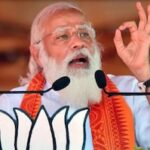
New Delhi, June 4, 2026. Venezuela’s acting President Delcy Rodriguez met with Prime Minister Modi on Wednesday. This meeting comes at a time when energy cooperation between India and Venezuela has rapidly increased. It is believed that a major agreement regarding oil supply between the two countries may be reached.
Earlier, Foreign Minister Jaishankar also met with Delcy Rodriguez. He stated that Rodriguez has long played an important role in strengthening India-Venezuela relations and that her discussions with Prime Minister Modi will further advance cooperation between the two countries.
The United States overthrew then-President Nicolas Maduro on January 4. Since then, Rodriguez has been the acting president. Rodriguez’s visit to India comes at a time when India is facing new challenges related to energy security. Due to the Hormuz crisis, India is seeking alternative suppliers.
According to the Ministry of External Affairs, Delcy Rodriguez will be in India from June 3 to 7 and will meet with several senior leaders, including Prime Minister Modi, during this period. Discussions are expected to focus on enhancing cooperation between the two countries in areas such as energy, trade, investment, health, pharmaceuticals, and renewable energy.
Venezuela becomes the third largest oil supplier
According to data from the energy tracking agency Kpler, in May 2026, Venezuela surpassed Saudi Arabia and the United States in oil supply. Currently, only Russia and the UAE have supplied more oil than Venezuela. According to the report, oil supply from Venezuela to India this month has increased by about 50 percent compared to April.
This visit is seen not just as a diplomatic trip but as an effort to strengthen the strategic partnership between India and Venezuela amid changing global energy equations. In the coming days, attention will also be on new agreements and investment proposals related to energy cooperation between the two countries.
Hormuz
Hormuz is a historically significant island and port city in the Persian Gulf, once a major hub of trade and commerce between the 13th and 16th centuries. It was part of the powerful Kingdom of Hormuz, which controlled lucrative spice and silk routes before being conquered by the Portuguese in 1507. Today, the island is known for its striking red soil and salt formations, as well as its cultural heritage as a crossroads of Persian, Arab, and European influences.
India
India, officially the Republic of India, is a vast South Asian country with a rich history dating back to the Indus Valley Civilization (circa 2500 BCE). It has been the birthplace of major religions like Hinduism, Buddhism, Jainism, and Sikhism, and was shaped by various empires, including the Maurya, Gupta, and Mughal dynasties, before becoming a British colony. India gained independence in 1947 and is now the world’s largest democracy, known for its diverse cultures, languages, and iconic landmarks like the Taj Mahal.
Venezuela
Venezuela is a South American country known for its diverse landscapes, including the Andes mountains, Amazon rainforest, and the world’s highest waterfall, Angel Falls. Its history includes indigenous civilizations, Spanish colonization beginning in the 16th century, and a key role in Latin America’s independence movement led by Simón Bolívar in the early 19th century. In modern times, Venezuela has been shaped by its vast oil reserves, political upheaval, and ongoing economic and social challenges.
Saudi Arabia
Saudi Arabia is a country on the Arabian Peninsula, known as the birthplace of Islam and home to its two holiest cities, Mecca and Medina. Historically, it was unified as a modern state in 1932 by King Abdulaziz Al Saud, and its vast oil reserves, discovered in the 1930s, transformed it into a major global economic power. Today, the country is undergoing significant social and economic reforms under Vision 2030, aiming to diversify its economy beyond oil.
United States
The United States of America is a large, diverse country in North America, founded in 1776 after declaring independence from Great Britain. Its history includes westward expansion, the Civil War over slavery, and its rise to become a global economic and military power. Today, it is known for its cultural influence, landmarks like the Statue of Liberty and Grand Canyon, and its role as a melting pot of different cultures.
Russia
Russia is the largest country in the world, spanning Eastern Europe and northern Asia, with a rich history shaped by the rise of the Kievan Rus’, the Mongol invasion, and the powerful Tsardom under rulers like Ivan the Terrible and Peter the Great. It later became the Soviet Union, a global superpower, before dissolving in 1991 into the modern Russian Federation. Culturally, Russia is known for its iconic contributions to literature, ballet, classical music, and architecture, including landmarks like the Kremlin and St. Basil’s Cathedral.
UAE
The United Arab Emirates (UAE) is a federation of seven emirates located on the Arabian Peninsula, formed in 1971 after the British withdrawal from the region. Historically a center for pearl diving, fishing, and trade, the country transformed dramatically following the discovery of oil in the 1950s and 1960s. Today, the UAE is known for its modern cities like Dubai and Abu Dhabi, which blend rapid development with traditional Bedouin culture.