-
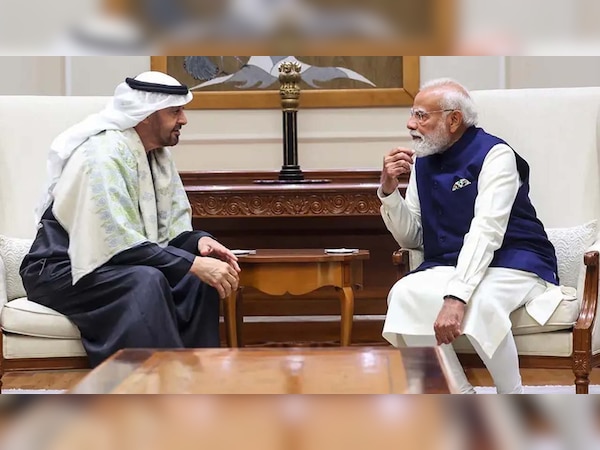
India UAE Relations: The bilateral relationship between India and the United Arab Emirates (UAE) has transformed from a traditional buyer-seller trade partnership into a highly strategic, transformative alliance. Driven by changing global equations—including the unpredictable foreign policy of the United States and the rise of a multipolar world order—both countries have rapidly advanced their economic, energy, and security cooperation.
In January 2026, India and the UAE further strengthened this alliance by signing a historic $3 billion liquefied natural gas (LNG) deal lasting 10 years. Along with this, they also made a formal commitment to boost trade ties and advance a comprehensive defense agreement. This step builds on their 2022 Comprehensive Economic Partnership Agreement (CEPA) and their joint participation in the I2U2 group (which includes India, Israel, the UAE, and the United States).
Additionally, both countries remain key pillars of the ambitious ‘India-Middle East-Europe Economic Corridor’ (IMEC). Announced at the G20 New Delhi summit, this corridor establishes a multi-modal transport and energy network, connecting India to Europe via the Arabian Gulf and the Levant region.
Impact on Regional Geopolitics
The deepening of India-UAE relations has profound implications for the geopolitics of both South Asia and the Middle East:
Countering Regional Rivals and Pakistan’s Isolation
Historically, the UAE had close ties with Pakistan. However, India’s economic rise and the UAE’s strategic realignment have effectively isolated Pakistan in the Gulf region. This shift accelerated when Pakistan signed a defense agreement with Saudi Arabia (a major regional rival of the UAE) in September 2025. As a result, indirect competition increased in various conflicts in the Middle East and North Africa (MENA) region, such as in Sudan and Libya.
By forging a close alliance with India, the UAE gains a powerful balancing force, while India successfully bypasses Pakistan’s historical ‘land veto’ on the route to Western markets.
Strategic Autonomy and Multi-Alignment
Both New Delhi and Abu Dhabi reject any kind of ‘binary’ or ‘zero-sum’ approach to global geopolitics. As the reliability of the United States as a security guarantor faces growing domestic indifference and uncertainty from policy shifts, both countries are actively expanding their partnerships.
The UAE and India use their relationship to balance their ties with other major powers such as China, Russia, and the European Union, thereby maximizing their diplomatic strength.
Integration of Defense and Air Technology
The UAE has rapidly modernized its domestic defense sector. It has emerged as a regional power in air defense, missiles, and electronic warfare. For India, which is actively seeking to diversify away from its traditional reliance on Russia for defense procurement, the UAE is a highly reliable, technologically advanced partner in defense manufacturing and security.
Challenges to the Relationship
Despite the continuously growing progress of India-UAE relations, several serious challenges remain:
Balancing Amid Middle Eastern Rifts
India’s key partners in the Middle East—the UAE, Israel, and Iran—often have very hostile relations with each other. Although India has so far successfully kept these relationships separate, any major tension or direct conflict between these regional powers (such as between Iran and Israel, or Iran and the Sunni Gulf monarchies) will severely test India’s policy of non-alignment and threaten its energy security.
Risk of Being Drawn into Conflict
As India’s security presence increases through joint naval exercises and potential defense agreements with the UAE, the risk of New Delhi being drawn into the complex geopolitical conflicts of the Middle East also rises. The blurring of lines between South Asian security dynamics and Middle Eastern proxy wars could expose India to regional instability.
Obstacles in Implementing Mega-Projects
Ambitious initiatives like IMEC face serious geopolitical disruptions. Ongoing regional conflicts, especially in the Levant, directly threaten the physical security and financial
India-Middle East-Europe Economic Corridor (IMEC)
The India-Middle East-Europe Economic Corridor (IMEC) is a proposed transnational infrastructure project announced in 2023, aiming to connect India, the Middle East, and Europe via a network of railways, shipping lanes, and energy pipelines. It is designed to enhance trade and economic integration, offering an alternative to traditional maritime routes like the Suez Canal, while also promoting regional connectivity and stability. The corridor builds on historical trade links, such as the ancient Silk Road, and represents a modern effort to foster cooperation between participating nations.G20 New Delhi summit
The G20 New Delhi summit was the 18th meeting of the Group of Twenty (G20), held in New Delhi, India, on September 9–10, 2023. It marked the first time India hosted the summit as part of its presidency, which began in December 2022, and focused on themes of inclusive growth, climate action, and global governance reforms. The summit concluded with the adoption of the New Delhi Leaders’ Declaration, which notably achieved consensus on key geopolitical issues, including the war in Ukraine.Arabian Gulf
The Arabian Gulf, also known as the Persian Gulf, is a historically significant body of water in the Middle East, bordered by countries like Saudi Arabia, Iran, and the United Arab Emirates. It has been a vital maritime trade route for centuries, connecting ancient civilizations and facilitating the exchange of goods such as pearls, spices, and oil. In modern times, the Gulf region is renowned for its vast oil reserves, which have driven rapid economic growth and urban development along its coastlines.Levant region
The Levant region, located in the eastern Mediterranean, is a historically significant area encompassing modern-day countries like Syria, Lebanon, Jordan, Israel, and Palestine. Often called the “Cradle of Civilization,” it was home to ancient cultures such as the Canaanites, Phoenicians, and Israelites, and later served as a crossroads for empires including the Romans, Byzantines, and Ottomans. Its strategic location has made it a center for trade, religion, and conflict throughout history.South Asia
South Asia is a diverse region comprising countries like India, Pakistan, Bangladesh, Sri Lanka, Nepal, Bhutan, and the Maldives, known for its rich cultural heritage and ancient civilizations. Historically, it was home to the Indus Valley Civilization, one of the world’s earliest urban cultures, and later saw the rise of major religions such as Hinduism, Buddhism, and Sikhism. The region’s history includes periods of powerful empires, colonial rule under the British, and a complex post-independence landscape marked by cultural fusion and ongoing development.Middle East
The Middle East is a historically and culturally rich region spanning parts of Western Asia and North Africa, known as the cradle of some of the world’s earliest civilizations, including Mesopotamia and Ancient Egypt. It is the birthplace of three major monotheistic religions—Judaism, Christianity, and Islam—and has been a crossroads for trade, culture, and conflict for millennia. Today, the region is defined by its diverse heritage, modern nation-states, and ongoing geopolitical significance.North Africa (MENA) region
The MENA region, encompassing North Africa and the Middle East, is a historically and culturally rich area known as the birthplace of major civilizations, including Ancient Egypt, Carthage, and the Islamic Golden Age. It has been a crossroads for trade, religion, and conquest, shaped by empires such as the Romans, Ottomans, and various European colonial powers. Today, the region is defined by its diverse blend of Arab, Berber, and Islamic heritage, alongside modern geopolitical and economic significance.Sudan
Sudan is a country in northeastern Africa with a rich and complex history, home to more pyramids than Egypt as remnants of the ancient Kingdom of Kush. Its cultural heritage is a blend of indigenous African, Arab, and Islamic influences, shaped by centuries of trade and conflict. Modern Sudan has faced significant challenges, including civil wars and the recent secession of South Sudan in 2011.