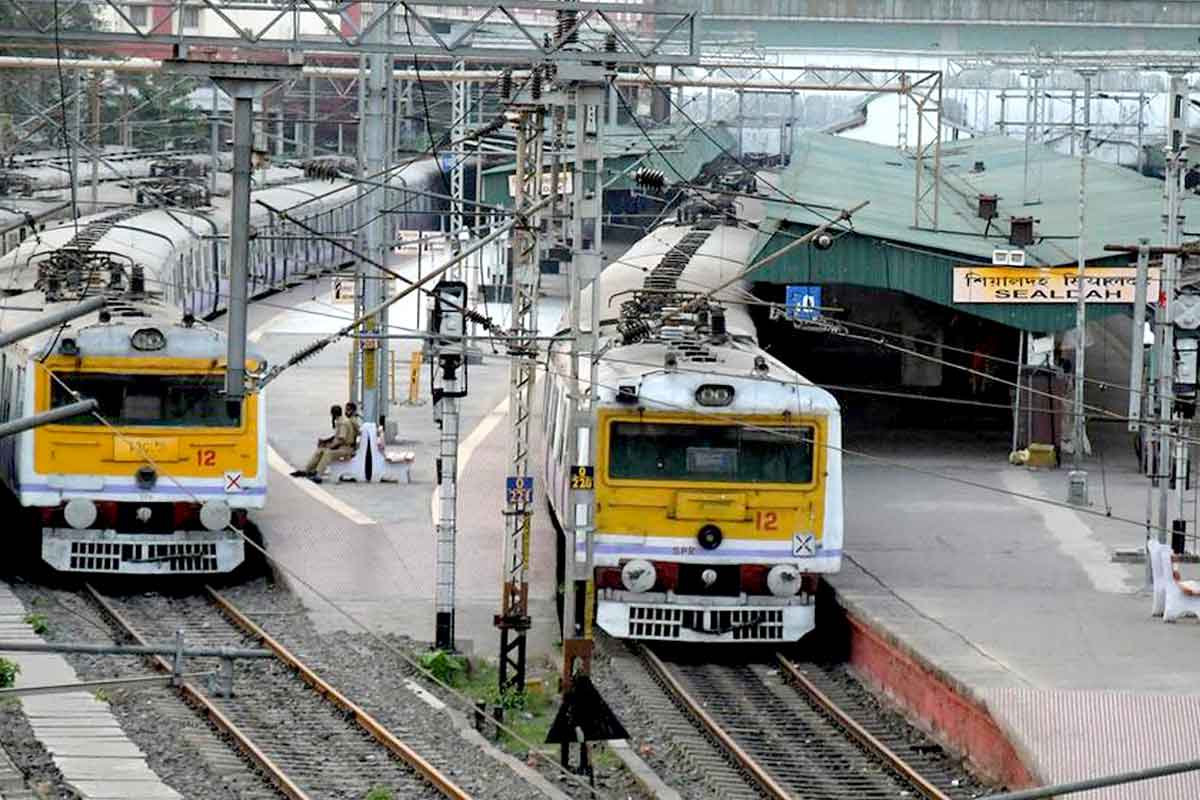
Due to a mega block in the Sealdah division, Eastern Railway has announced the cancellation of several local trains on the upcoming Saturday and Sunday. A major traffic and power block will be implemented in the Sealdah division on Saturday, June 6, and Sunday, June 7, for infrastructure development and urgent safety maintenance work.
It has been reported that there will be a total of 15 hours of traffic and power block on the up and down suburban lines between Sealdah and Kankurgachi Road Junction. Work will be carried out on bridge number 3 during this time. Train movement on this line will be completely suspended from 10:15 PM Saturday to 1:15 PM Sunday. Additionally, train movement at Narkeldanga car shed will be completely closed from 7:00 PM Saturday to 4:00 PM Sunday.
Also read:
On the other hand, the second mega traffic block will be on the down passenger line at the Ballygunge station area. A traffic block will be in place for a total of 6 hours (360 minutes) from 11:10 PM Saturday to 5:10 AM Sunday.
Railway authorities have stated that the service life of the old girders on the bridge has expired. Eastern Railway has announced these two traffic blocks to replace them. Installing modern and stronger girders will further enhance the safety of the bridge. Additionally, there are plans to increase train speed on this important railway line in the future. These girders will also help make service smoother. The decision for a mega block over the weekend was made to minimize inconvenience to passengers.
Local trains canceled on the 6th:
Sealdah – Naihati: Up 31443, 31445, 31447, Down- 31442, 31446, 31450
Sealdah – Ranaghat: Up 31631 / Down 31636
Sealdah – Bongaon: Up 33849 / Down 33856
Sealdah – Shantipur: Up 31533 / Down 31538
Sealdah – Kalyani Border: Up 31339, 31343 / Down 31338, 31340
Sealdah – Dankuni: Up 32249 / Down 32252
Sealdah South Branch
Sealdah – Lakshmikantapur: Down 34754, Up 34755
On Sunday, multiple trains on the Sealdah-Bongaon and Sealdah-Kalyani Border lines have been canceled. Additionally, on the Sealdah South branch, multiple trains on the Sealdah-Diamond Harbour and Sealdah-Sonarpur lines have also been canceled. They are:
Sealdah – Bongaon: 33825 Up / 33820 Down
Sealdah – Habra: 33651, 33653, 33655, 33657 Up / 33652, 33654, 33656, 33658 Down
Sealdah – Dankuni: 32211, 32215, 32219, 32227 Up / 32212, 32216, 32220, 32228 Down
The canceled trains on the South branch are:
Sealdah – Diamond Harbour: 34812 Down / 34815 Up
Sealdah – Sonarpur: 34412 Down / 34411 Up
Sealdah – Lakshmikantapur: 34716 Down / 34713 Up
Additionally, several other trains have been canceled.
Sealdah division
Sealdah division is a major railway division under Eastern Railway in India, headquartered in Kolkata. Established in the 19th century, it serves as a critical hub connecting Kolkata to northern and eastern parts of West Bengal, as well as to Bangladesh. Its history dates back to the British colonial era, when Sealdah station was built in 1869 to facilitate passenger and freight traffic.
Kankurgachi Road Junction
Kankurgachi Road Junction is a busy intersection in the Salt Lake area of Kolkata, India, connecting key thoroughfares like VIP Road and Kankurgachi Road. Historically, the area developed rapidly during Kolkata’s eastward expansion in the late 20th century, transitioning from marshy land into a major residential and commercial hub. Today, it is known for its heavy traffic and proximity to landmarks such as the Salt Lake City Center and Nicco Park.
bridge number 3
Bridge Number 3 is a significant historical structure located in the city of Pripyat, Ukraine, within the Chernobyl Exclusion Zone. Originally built in the Soviet era as a standard concrete bridge, it gained notoriety after the 1986 Chernobyl nuclear disaster, when it served as a key crossing point for emergency responders and later became a haunting symbol of the abandoned city. Today, it stands as a poignant reminder of the catastrophe, often featured in photographs and documentaries exploring the ghost town.
Narkeldanga car shed
The Narkeldanga car shed, located in Kolkata, India, is a historic tram depot that has served the city’s iconic tram network since the late 19th or early 20th century. It played a key role in maintaining and housing trams that have been a vital part of Kolkata’s public transport heritage. Today, it remains in operation, symbolizing the enduring legacy of one of Asia’s oldest tram systems.
Ballygunge station
Ballygunge station is a suburban railway station located in the Ballygunge neighborhood of Kolkata, India, serving the Kolkata Suburban Railway system. Opened in the late 19th century during the British colonial era, it was originally part of the Bengal Nagpur Railway network, connecting the area to the city center and beyond. Today, it remains an important local transit hub, facilitating daily commuter travel in southern Kolkata.
Sealdah
Sealdah is a major neighborhood and railway hub in Kolkata, India, centered around the historic Sealdah Railway Station, which opened in 1862 as one of the city’s oldest and busiest terminals. The area developed rapidly during British colonial rule as a key commercial and transport link, connecting Kolkata to eastern India and Bangladesh. Today, it remains a bustling, crowded district known for its markets, street food, and vibrant local culture.
Naihati
Naihati is a city in West Bengal, India, located on the banks of the Hooghly River. Historically, it emerged as an important railway junction and industrial center during the British colonial period, particularly known for its jute mills and paper factories. The town is also culturally significant as the ancestral home of the famous Bengali poet Kazi Nazrul Islam, who spent part of his childhood there.
Ranaghat
Ranaghat is a city in the Nadia district of West Bengal, India, located on the banks of the Churni River. Historically, it emerged as a significant trading and administrative center during the British colonial period, particularly after the opening of the Eastern Bengal Railway in the late 19th century. Today, it is known for its jute and textile industries, as well as its proximity to the Bangladesh border, which has influenced its cultural and economic life.