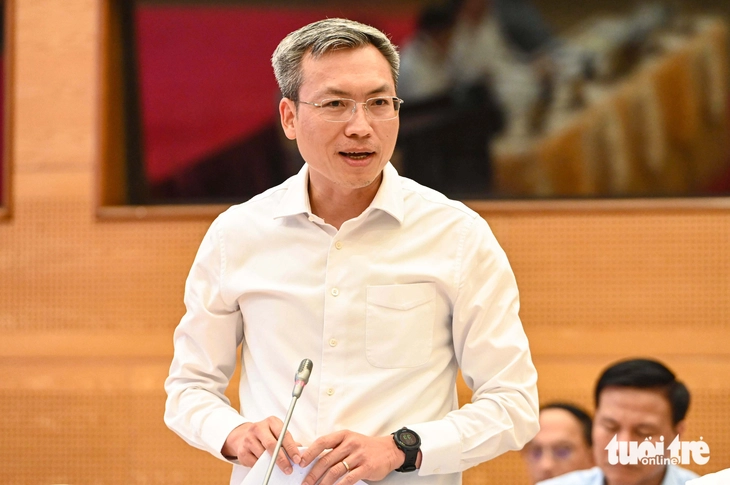
The Ministry of Public Security is coordinating with relevant agencies to build and advise on the implementation of the Artificial Intelligence Law. It includes provisions that clearly prohibit activities that exploit AI to deceive or manipulate human perception.
At the Government press conference on the afternoon of June 3, Major General Nguyen Quoc Toan – Chief of Office, Spokesperson of the Ministry of Public Security – answered questions about the results of implementing the Prime Minister’s Directive 38 on the peak campaign to combat, prevent, and strictly handle acts of infringing upon rights.
He also issued warnings and outlined measures to address the situation of using AI and deepfake for fraud.
Three-month peak campaign to strictly handle intellectual property rights violations
According to Major General Nguyen Quoc Toan, detecting and combating acts of infringing upon intellectual property rights is a regular task of the police force.
In connection with the Prime Minister’s Directive 38, a corresponding Directive 38 was also issued, implementing a three-month nationwide peak campaign.
In the first month of the peak campaign, three major results were achieved:
Coordinating with telecommunications service providers to block websites infringing upon intellectual property rights.
As a result, 194 websites were identified, including 8 movie streaming sites, 27 e-commerce sites violating industrial property rights, and 159 live football streaming sites infringing upon intellectual property.
Coordinating with relevant forces to inspect, detect, and combat violations. 56 cases were prosecuted and 98 suspects were charged with crimes related to copyright and related rights infringement.
Administrative penalties were also intensified for violations. After nearly one month of the peak campaign, approximately 216 individuals were fined, with total fines exceeding 850 million VND.
The Ministry of Public Security also urged businesses and citizens to comply with legal regulations and participate in combating violations. This not only protects their own interests but also contributes to establishing a disciplined social order and a transparent, healthy, and safe business environment.
Three psychological factors that can lead to online fraud
Regarding the use of AI to create fake images and voices for fraudulent activities, Major General Toan stated that technology is developing extremely rapidly, bringing unprecedented opportunities and benefits, but also challenges. This is a global issue because cyberspace has no borders.
This behavior is a matter of pattern: wherever there is vibrant activity, there will be exploitation for legal violations. Cyberspace is becoming an environment and a tool for illegal activities.
The Ministry of Public Security has proactively identified this issue early and is vigorously implementing prevention and combat measures through four groups of solutions.
First, focusing on perfecting the legal system. Toan considered this a very important factor, including regulations to address behaviors occurring in the digital space and environment.
“Recently, we have developed the Personal Data Protection Law and the amended Cybersecurity Law. Along with that is the draft decree on administrative sanctions in the field of cybersecurity and personal data protection. These include many provisions for handling acts that exploit AI and deepfake technology to create false information,” according to Major General Nguyen Quoc Toan.
The Ministry of Public Security is also coordinating with relevant agencies to build and advise on the implementation of the Artificial Intelligence Law. It includes provisions that clearly prohibit