
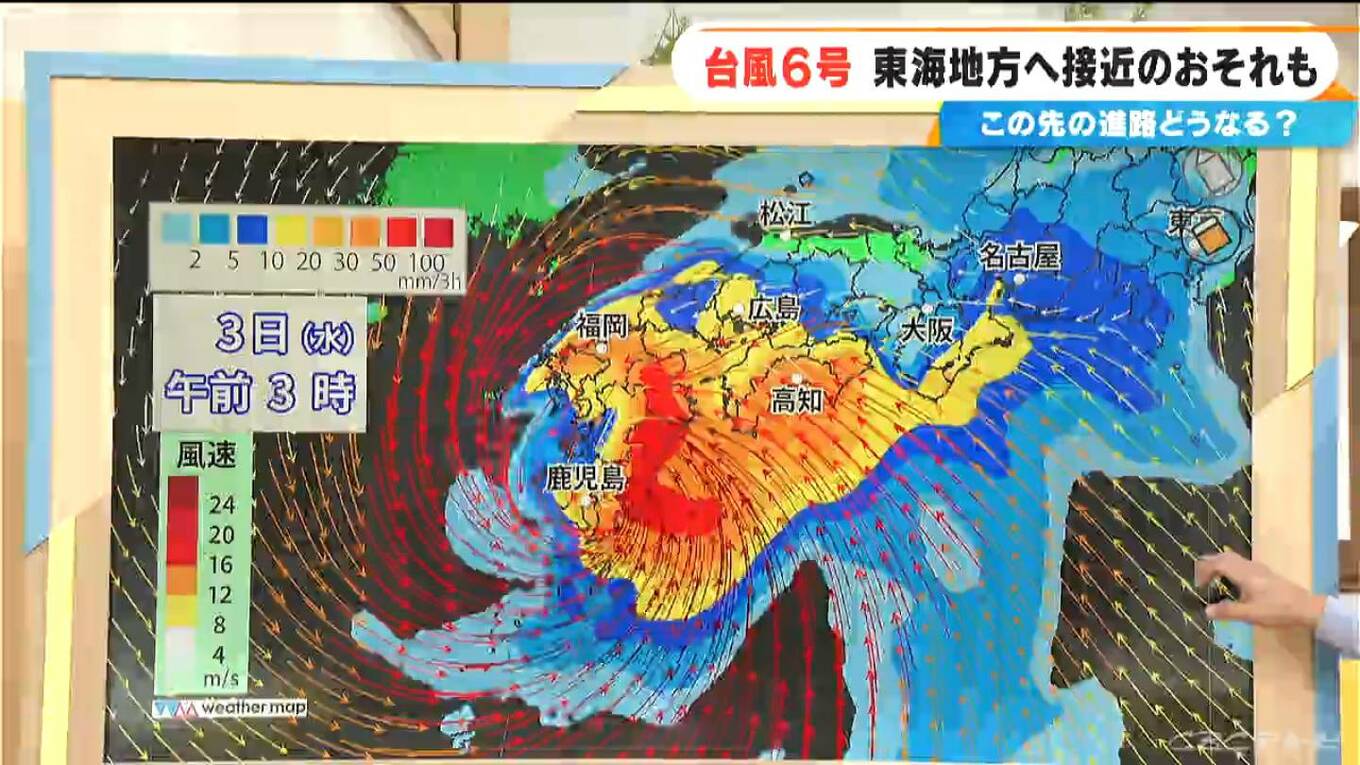
Typhoon No. 6: What lies ahead?
Looking at the satellite cloud imagery, the typhoon’s cloud cover has become quite organized. A swirling cloud pattern can now be seen over the sea south of Japan.
Now, let’s check the current position of the typhoon. It is currently located over the sea east of the Philippines. As it progresses, it is expected to move northward and then shift eastward, riding on the upper-level winds.
The forecast for the central pressure shows it dropping to 970 hPa over the sea south of Okinawa, and then further down to 960 hPa near Okinawa. A decrease in pressure indicates that the typhoon is intensifying.
The typhoon is expected to strengthen by one level, approaching Okinawa with strong intensity.
Tokai region
The Tokai region is a historic and industrial area in central Japan, encompassing Aichi, Gifu, Mie, and Shizuoka prefectures. It was a key route on the ancient Tokaido Road connecting Kyoto and Edo (modern Tokyo), and is home to Nagoya, a major port and manufacturing hub. Today, the region is known for its automotive and ceramics industries, as well as cultural sites like Nagoya Castle and Ise Grand Shrine.
Okinawa
Okinawa, a Japanese prefecture consisting of hundreds of islands in the East China Sea, is renowned for its unique Ryukyuan culture, distinct from mainland Japan. Its history includes the prosperous Ryukyu Kingdom (1429–1879), which traded extensively with China and Southeast Asia, before being annexed by Japan. The islands were also the site of the devastating Battle of Okinawa in 1945 during World War II, and today they host a significant portion of U.S. military bases in Japan.
Philippines
The Philippines is a Southeast Asian archipelago with a rich history shaped by indigenous cultures, Spanish colonization (1565–1898), and American influence (1898–1946). Known for its stunning beaches, vibrant festivals, and diverse heritage, it became an independent republic in 1946. Today, its cultural sites, such as the Baroque Churches of the Philippines and the historic city of Vigan, reflect this layered past.
Tokai region
The Tokai region is a historical and cultural area in central Japan, primarily known for the Tokaido road, a major route connecting Tokyo and Kyoto during the Edo period. It encompasses modern-day Aichi, Gifu, Mie, and Shizuoka prefectures, and is famous for its role in Japan’s industrial development, particularly through the city of Nagoya. The region blends traditional heritage, such as the Ise Grand Shrine, with modern economic significance as a hub for manufacturing and transportation.
Tokaido Road
&
Tokai region
The Tokai region is a major industrial and cultural area in central Japan, encompassing Aichi, Gifu, Mie, and Shizuoka prefectures. Historically, it was a vital corridor along the ancient Tokaido road, which connected Kyoto and Edo (modern-day Tokyo). Today, it is known for cities like Nagoya, a hub of automotive manufacturing, including Toyota’s headquarters, and for its rich cultural heritage, such as Ise Grand Shrine and the historic castle in Nagoya.
Tokaido Road
The Tokaido Road was one of Japan’s most important historical highways, connecting the imperial capital of Kyoto with the political hub of Edo (modern-day Tokyo) during the Edo period (1603–1868). Stretching roughly 500 kilometers along the Pacific coast, it featured 53 post stations where travelers could rest, trade, and change horses. This route played a vital role in Japan’s cultural and economic exchange, and its legacy is famously captured in Utagawa Hiroshige’s ukiyo-e series “The Fifty-Three Stations of the Tokaido.”
Kyoto
Kyoto, once the imperial capital of Japan for over a thousand years (from 794 until 1868), is renowned for its profound cultural heritage. The city is home to numerous classical Buddhist temples, Shinto shrines, traditional wooden houses, and iconic landmarks like the Golden Pavilion and the Fushimi Inari Shrine. Its historic districts, such as Gion, preserve the legacy of geisha culture, making Kyoto a living museum of Japan’s pre-modern history.
Edo
Edo, the former name of modern-day Tokyo, was a small fishing village until the early 17th century when it became the seat of the Tokugawa shogunate. Under the shoguns, it rapidly grew into one of the world’s largest cities and the political and cultural heart of Japan during the Edo period (1603–1868). After the Meiji Restoration, the city was renamed Tokyo and continued to develop into Japan’s sprawling capital.
Nagoya
Nagoya is a major industrial and cultural hub in Japan, historically known as the seat of the powerful Owari Tokugawa clan during the Edo period. The city is famous for Nagoya Castle, built in 1612, which was largely destroyed in World War II but later reconstructed, and for its role as a center of manufacturing, particularly in the automotive and aerospace industries. Today, Nagoya blends modern urban life with traditional sites like Atsuta Shrine, one of Shinto’s most important shrines.
Nagoya Castle
Nagoya Castle, originally built in 1612 by the Tokugawa shogunate, was a key stronghold in the Owari domain. It was famous for its golden shachihoko (mythical dolphin-like creatures) atop the keep. The castle was largely destroyed during World War II, but its main tower was reconstructed in 1959, and it remains a popular historical landmark today.
Ise Grand Shrine
The Ise Grand Shrine, located in Mie Prefecture, Japan, is the most sacred Shinto shrine in the country, dedicated to the sun goddess Amaterasu. Its history dates back over 2,000 years, and it is famously rebuilt every 20 years in a tradition called *Shikinen Sengū* to maintain spiritual purity and preserve ancient building techniques. The shrine complex consists of two main sites—Naikū and Gekū—and attracts millions of pilgrims and visitors each year.
Okinawa
Okinawa is a Japanese prefecture consisting of hundreds of islands in the East China Sea, known for its unique Ryukyuan culture and history. Once the independent Ryukyu Kingdom, it was a vital trading hub before being annexed by Japan in the 19th century. The islands were the site of the devastating Battle of Okinawa during World War II and today host a significant number of U.S. military bases.
Related news

Australia considers restricting children’s social media use, with a ban for those under 16 in place; what do people think?
Discussions on whether to regulate children's use ...

The only official U-10 soccer tournament in the Tokai region, “OKAYA CUP,” features intense matches played in 8-a-side soccer.
The only Tokai region tournament for U-10 official...
Triple typhoons expected to form: Typhoon No. 17 has developed, with two remaining tropical disturbances. Potential impacts on Japan and latest forecasted paths.
Triple Typhoon Formation: Typhoon No. 17 has forme...
A police car on an emergency run collided with a passenger car at an intersection in Nakamura Ward, Nagoya, leaving three people from both vehicles with minor injuries.
A police car driving urgently collided with a pass...

JR Kansai Line resumes train service in both directions between Nagoya and Kuwana.
[Traffic Information] JR Kansai Line: Nagoya to Ku...