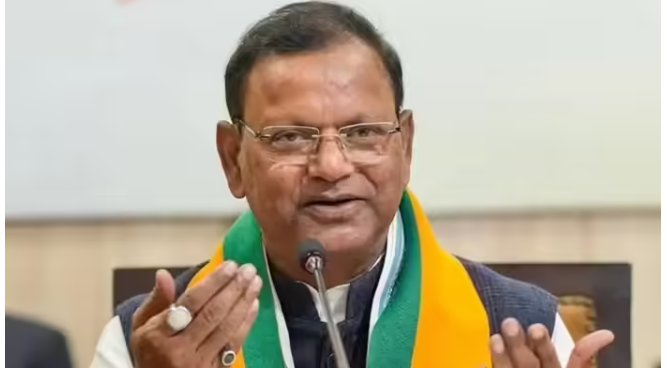
Chandauli. In connection with the assault on a female leader of the Samajwadi Party in Chandauli, Uttar Pradesh, the state president of the Bharatiya Janata Party and Union Minister of State for Finance launched a sharp attack on the Samajwadi Party. The Union Minister, while strongly criticizing the Samajwadi Party, said that the Samajwadi Party’s PDA model has now become a symbol of ‘pain, oppression, and humiliation.’ His remarks have further heated up the political atmosphere.
The minister taunted that the Samajwadi Party’s PDA has now become a symbol of ‘pain, oppression, and humiliation.’ He alleged that the Samajwadi Party’s respect for women is limited to posters and slogans, while the reality is completely the opposite.
Chandauli
Chandauli is a district in the Indian state of Uttar Pradesh, known for its historical and cultural significance. It is believed to have been a part of the ancient Mahabharata-era kingdom of Kashi and later came under various rulers, including the Mughals and the British. Today, it is recognized for its natural landscapes, such as the Chandraprabha Wildlife Sanctuary, and its role in regional agriculture and trade.
Uttar Pradesh
Uttar Pradesh is a culturally and historically rich state in northern India, often considered the heartland of the country’s ancient civilization. It is home to the iconic Taj Mahal in Agra, the sacred city of Varanasi on the Ganges River, and the historic city of Ayodhya, believed to be the birthplace of Lord Rama. The region has been a center of power for major empires, including the Maurya, Gupta, and Mughal dynasties, and played a pivotal role in India’s independence movement.
Chandauli
Chandauli is a district in the Indian state of Uttar Pradesh, known for its historical and cultural significance. It is home to ancient sites like the Lakhania Dabbar waterfall, which features Ashokan rock edicts dating back to the 3rd century BCE, highlighting its connection to the Mauryan Empire. The region also has ties to the Vedic period and the legendary King Chandra, from whom it is said to derive its name.
Uttar Pradesh
Uttar Pradesh is a culturally and historically rich state in northern India, often considered the heart of the Hindi-speaking region. It was home to the ancient kingdoms of Kosala and Magadha, and later became a key center of the Mughal Empire, with its capital at Agra housing the iconic Taj Mahal. The state also holds immense religious significance as the site of Varanasi (the holiest city in Hinduism) and Ayodhya (the birthplace of Lord Rama).
Samajwadi Party
The Samajwadi Party is a prominent political party in India, primarily based in the state of Uttar Pradesh. It was founded in 1992 by Mulayam Singh Yadav, a former chief minister of the state, with a focus on representing the interests of backward castes, minorities, and the underprivileged. The party has played a significant role in state and national politics, having formed multiple governments in Uttar Pradesh and influencing socialist and secular policies in India.
<div class="my-4 p-4 rounded-lg shadow-md bg-blue-50 border-l-4 border
Chandraprabha Wildlife Sanctuary
Chandraprabha Wildlife Sanctuary, located in Uttar Pradesh, India, was established in 1957 and is named after the nearby Chandraprabha River. It once served as a key habitat for lions and tigers, but these populations have since declined, though the sanctuary still hosts leopards, deer, and various bird species. The area is also known for the ancient Rajdari and Devdari waterfalls, which add to its scenic and cultural significance.
Taj Mahal
The Taj Mahal is a white marble mausoleum located in Agra, India, built between 1632 and 1653 by Mughal emperor Shah Jahan in memory of his beloved wife, Mumtaz Mahal. It is renowned as a masterpiece of Mughal architecture, blending elements of Islamic, Persian, and Indian styles. Today, it stands as a UNESCO World Heritage Site and one of the most iconic symbols of love in the world.
Varanasi
Varanasi, one of the world’s oldest continuously inhabited cities, is a major spiritual hub in India, located on the banks of the Ganges River. For millennia, it has been a center of Hindu pilgrimage, learning, and culture, deeply associated with the cycles of life and death. The city’s ghats, temples, and ancient rituals reflect its enduring history as a place where devotees come to perform sacred rites and seek spiritual liberation.
Ayodhya
Ayodhya is an ancient city in northern India, considered one of the seven holiest cities in Hinduism and believed to be the birthplace of the god Rama. Its history spans millennia, featuring prominently in the epic Ramayana as the capital of the Kosala Kingdom. The site has also been a focal point of significant religious and political controversy in modern times, particularly surrounding the Babri Masjid mosque and the subsequent construction of the Ram Mandir temple.
Lakhania Dabbar waterfall
Lakhania Dabbar waterfall is a scenic natural attraction located in the Satkosia Tiger Reserve in Odisha, India. Its name is derived from the local Odia language, meaning “a million streams,” reflecting the waterfall’s formation from numerous small channels cascading down a rocky cliff. The site is not only a popular tourist destination but also holds cultural significance, as it is associated with local legends and traditional beliefs, though its recorded history is primarily tied to the region’s natural heritage and conservation efforts.
Ashokan rock edicts
The Ashokan rock edicts are a collection of inscriptions carved on rocks and pillars across the Indian subcontinent by the Mauryan Emperor Ashoka during the 3rd century BCE. These edicts, written primarily in Prakrit using Brahmi script, convey Ashoka’s policies of non-violence, religious tolerance, and moral governance after his conversion to Buddhism. They provide crucial historical insights into the spread of Buddhism and the administration of the Mauryan Empire.
Kosala
Kosala was an ancient Indian kingdom and a prominent Mahajanapada (great realm) during the 6th century BCE, located in present-day Uttar Pradesh. It is historically significant as the home of the legendary King Rama from the Ramayana, with its capital at Ayodhya, and as a center of Buddhism where the Buddha spent much of his life. The kingdom was later annexed by the Magadha empire under King Ajatashatru, marking its decline as an independent state.
Magadha
Magadha was an ancient kingdom in present-day Bihar, India, and a powerful center of Indian civilization from around the 6th century BCE. It was the heart of the Mahajanapada period and became the core of major empires, including the Maurya and Gupta dynasties. The region is historically significant as the homeland of both Buddhism and Jainism, where Buddha and Mahavira spent much of their lives teaching.