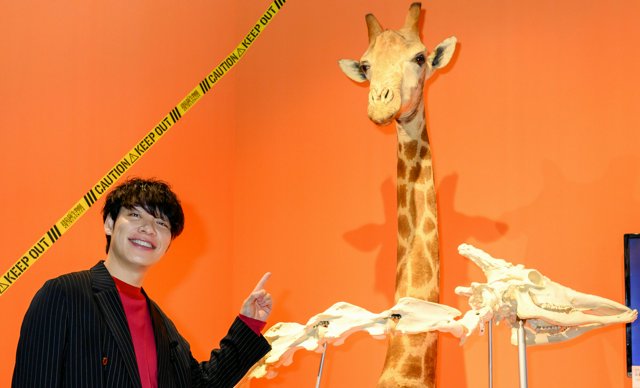
The special exhibition “Super Dangerous Creatures: Science Challenges the True Power of Living Beings” is currently being held in Ueno, Tokyo. This exhibition focuses on the dangerous “special moves” unleashed by various living beings, from insects to fish, and attempts to elucidate them through a scientific approach.
The audio guide, which helps visitors understand the exhibition, is narrated by a member of the comedy duo Kirin. As a comedian and host, he has established an unshakable position in the entertainment world, but he says there are similarities between the dangerous creatures introduced in the exhibition and his own way of surviving in show business.
The keyword is “fart”? We spoke with him at the guide recording site.
— You were set as the guide of the “Dangerous Creatures Research Institute.”
I was in the role of welcoming people, but while reading, I ended up messing up several times when I thought “huh?” (laughs). I think the surprise I felt, as if I were walking through the museum myself, came through in my voice.
— Did you pay attention to your tone or intonation?
In variety show narration, I sometimes raise the pitch, but since this is the “Super Dangerous Creatures” exhibition, I wanted to convey the danger properly while keeping it interesting, so I kept my voice quite low, among the lowest I use.
— Which creature caught your attention the most?
The army ant. Honestly, I didn’t even know they existed, but the queen ant is incredibly large, and some individuals live for nearly 30 years. That makes me think it’s not really an ant but some other creature.
【Army ants are one of the highlights of the exhibition. On a popular show “Crazy Journey,” in 2025, they succeeded in filming the queen ant deep inside a nest guarded by tens of millions of worker ants in the jungles of Kenya. Although a different specimen, one of the world’s few rare queen ant specimens is being displayed for the first time in Japan.】
The surrounding worker ants are organized like a company, with divided roles and strict control. Adults might relate to this structure. It’s a mystery of life.
【In the first half of the exhibition, the giraffe is introduced as a surprising power fighter. The skeletal and taxidermy exhibits recreate the “necking” behavior where male giraffes swing their long necks to fight each other over females. The exhibition video also allows visitors to experience this intensity.】
— You’ve carried the name “Kirin” (giraffe) for many years.
Giraffes are often seen as cute animals, but they engage in necking, a fighting style that requires a strong neck and spring. When they fight to protect what they need to, they are truly powerful. On the other hand, our duo, Kirin, tends to avoid conflict, and if something bothers us, we sometimes ignore each other. We’ve continued like this for 27 years without fighting or talking it out, which is not great (bitter laugh). I’d like to learn from the real giraffe’s aggressiveness.
— So, do you ever neck with your partner, Tamura?
People often think of Tamura these days as some kind of imaginary creature, but we still do comedy. I hope you can see our necking at the theater.
【The exhibition categorizes the creatures into eight types based on their abilities and characteristics, such as the “Killer Bite Type” that uses sharp teeth to take down prey, and the “Swarm Type” where small insects or fish gather to obtain food. Each type is set up like a lab for visitors to explore.】
— Which type do you think you are, based on this classification?
I definitely don’t think I’m a creature with high attack power. In that sense, maybe I’m the “Chemical Attack Type” (which releases high-temperature gas or strong acidic stomach fluids). I often take on roles that respond to others’ actions, and thankfully, I have a lot of hosting work. Rather than stepping forward to make jokes or react strongly, I feel like I take something from the other person and “release a high-quality fart” (laughs). I do that intentionally.
— Your reflexes are on par with a skunk.
There</p