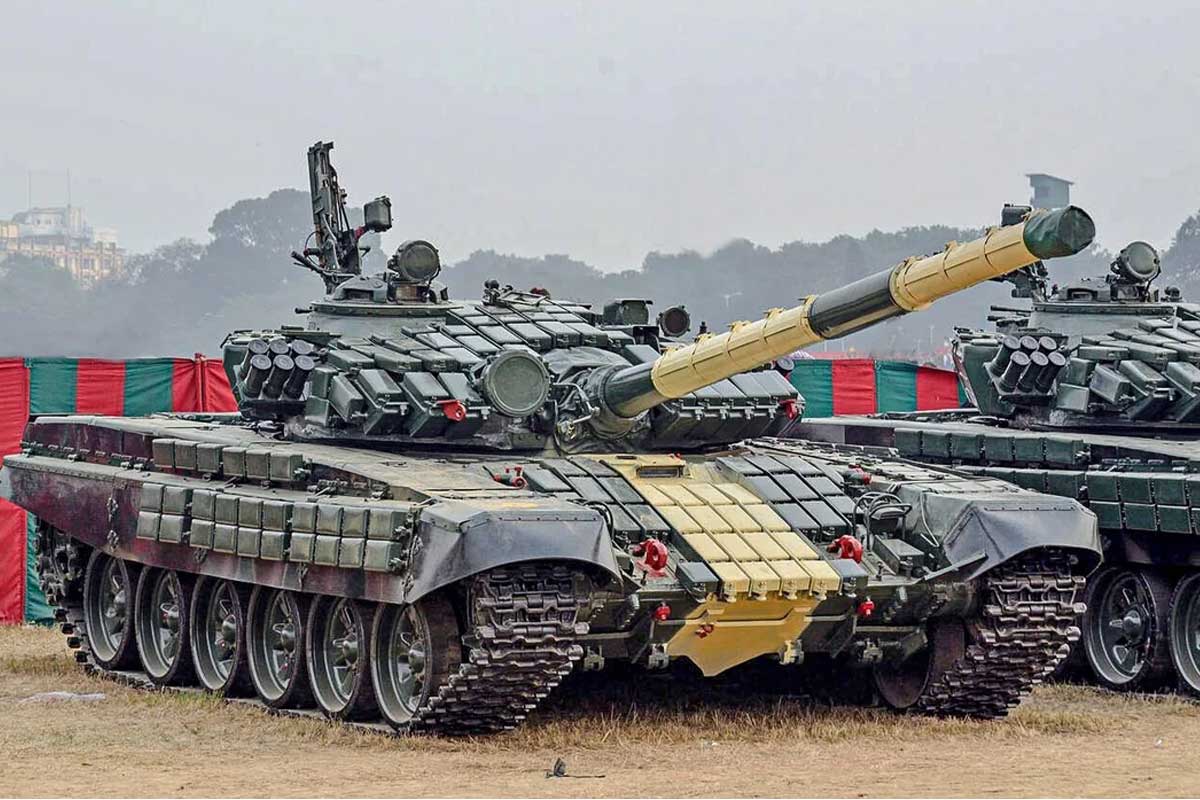
Not just Pakistan, but also its ally China. To confront the adversary, the army remains prepared at every moment. The focus is always on how to become even stronger. Therefore, a modernization plan has been undertaken to upgrade the old T-72 tanks. The goal is to ensure these tanks remain relevant even after 2030. Notably, the T-72 tank was first introduced into the army’s arsenal in 1978.
When this armored combat vehicle first entered the army’s hands in the 1970s, it was considered one of the world’s most advanced tanks. It featured a powerful 125 mm cannon, an advanced fire control system, a low-profile design, and an excellent power-to-weight ratio! This undoubtedly posed a significant challenge to the enemy in terms of strength and capability. It is worth mentioning that when the T-72 first arrived in India, arch-rival Pakistan was phasing out its old Patton tanks and incorporating Chinese-made T-59, T-69, and T-85 tanks into its arsenal. Later, they also purchased around 300 T-80 tanks from Ukraine.
Read more:
A modernization plan has been undertaken to upgrade the old T-72 tanks. The goal is to ensure these tanks remain relevant even after 2030. Notably, the T-72 tank was first introduced into the army’s arsenal in 1978.
But “no one remains equal forever.” During the 1991 Gulf War, powerful Western tanks highlighted the limitations of the T-72 for the first time. Equipped with superior thermal imagers, night vision, and advanced fire control systems, those tanks made the T-72 appear somewhat outdated.
Consequently, the army later began incorporating more modern T-90 tanks. The first batch of 124 Russian-made T-90 tanks was inducted into the army’s arsenal in 2001. Recently, the Armoured Vehicles Corporation Limited in Avadi, Tamil Nadu, delivered the thousandth T-90 tank to the army.
But what about the T-72? For their modernization, the army has launched “Project Rhino.” Through new engines, modern fire control systems, and enhanced protection measures, these tanks are being made more powerful. In the future, they may also be converted into unmanned combat platforms. The army believes this will keep the T-72 tanks effective for many years to come and they will play a crucial role until “future-ready combat vehicles” are introduced.
T-72 tank
The T-72 is a Soviet-designed main battle tank that entered production in 1971, becoming one of the most widely produced and exported tanks of the Cold War. It was developed as a simpler, more cost-effective alternative to the T-64, and its robust design and ease of mass production led to its use by over 40 countries worldwide. The tank has seen extensive combat in numerous conflicts, including the Iran-Iraq War, the Gulf War, and the ongoing war in Ukraine, where it remains a common but often outdated battlefield asset.
Patton tanks
Patton tanks, named after General George S. Patton, were a series of American main battle tanks that served as the backbone of U.S. armored forces during the Cold War. The M46, M47, M48, and M60 models were developed from the late 1940s through the 1950s, with the M48 and M60 seeing extensive combat in the Vietnam War and various Middle Eastern conflicts. Their design emphasized a powerful main gun and robust armor, and they were widely exported to allied nations, becoming iconic symbols of mid-20th-century armored warfare.
<div class="my-4 p-4 rounded-lg shadow-md bg-blue-50 border-l-
T-72 tank
The T-72 is a Soviet-designed main battle tank that entered service in 1973, becoming one of the most widely produced and exported armored vehicles of the Cold War. It was developed as a more affordable and simpler alternative to the advanced T-64, featuring a powerful 125mm smoothbore gun and robust armor. Despite its initial reputation, the T-72 saw extensive combat in conflicts from the Iran-Iraq War to the Gulf War and the ongoing war in Ukraine, where its vulnerabilities have been exposed by modern anti-tank weapons.
Patton tanks
Patton tanks are a series of American main battle tanks named after General George S. Patton, first introduced during the Cold War era. The M46, M47, M48, and M60 models served as the backbone of U.S. armored forces from the 1950s through the 1970s, seeing action in conflicts like the Korean and Vietnam Wars. These tanks were widely exported and remain in service with some countries today, symbolizing mid-20th century armored warfare.
T-59
T-59 is a type of Chinese main battle tank developed in the late 1950s, based on the Soviet T-54A design. It was mass-produced and widely used by the People’s Liberation Army, playing a key role in China’s armored forces during the Cold War era. The T-59’s robust and simple design allowed it to be exported to numerous countries and remain in service for decades.
T-69
T-69 is a historic Soviet tank used during World War II, specifically a variant of the T-34, known for its enhanced armor and combat capabilities. It played a significant role in key battles on the Eastern Front, contributing to the Soviet Union’s eventual victory over Nazi Germany. Today, T-69 tanks are often preserved as museum pieces, serving as a reminder of wartime engineering and military history.
T-85
T-85 is a designation for a type of Soviet-era tank, specifically the T-34/85, a widely produced and influential medium tank used during World War II. It was an upgraded version of the T-34, featuring a more powerful 85mm gun and a three-man turret, which significantly improved its combat effectiveness against German heavy tanks. The T-34/85 played a crucial role in the Soviet victory on the Eastern Front and remained in service with many countries for decades after the war.
T-80
T-80 is a Soviet-era main battle tank first introduced in 1976, known for being the world’s first production tank equipped with a gas turbine engine. It saw service during the Soviet-Afghan War and later conflicts involving Russia and other nations. Despite its advanced design, the T-80’s high fuel consumption and maintenance demands limited its widespread adoption compared to the more economical T-72.
T-90
The T-90 is a Russian main battle tank developed in the early 1990s as an upgrade of the T-72, incorporating advanced armor and fire control systems from the T-80. It entered service with the Russian Army in 1992 and has since been widely exported to countries like India, Algeria, and Vietnam, seeing combat in conflicts such as the Syrian Civil War. Known for its durability and cost-effectiveness, the T-90 remains a key component of modern armored forces.
Armoured Vehicles Corporation Limited
The Armoured Vehicles Corporation Limited (AVCL) is an Indian state-owned company headquartered in Avadi, Chennai, dedicated to the design, development, and manufacture of armored fighting vehicles. Established in 1961, it was originally formed as a subsidiary of the Heavy Vehicles Factory to produce the Vijayanta main battle tank for the Indian Army. Over the decades, AVCL has played a crucial role in India’s defense self-reliance, producing platforms like the Arjun main battle tank and various infantry combat vehicles.