
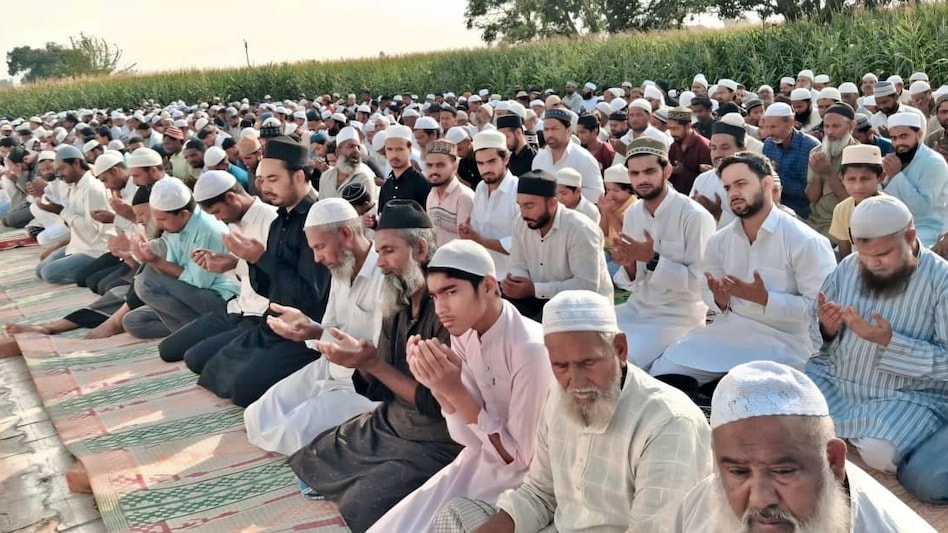
The festival of Bakrid was celebrated with full devotion and joy in Uttar Pradesh. From Chandauli to Agra, people of the Muslim community offered prayers in mosques and Eidgahs across various districts of the state. As per government guidelines, prayers were not held on the streets, and strict security arrangements were in place.
Devotees of the Muslim community in various districts of Uttar Pradesh peacefully offered Bakrid prayers inside Eidgahs and mosques. To ensure compliance with the strict guidelines of the state government, police and administrative officials remained alert with drone cameras, CCTV, and heavy force. In Chandauli, Ayodhya, Hapur, Sambhal, Auraiya, Kaushambi, Ghazipur, Firozabad, Sultanpur, Saharanpur, and Agra, open sacrifices and prayers on the streets were completely prevented under the supervision of magistrates. Worshippers offered collective prayers for brotherhood, progress, and prosperity in the country, and amidst security arrangements, they embraced each other and exchanged festival greetings.
Chandauli
Chandauli is a district in the Indian state of Uttar Pradesh, historically known as part of the ancient Kashi region. It has significant cultural and religious importance, being associated with the sacred Ganges River and the nearby town of Chandauli, which is believed to have roots in the Vedic period. The area is also noted for its scenic landscapes, including waterfalls and forests, and has played a role in the region’s agricultural and spiritual heritage.
Agra
Agra is a city in northern India, best known as the home of the iconic Taj Mahal, a stunning white marble mausoleum built by Mughal emperor Shah Jahan in the 17th century in memory of his wife Mumtaz Mahal. Once the capital of the Mughal Empire, the city also features other UNESCO World Heritage sites like the Agra Fort and the planned city of Fatehpur Sikri, reflecting its rich architectural and historical legacy. Today, Agra is a major tourist destination, drawing millions of visitors from around the world.
Ayodhya
Ayodhya is a historic city in northern India, considered one of the seven most sacred pilgrimage sites in Hinduism, traditionally believed to be the birthplace of Lord Rama. Its history dates back thousands of years, featuring prominently in the ancient epic Ramayana, and it has been a focal point of religious and political significance, including the contentious Babri Masjid-Ram Janmabhoomi dispute that was resolved by a Supreme Court ruling in 2019, allowing for the construction of a grand Ram temple.
Hapur
Hapur is a city in the Indian state of Uttar Pradesh, historically known as the birthplace of the Ganga-Jamuni culture and a key trading post on the route from Delhi to Meerut. It gained prominence during the Mughal era as a center for grain and sugar trade, and later played a role in the Indian independence movement.<
Taj Mahal
The Taj Mahal is a white marble mausoleum located in Agra, India, built between 1632 and 1653 by Mughal emperor Shah Jahan in memory of his beloved wife, Mumtaz Mahal. It is a masterpiece of Mughal architecture, blending Islamic, Persian, and Indian styles, and is recognized as one of the Seven Wonders of the World. Today, it stands as a symbol of eternal love and is a UNESCO World Heritage Site, attracting millions of visitors annually.
Agra Fort
Agra Fort is a historic Mughal fort located in Agra, India, built primarily between 1565 and 1573 under Emperor Akbar. It served as the main residence of the Mughal emperors until 1638, when the capital moved to Delhi, and later became a site of imprisonment for Shah Jahan, who is said to have gazed at the Taj Mahal from its towers. Recognized as a UNESCO World Heritage Site, the fort showcases a blend of Islamic and Hindu architectural styles.
Fatehpur Sikri
Fatehpur Sikri is a historic city in Uttar Pradesh, India, founded by Mughal Emperor Akbar in 1571 as his capital. It was built to honor the Sufi saint Salim Chishti, who predicted the birth of Akbar’s heir. The city features stunning Mughal architecture, including the Buland Darwaza and Jama Masjid, but was abandoned shortly after its construction due to water shortages.
Ram Janmabhoomi
Ram Janmabhoomi is a sacred site in Ayodhya, India, believed by Hindus to be the birthplace of Lord Rama, a major deity. The site has a long and contentious history, including the 16th-century Babri Masjid mosque built there, which was destroyed in 1992, sparking widespread conflict. In 2019, the Indian Supreme Court awarded the land for the construction of a Hindu temple, which is now being built.
Babri Masjid
Babri Masjid was a 16th-century mosque located in Ayodhya, India, built under the Mughal emperor Babur’s commander Mir Baqi. It became a major site of religious and political conflict, as many Hindus believe it was constructed on the ruins of a temple marking the birthplace of the deity Rama. The mosque was destroyed in 1992 by a Hindu nationalist mob, sparking widespread communal violence, and the site was later awarded to Hindus for temple construction in a 2019 Supreme Court ruling.
Related news

Payment for parking to petrol will be made via FASTag, digital payments to get a major expansion.
New Delhi, December 22, 2025. FASTag will no longe...

Mystery explosion at Israeli defense site: Ex-CIA analyst doubts Tehran’s claim it was a planned test.
Blast at Tomer Defence Test Site Near Beit Shemesh...

Alert issued for severe heat; public health department leaves canceled, officials ordered to stay in the field.
Haryana, May 27, 2026. In view of the severe heat ...

Drunk youths’ speed turns into disaster as two cars collide head-on; six injured including a young woman in Mathura.
A speeding car driven by intoxicated youths came f...
On Trump’s birthday, talk of a ‘Fight Night’ at the White House sparks intense online debate.
WASHINGTON, May 28, 2026. Discussion has intensifi...