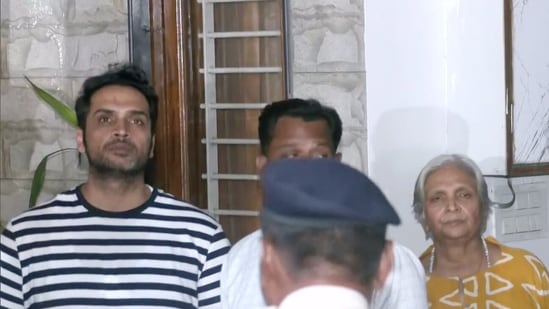
Retired Judge Giribala Singh is an accused in her daughter-in-law Twisha Sharma’s death case over allegations of harassment, dowry demands.
Giribala Singh, a retired judge and accused in the death case of her daughter-in-law, lost her anticipatory bail in a late-night hearing by the Madhya Pradesh High Court on Wednesday, during which the High Court cited non-cooperation in its order while the victim’s side highlighted character assassination in its argument.
In the hearing of the single bench, Justice Devanarayan Mishra observed consistent allegations, non-cooperation, heinous nature of the offense, and the trial court’s failure to consider evidence as main points to cancel the bail order given by Bhopal District Court on May 15.
Twisha Sharma, a woman in her 30s, was found dead on May 12 at her marital home in Madhya Pradesh’s Bhopal. Initially suspected to be a suicide, the death later led to an investigation with allegations against her husband, Samarth, and mother-in-law of harassment and dowry demands.
The case is currently being investigated by the Central Bureau of Investigation (CBI).
A first information report (FIR) was registered on May 15 in the case, and a trial court granted Giribala Singh interim bail within a few hours of the FIR registration, while her son Samarth, who surrendered after 10 days of being missing, remains in CBI custody.
Why Giribala Singh’s anticipatory bail was quashed
In the late-night hearing of the Madhya Pradesh High Court single bench, Justice Devanarayan Mishra observed consistent allegations, non-cooperation, heinous nature of the offense, and the trial court’s failure to consider evidence as main points to cancel the bail order given by Bhopal District Court on May 15.
“The anticipatory bail order by the 10th Additional Sessions Judge, Bhopal, for the offense punishable under sections 80(2), 85, 3(5) of BNS, 2023 and Sections 3 & 4 of the Dowry Prohibition Act, 1961, is hereby quashed,” the earlier report quoted the court as saying.
After receiving anticipatory bail, Giribala Singh is not cooperating with the investigation agency, although several notices were issued to her for recording her statement and cooperating with the agency, the order read.
The High Court also noted that the lower court did not consider several key facts, such as WhatsApp chats, which suggest that the allegations are not only against Samarth Singh.
“It is also an admitted fact that the deceased became pregnant and it was terminated within two months. The complainant party has alleged against the accused, whereas Giribala Singh has submitted that the deceased herself was interested in terminating the pregnancy. From the WhatsApp chats also, it cannot be said that the allegations are only against Samarth Singh, but the trial court did not consider all these facts,” said the order.
On the claim of money transactions in Twisha’s account by Giribala Singh, the court said the marriage took place on December 9, 2025, and money transactions were made from October 2025 to February 2026, with no money transferred into the deceased’s account closer to her death.
“It cannot be said that Giribala Singh has transferred much money into the victim’s account, by which it could be presumed that there was no demand for dowry in light of the above factual aspects of the case and the allegations leveled against Giribala Singh,” it read.
Injury marks, ‘character maligned’
The court cited injury marks mentioned in the postmortem report. “As per the postmortem report, death was due to antemortem hanging by ligature, but from the postmortem, it is also clear that six other injuries were found in the body of the deceased, in which four injuries were on the left arm, one on the ring finger, and one on the head, and those were ant