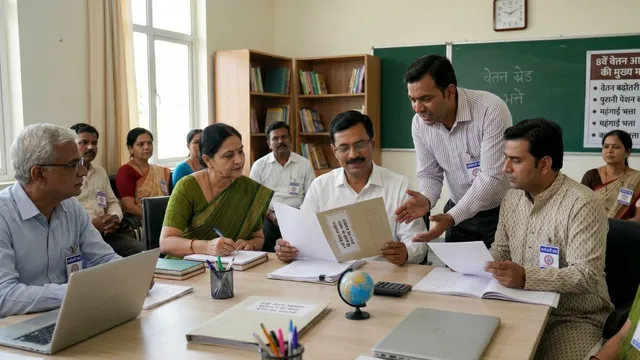
All India NPS Employee Federation (AINPSEF) submitted a memorandum to the 8th Pay Commission demanding a minimum basic salary of 50,000 rupees and a fitment factor of 3.83 for central government teachers… read more
New Delhi. Since the formation of the 8th Pay Commission, various employee organizations have been presenting their demands regarding salary increases. In this context, the Progressive Teachers Justice Forum (PSNM), which is representing central government teachers from union territories before the Eighth Pay Commission, has demanded a minimum basic salary of 50,000 rupees and a fitment factor of up to 3.83 in its memorandum to the Eighth Pay Commission.
PSNM, which is an affiliated unit of the All India NPS Employees Federation (AINPSEF), submitted its memorandum to the 8th Pay Commission on April 20, 2026, demanding salary increases for teachers from union territories working in institutions such as Kendriya Vidyalaya and Navodaya Vidyalaya.
Key demands of AINPSEF for teachers
- Increase House Rent Allowance (HRA) to 36%
- Increase annual salary increment to 7%
- Merge basic pay with Dearness Allowance (DA) when DA reaches 50%
- Restore the Old Pension Scheme (OPS) and ensure minimum guaranteed promotions every six, 12, 18, and 24 years
Minimum salary of 50,000 rupees and fitment factor up to 3.83
The organization has demanded that the minimum basic salary for a Level 1 employee be increased to between 50,000 rupees and 60,000 rupees. It has demanded a fitment factor between 2.62 and 3.83.
AINPSEF has also demanded an annual salary increment of 6%-7%, which would ensure an approximate annual salary increase of 10%.
According to the Seventh Pay Commission, the basic salary for a Level 1 employee is 18,000 rupees. The commission’s fitment factor is 2.57, while employees receive a 3% annual salary increment.
Dearness Allowance (DA) to be merged with basic pay
Employees want DA to be calculated up to two decimal places, unlike the current practice where decimals are not calculated. Employees demand that when DA reaches 50%, it should be merged with the basic salary.
At least 7,000 rupees Children Education Allowance
AINPSEF has demanded that the 8th Pay Commission increase the Children Education Allowance (CEA) from 2,812.59 rupees per month to 7,000 rupees per month per child (up to graduation level). Central government teachers currently receive CEA until the child’s 12th grade.
Increase in HRA up to 36%
The employee organization has proposed increasing HRA from the current 10%, 20%, and 30% to 12%, 24%, and 36% respectively for different cities.
Minimum transport allowance of 9,000 rupees
The employees’ union has also proposed increasing the transport allowance to 12%-15% of the basic salary (minimum 9,000 rupees plus increase according to Dearness Allowance percentage). Transport allowance rates for employees at different levels are currently 1,800 rupees, 3,600 rupees, and 7,200 rupees respectively. Employees have also demanded a digital assistance allowance of 2,000 rupees per month (for broadband and AI assistance). No such allowance existed in the Seventh Pay Commission.
Cash encashment of earned leave for 400 days upon retirement
PSNM seeks 14 days of casual leave (CL), 30 earned leave (EL), and 20 days of medical leave annually. It seeks cash encashment of earned leave for up to 400 days upon retirement, compared to the current 300 days. During service, it seeks cash encashment of earned leave for up to 30 days annually.
Minimum bonus of 27,640 rupees for all employees
The employee organization is demanding that the 8th Pay Commission increase