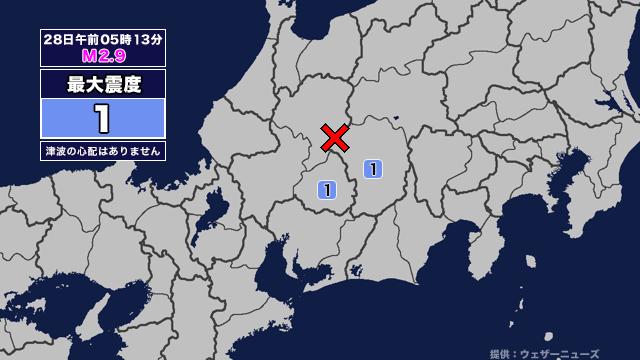
At around 5:13 a.m. on May 28, an earthquake with a maximum intensity of 1 struck the Hida region of Gifu Prefecture as its epicenter. Shaking of maximum intensity 1 was observed within Gifu Prefecture.
The areas that recorded a maximum intensity of 1 were Nagano Prefecture and Gifu Prefecture.
There is no concern about a tsunami from this earthquake.
The epicenter depth is 10 km. The magnitude (M) indicating the scale of the earthquake is estimated at 2.9.
Gifu Prefecture
[Intensity 1]
Nakatsugawa City
Hida region
The Hida region, located in the mountainous northern area of Gifu Prefecture, Japan, is renowned for its deep forests, traditional craftsmanship, and the historic city of Takayama, often called “Little Kyoto.” Historically, it was a remote and autonomous area known for its skilled carpenters and woodworkers, who were instrumental in building imperial palaces and temples in Kyoto during the Heian and Edo periods. Today, the region is celebrated for its well-preserved Edo-era townscapes, Hida beef, and the Hida Folk Village, which showcases the area’s cultural heritage.
Gifu Prefecture
Gifu Prefecture, located in the Chubu region of Japan, is renowned for its rich history and stunning natural landscapes, including the iconic Mount Kinka and the historic city of Takayama. It was a key strategic region during the Sengoku period, notably serving as the base for the warlord Oda Nobunaga, who used Gifu Castle as his stronghold in the 16th century. Today, the prefecture is famous for its traditional crafts, such as Mino washi paper, and cultural experiences like the cormorant fishing on the Nagara River.
Nagano Prefecture
Nagano Prefecture, located in central Japan’s Honshu island, is a mountainous region known for hosting the 1998 Winter Olympics. Historically, it was home to the powerful Zenko-ji Temple, a 7th-century Buddhist temple that remains a major pilgrimage site. The area also preserves samurai-era towns like Matsumoto, home to one of Japan’s oldest and most beautiful original castles.
Nakatsugawa City
Nakatsugawa City, located in Gifu Prefecture, Japan, is a historic post town along the Nakasendo, one of the five major routes of the Edo period. It flourished as a key rest stop for travelers and feudal lords, and today it preserves traditional architecture and cultural heritage, such as the well-maintained Magome-juku and the scenic Kiso Valley. The city is also known for its natural beauty, including the Ena Gorge and the historic Oi River.
Takayama
Takayama is a historic city in the Japanese Alps, known for its beautifully preserved old town that evokes the Edo period. Its history is deeply rooted in its role as a prosperous merchant and political center, with skilled craftsmen who developed the renowned “Takayama” lacquerware and furniture. The city also hosts the famous semi-annual Takayama Festival, showcasing ornate floats that date back to the 16th century.
Hida Folk Village
Hida Folk Village is an open-air museum in Takayama, Japan, showcasing over 30 traditional Gassho-zukuri farmhouses from the Hida region, some dating back to the Edo period. These structures feature steep thatched roofs designed to withstand heavy snowfall and were originally built by local farmers and craftsmen. The village preserves the region’s rural history and architectural heritage, offering visitors a glimpse into life in mountainous Japan centuries ago.
Mount Kinka
Mount Kinka is a 329-meter-tall mountain located in Gifu City, Japan, famous for the iconic Gifu Castle that sits atop its summit. Historically, the mountain served as a strategic defensive site, with the original castle built by the Saitō clan in the 13th century, though the current structure is a 1956 reconstruction. Today, it is a popular tourist destination, offering panoramic views of the Nagara River and the city, and is accessible via a scenic ropeway.
Gifu Castle
Gifu Castle, originally built in the early 13th century by the Nikaido clan, is a historic mountaintop fortress in Gifu City, Japan. It is famously associated with the warlord Oda Nobunaga, who captured it in 1567 and used it as a base for his campaign to unify Japan. The current structure is a 1956 reconstruction, offering panoramic views and housing a museum that details the castle’s rich samurai history.
Zenko-ji Temple
Zenko-ji Temple, located in Nagano, Japan, is one of the country’s most important and oldest Buddhist temples, founded in the 7th century. It is unique for being non-sectarian, representing all major Buddhist schools, and houses the first Buddhist statue ever brought to Japan—a hidden “absolute secret” image never shown to the public. The temple has been a major pilgrimage site for centuries, and its main hall is a designated National Treasure.
Matsumoto Castle
Matsumoto Castle, also known as “Crow Castle” due to its striking black exterior, is one of Japan’s most complete and beautiful original castles. Built primarily in the late 16th century during the Sengoku period, it served as a military fortress and later as a symbol of power for the ruling lords. Unlike many Japanese castles that were reconstructed, Matsumoto Castle retains its original wooden interior and stone foundation, offering a rare glimpse into feudal Japan’s architectural and defensive ingenuity.
Magome-juku
Magome-juku was the 43rd post station on the historic Nakasendō road, which connected Edo (modern Tokyo) and Kyoto during the Edo period. Located in a mountainous region of present-day Gifu Prefecture, it served as a vital resting stop for travelers and merchants, and its well-preserved traditional wooden buildings and stone-paved streets now attract tourists. The town was famously the birthplace of the writer Toson Shimazaki, and it remains a popular destination for those exploring Japan’s historic highways.
Ena Gorge
Ena Gorge is a scenic valley located in Yamanashi Prefecture, Japan, known for its dramatic granite cliffs and the clear waters of the Ena River. Historically, it served as an important passage along the Nakasendo road, one of the five major routes of the Edo period, connecting Tokyo and Kyoto. Today, it is a popular destination for hiking, rafting, and enjoying natural rock formations like the “Meoto Iwa” (Wedded Rocks).