Medan –
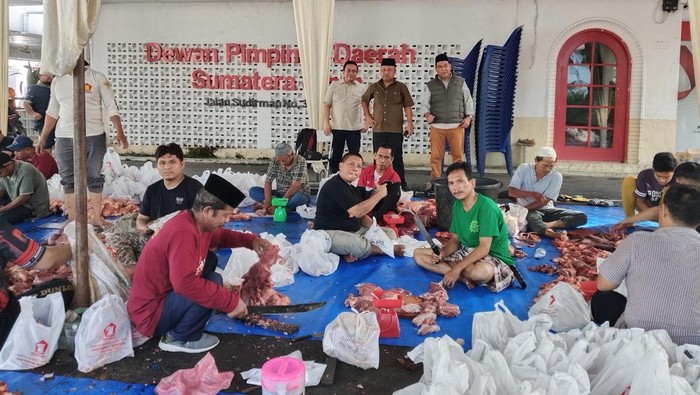
The Regional Leadership Council of the Gerindra Party in North Sumatra slaughtered 18 cows and 6 goats during this year’s Eid al-Adha. The sacrificial meat was distributed to communities in several areas, including Medan, Binjai, Langkat, Deli Serdang, and Serdang Bedagai.
The head of the Gerindra North Sumatra Regional Leadership Council stated that Eid al-Adha is a sacred moment for Muslims to learn to be willing to sacrifice and to increase care for others.
“Eid al-Adha is a sacred moment for Muslims to be willing to sacrifice. Additionally, this moment reminds Muslims to share with others. This is what Gerindra is doing,” he said.
The chairman of the Sacrificial Committee for the Gerindra North Sumatra Regional Leadership Council is a member of the North Sumatra Regional House of Representatives. The deputy chairman of the Medan City Regional House of Representatives serves as the committee treasurer.
Meanwhile, the secretary of Gerindra North Sumatra stated that this year for Eid al-Adha, they slaughtered 18 cows and 6 goats, which were then distributed to communities in various regions.
“The sacrificial meat was distributed to residents in Medan, Binjai, Langkat, Serdang Bedagai, and Deli Serdang,” he said.
He added that this step is a form of the Gerindra Party’s commitment to continuously be present and loyal to the people, especially during religious moments full of the meaning of togetherness and social care.
“This is a form that Gerindra remains loyal to the people. This is the message from the President, who is also the General Chair of the Gerindra Party, that party cadres must be straight and loyal to the interests of the people,” he concluded.
Medan
Medan is the capital of North Sumatra, Indonesia, known for its diverse cultural heritage shaped by Malay, Batak, Chinese, and Indian influences. It developed rapidly in the late 19th and early 20th centuries as a major trading hub for tobacco, rubber, and palm oil under Dutch colonial rule. Today, Medan is famous for landmarks like the Maimun Palace and the Great Mosque of Medan, reflecting its rich history and multicultural identity.
Binjai
Binjai is a city in North Sumatra, Indonesia, located between Medan and the provincial border. Historically, it grew as an important trading and agricultural hub during the Dutch colonial era, particularly for rubber and palm oil plantations. Today, Binjai is known for its cultural diversity and serves as a gateway to the nearby Gunung Leuser National Park.
Langkat
Langkat is a regency in North Sumatra, Indonesia, historically known as the site of the powerful Malay Sultanate of Langkat, which flourished in the 19th century through oil palm and rubber trade. The region is home to the Istana Maimun-like Darul Aman Palace and the iconic Azizi Mosque, reflecting its rich Malay cultural heritage. Today, Langkat is recognized for its natural attractions, including the Bukit Lawang ecotourism area, which serves as a gateway to the Gunung Leuser National Park.
<h3 class="text-lg font-semib
Maimun Palace
Maimun Palace, also known as Istana Maimun, is a royal palace located in Medan, North Sumatra, Indonesia. Built between 1887 and 1891 by the Sultan of Deli, it is a striking example of Malay architecture blended with Islamic, Indian, and European influences. Today, it remains a popular cultural landmark and a symbol of the region’s rich history.
Great Mosque of Medan
The Great Mosque of Medan, officially known as Masjid Raya Al-Mashun, is a historic mosque located in Medan, North Sumatra, Indonesia. Built between 1906 and 1909 during the reign of the Sultanate of Deli, its architecture uniquely blends Middle Eastern, Indian, and Malay styles, featuring an octagonal shape and a prominent black dome. The mosque stands as a significant cultural and religious landmark, symbolizing the region’s rich Islamic heritage and colonial-era history.
Gunung Leuser National Park
Gunung Leuser National Park, located in northern Sumatra, Indonesia, is a UNESCO World Heritage Site and part of the Tropical Rainforest Heritage of Sumatra. Established in 1980, it covers over 7,900 square kilometers and is a critical sanctuary for endangered species like the Sumatran orangutan, tiger, and rhinoceros. The park’s history of conservation efforts began in the 1930s as a protected area, and it remains a vital refuge for biodiversity and ecosystem preservation.
Darul Aman Palace
Darul Aman Palace is a historic neoclassical building located in Kabul, Afghanistan. It was constructed in the 1920s under King Amanullah Khan as part of his modernization efforts, intended to serve as the parliament building. The palace suffered heavy damage during the Afghan civil war in the 1990s but has since been partially restored and now stands as a symbol of the country’s turbulent history and aspirations for peace.
Azizi Mosque
The Azizi Mosque is a historic mosque located in the city of Mosul, Iraq. Originally built in the 19th century during the Ottoman era, it was named after Sultan Abdulaziz. The mosque was tragically destroyed in 2014 by ISIS, but efforts have been made to restore it as part of the broader reconstruction of Mosul’s cultural heritage.
Bukit Lawang
Bukit Lawang is a small village in North Sumatra, Indonesia, best known as the primary gateway to the Gunung Leuser National Park, a UNESCO World Heritage site. Its modern history began in the 1970s when a orangutan rehabilitation center was established there, aiming to reintroduce ex-captive orangutans into the wild. Today, it is a popular ecotourism destination where visitors can trek through the rainforest to observe wild orangutans and other wildlife in their natural habitat.