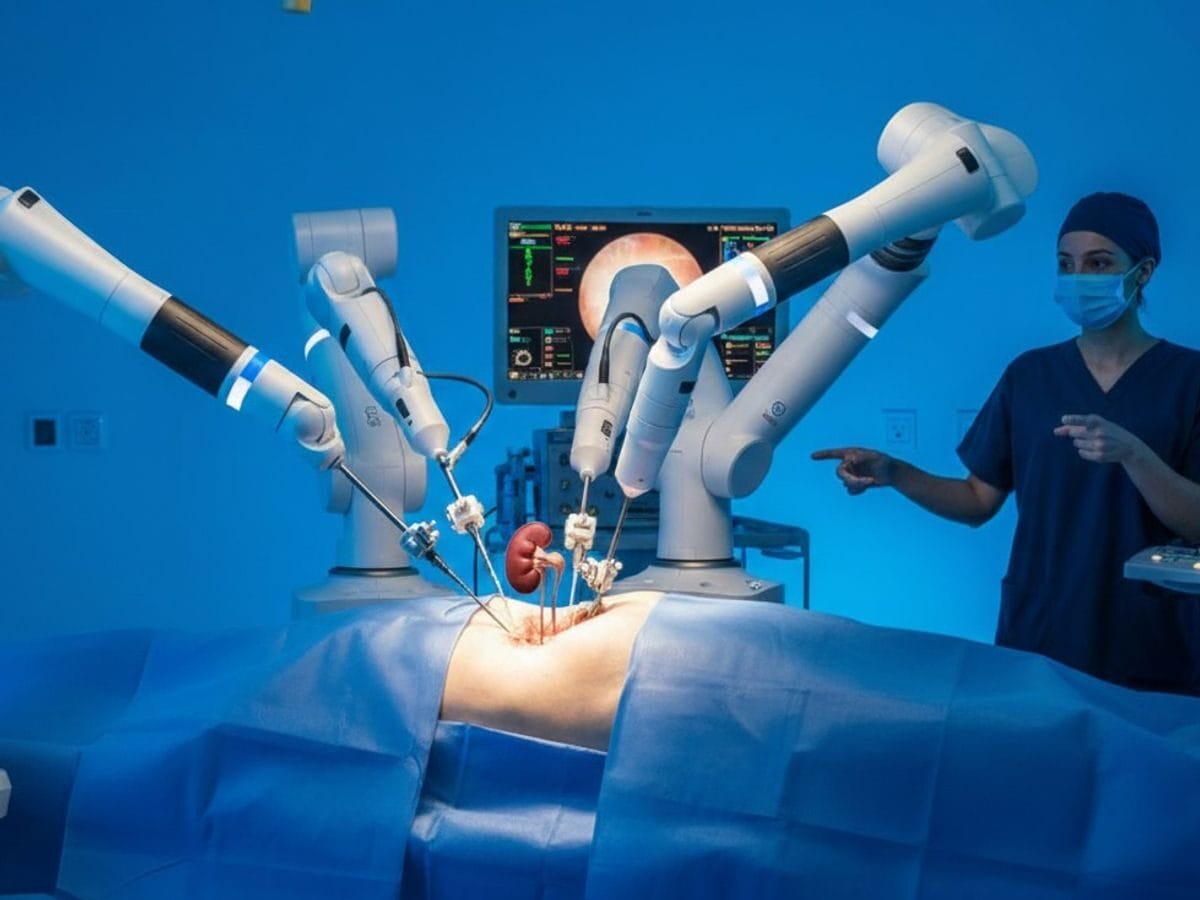
New Delhi, A 67-year-old woman underwent a ‘splenorenal bypass surgery’ with the help of a robot at a hospital in Delhi, as only one of her kidneys was functioning. The hospital claims this is the first surgery of its kind in India.
‘Splenorenal bypass surgery’ is a vascular procedure in which the splenic artery is connected to the left renal artery to restore blood flow to the kidney. This surgery is primarily performed to treat renovascular hypertension or to maintain kidney function when there is disease in the main aorta. According to Max Super Speciality Hospital in Saket, the woman from Lucknow who underwent the surgery was suffering from severe ‘renal artery stenosis’ (narrowing of the artery supplying blood to the kidney), and her blood pressure could not be controlled despite taking three ‘anti-hypertensive’ (medications used to treat high blood pressure) drugs.
According to the hospital, the woman’s right kidney had already been surgically removed, and later, severe narrowing was found in the artery supplying blood to her left kidney. The hospital stated that due to the narrowing of the artery, blood supply to the woman’s left kidney decreased, causing her blood pressure to become uncontrollable. The hospital said doctors decided to perform a ‘splenorenal bypass surgery’ on the woman, in which her splenic artery (the artery supplying blood to the spleen) was connected to the renal artery (the artery carrying oxygenated blood directly from the abdominal aorta to the kidney) to bypass the blocked portion and restore blood supply to the kidney.
Rapid improvement in the woman’s health after surgery
According to the hospital, this complex surgery was performed under the leadership of the Chairman of the Department of Urology, Kidney Transplant, Robotics, and Uro-Oncology at the hospital. The hospital said the decision to use a robot enabled the team of doctors to connect the arteries with minimal incisions and greater precision.
According to the hospital, the woman’s condition improved rapidly after the surgery. Not only was she able to walk and move around from the next day, but her blood pressure also remained remarkably controlled. It stated that post-surgery tests confirmed smooth blood flow in the woman’s kidney. The Chairman said, “‘Renal artery stenosis’ can be particularly challenging when it affects a single functioning kidney, as prolonged disruption of blood supply can cause irreversible damage to the patient’s kidney and lead to severe uncontrolled hypertension.”