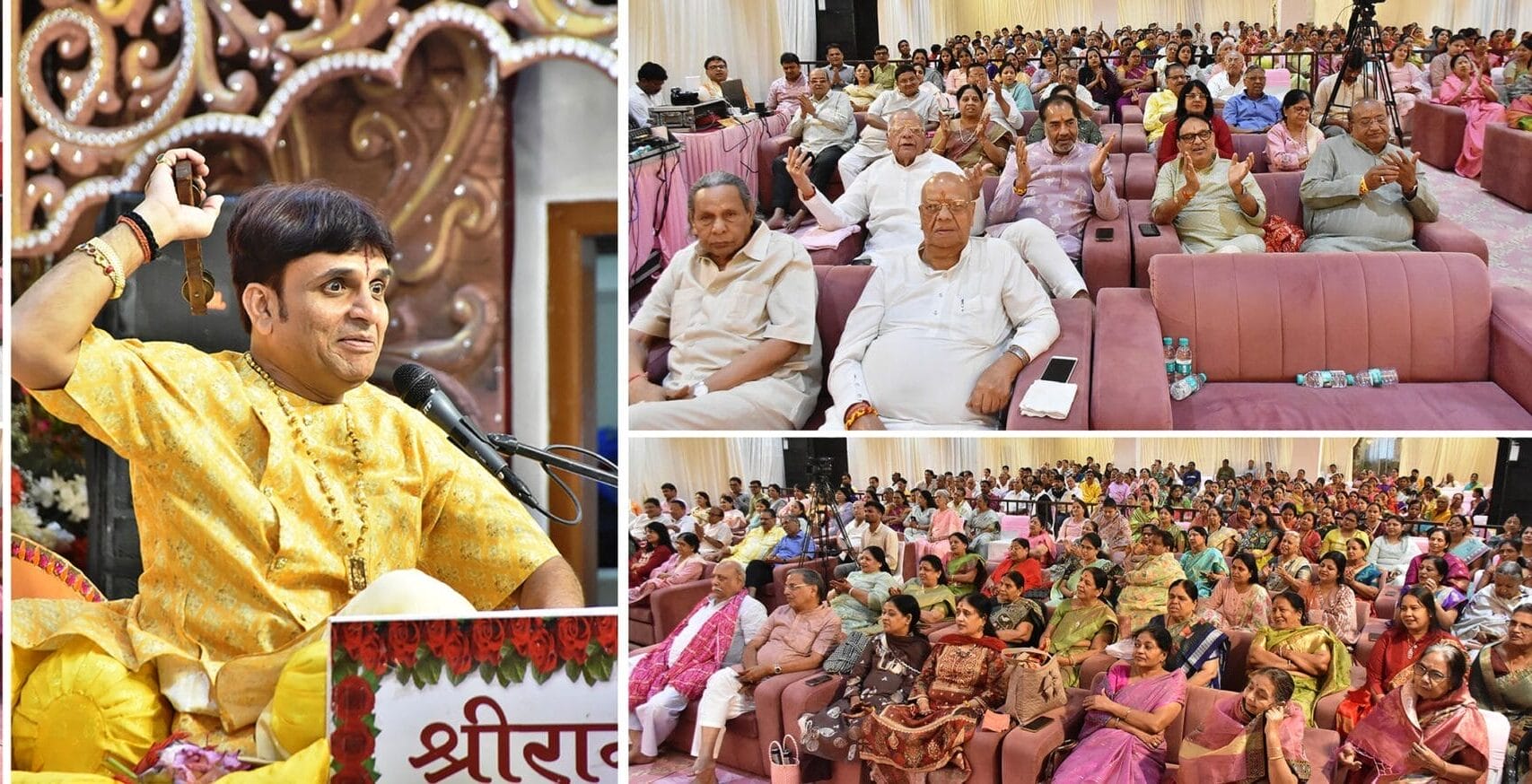
Hyderabad, The establishment of Ram Rajya is not an external state. It is first and foremost an internal state. A living being must establish Ram Rajya within themselves. Until Ram Rajya is established within, one cannot have the vision of Lord Rama. To realize the Lord, one must establish Ram Rajya within oneself.
At the Shri Shyam Temple, Shivdatt Rai Prahlad Rai Satsang Hall in Kachiguda, during the third day of the Shri Ram Katha organized by Shri Bhagwat Seva Samiti, Hyderabad-Secunderabad, in the month of Purushottam, the storyteller Dr. Srinivas Sharma (Shriji), from Kolkata, expressed these sentiments while narrating the Katha.
Maharaj further said that the Supreme Soul resides within all of us, but we seek Him through arguments. Due to arguments, our emotions and nature change, leading to ill feelings towards the Lord. Therefore, the Supreme Soul should not be experienced through the intellect, but through the heart. There are only two paths in life. One is desire and the other is devotion. It depends on us which path we choose. As we choose our path, so does our future and mental state become.
The Story of Vibhishana and Sugriva’s Salvation
Dr. Srinivas Sharma further said that among all the characters in the Ramayana, the most benevolent is Lord Hanuman. By following his advice, Vibhishana and Sugriva attained salvation. Bajrang Bali not only removes obstacles but also connects the living being to the Lord’s feet. Therefore, his character is considered the most redeeming in the Ramayana. Maharaj said that we should never be proud in life.
The Ramayana describes that whoever was proud did not benefit. If we wish to establish Ram Rajya within ourselves, we must nurture good wisdom within us. Good wisdom is the key that leads our life on the path of devotion.
No One Could Move Shiva’s Bow
Describing the breaking of the bow in subsequent episodes, Maharaj said that all the kings who came to the swayamvara tested their strength, but no one could move Shiva’s bow even a fraction. Distressed by this, King Janak said that it seems the earth has become devoid of heroes. Then, at the command of Guru Vishwamitra, Rama rose with humility and broke the bow in an instant. As the bow broke, flowers rained from the sky.
Sita stepped forward and placed the victory garland around Lord Rama’s neck. Describing the conversation with Parashurama, he said that seeing Shiva’s bow broken, Parashurama lost his composure and thundered, asking who had broken the bow. Lord Rama, with great calmness and humility, said, “O Lord, the one who broke Shiva’s bow is but your servant.” After this, all of Parashurama’s pride and anger vanished. This episode teaches us that where there is a clash of aggression and anger, only the wisdom in the form of Lord Rama can bring peace.
Shri Shyam Temple, also known as Khatu Shyam Temple, is a prominent Hindu pilgrimage site located in Khatu, Rajasthan, dedicated to Lord Krishna as the deity Shyam. According to legend, the temple houses the head of Barbarika, a warrior from the Mahabharata epic who was blessed by Krishna, and the current structure was built in the 11th century with later expansions. It is a major center of devotion for followers of the Khatu Shyam tradition, attracting millions of pilgrims annually, especially during the Phalgun Mela festival.
Kachiguda
Kachiguda is a historic neighborhood in Hyderabad, India, named after the Kachegoda (or Kachiguda) railway station, which was built in 1916 during the Nizam era and serves as a major junction. The area was originally a village that developed around the railway line, becoming a key commercial and residential hub. Today, it is known for its bustling markets, landmarks like the Kachiguda Clock Tower, and its blend of colonial-era architecture with modern urban life.
Hyderabad
Hyderabad is a major city in southern India, known for its rich history as the capital of the Nizams, a former princely state. Founded in 1591 by Muhammad Quli Qutb Shah, it features iconic landmarks like the Charminar and Golconda Fort, blending Indo-Islamic architecture. Today, it is a thriving tech and cultural hub, famously nicknamed “Cyberabad” for its booming IT industry.
Secunderabad
Secunderabad is a major twin city of Hyderabad in Telangana, India, originally founded as a British cantonment in 1806 after the Treaty of Bassein. It was named after Sikandar Jah, the third Nizam of Hyderabad, and served as a key military base for the British Indian Army. Today, it remains an important commercial and railway hub, known for its colonial-era architecture and vibrant cultural diversity.
Kolkata
Kolkata, formerly known as Calcutta, is the capital of the Indian state of West Bengal and served as the capital of British India until 1911. Founded in 1690 by the British East India Company, it grew into a major colonial port and cultural hub, becoming a center for Indian literature, art, and the independence movement. Today, it is renowned for its vibrant festivals, colonial architecture, and rich intellectual heritage.
Ramayana
The Ramayana is an ancient Indian epic attributed to the sage Valmiki, dating back to around the 5th to 4th century BCE. It narrates the story of Prince Rama’s quest to rescue his wife Sita from the demon king Ravana, exploring themes of duty, loyalty, and righteousness. The epic has profoundly influenced the culture, art, and literature of South and Southeast Asia for millennia.
Shiva’s bow
Shiva’s bow is a powerful divine weapon from Hindu mythology, famously wielded by Lord Shiva. Its most notable appearance is in the epic Ramayana, where the bow was broken by Prince Rama during King Janaka’s contest to win Sita’s hand in marriage, an event that demonstrated Rama’s divine strength. This act is considered a pivotal moment in the epic, leading to the union of Rama and Sita.
Guru Vishwamitra
Guru Vishwamitra is a revered sage in Hindu tradition, known for his transformation from a powerful king into a great rishi (seer) through intense penance. According to ancient scriptures like the Ramayana and Puranas, he played a key role in guiding Lord Rama and composing the sacred Gayatri Mantra. His story highlights themes of perseverance, spiritual evolution, and the power of self-discipline.