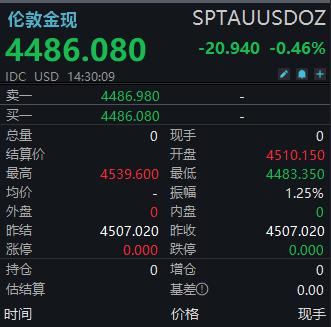
Spot gold prices fell during Asian trading hours on May 27. As of 14:30, the spot gold price had dropped to $4,486 per ounce.
Compared to the historical high of nearly $5,600 per ounce in January of this year, current international gold prices have fallen by about 20%.
Since mid-May, the fluctuation range of spot gold prices has narrowed significantly, basically fluctuating in the $4,500-$4,700 per ounce range. With gold prices consolidating, multiple international investment banks have recently lowered their gold price forecasts.
JPMorgan Chase has lowered its average gold price forecast for this year from $5,708 per ounce to $5,243 per ounce. Morgan Stanley has lowered its target price for the second half of the year from $5,700 per ounce to $5,200 per ounce. Citigroup, while remaining optimistic about the medium-term market, is bearish on the short-term outlook for gold prices, expecting a target price of only $4,300 per ounce over the next three months.
A senior deputy director of research and development at a financial rating agency stated that short-term gold prices will continue to maintain a narrow range consolidation pattern, with low probability of both upward breakthroughs and deep corrections. The main reason is that current bullish and bearish factors have entered a stage of temporary equilibrium.
Although the United States and Iran are close to reaching a peace agreement, military operations have not completely stopped, maintaining a game pattern of “fighting while negotiating.”
“This leaves uncertainty about navigation through the Strait of Hormuz, and the bottom support for energy prices remains.” The official also noted that the hawkish policy expectations of the Federal Reserve are basically solidified, with almost zero expectation of interest rate cuts within the year, driving the 10-year U.S. Treasury yield to maintain a high level. This means the opportunity cost of holding gold continues to rise, also putting pressure on gold prices.
Additionally, according to the official, after gold prices fell to around $4,500 per ounce, the willingness of medium- and long-term allocation funds to enter the market on dips has increased, providing bottom support for gold prices.
Short-term volatility does not mean a long-term decline. In the official’s view, the core logic supporting the rise in gold prices has not fundamentally reversed. In the medium to long term, gold prices are still on a clear upward track.
An analyst from a futures research institute also holds a bullish view on the long-term price of gold. In their view, the decline in U.S. consumer inflation leading to expectations of Federal Reserve interest rate cuts, the continuous increase in outstanding public debt of major global countries including the United States, and the continued increase in gold holdings by multiple central banks will become potential catalysts for a rise in international gold prices.
So, is there a chance for gold prices to break through the historical high of $5,600 within the year?
The official believes this possibility still exists, but not under the baseline scenario.
“To break through $5,600 per ounce means that on the current high basis, there needs to be further significant increase, usually requiring a confluence of multiple bullish factors, rather than being driven by a single factor.” The official stated that this includes a substantial shift in the Federal Reserve’s monetary policy, the realization of U.S. fiscal risks, an unexpected escalation of the U.S.-Iran conflict, and an unexpected increase in global central bank gold purchases.
The official further emphasized that if only some of these factors appear, gold prices are more likely to tend to fluctuate upward in a high range; if multiple factors converge, $5,600 per ounce is not impossible.
Currently, gold prices have fallen below $4,500 per ounce. Is this an opportunity to enter the market?
The official suggested that investors can formulate differentiated strategies based on their own capital attributes and risk preferences.
For short-term trading funds, they can engage in range-bound operations around the core fluctuation range of $4,500-$4,700 per ounce, strictly implementing position management and stop-loss and take-profit levels. When gold prices fall to around $4,500 per ounce, they can build long positions, and when they rebound to around $4,700 per ounce, they can take profits and exit. However, they need to be wary of the risk of range breakouts caused by unexpected events and avoid blindly chasing rises and selling off declines.
The analyst suggested that short-term investors can conduct short-term buying and selling operations through commercial banks or the Shanghai Futures Exchange, based on