Take refuge in Shrimad Bhagavata for everlasting happiness.
Hyderabad: To attain true joy in life, one must seek refuge in the Shrimad Bhagavat. The pleasures of the world are fleeting, but the bliss of the Katha lasts forever.
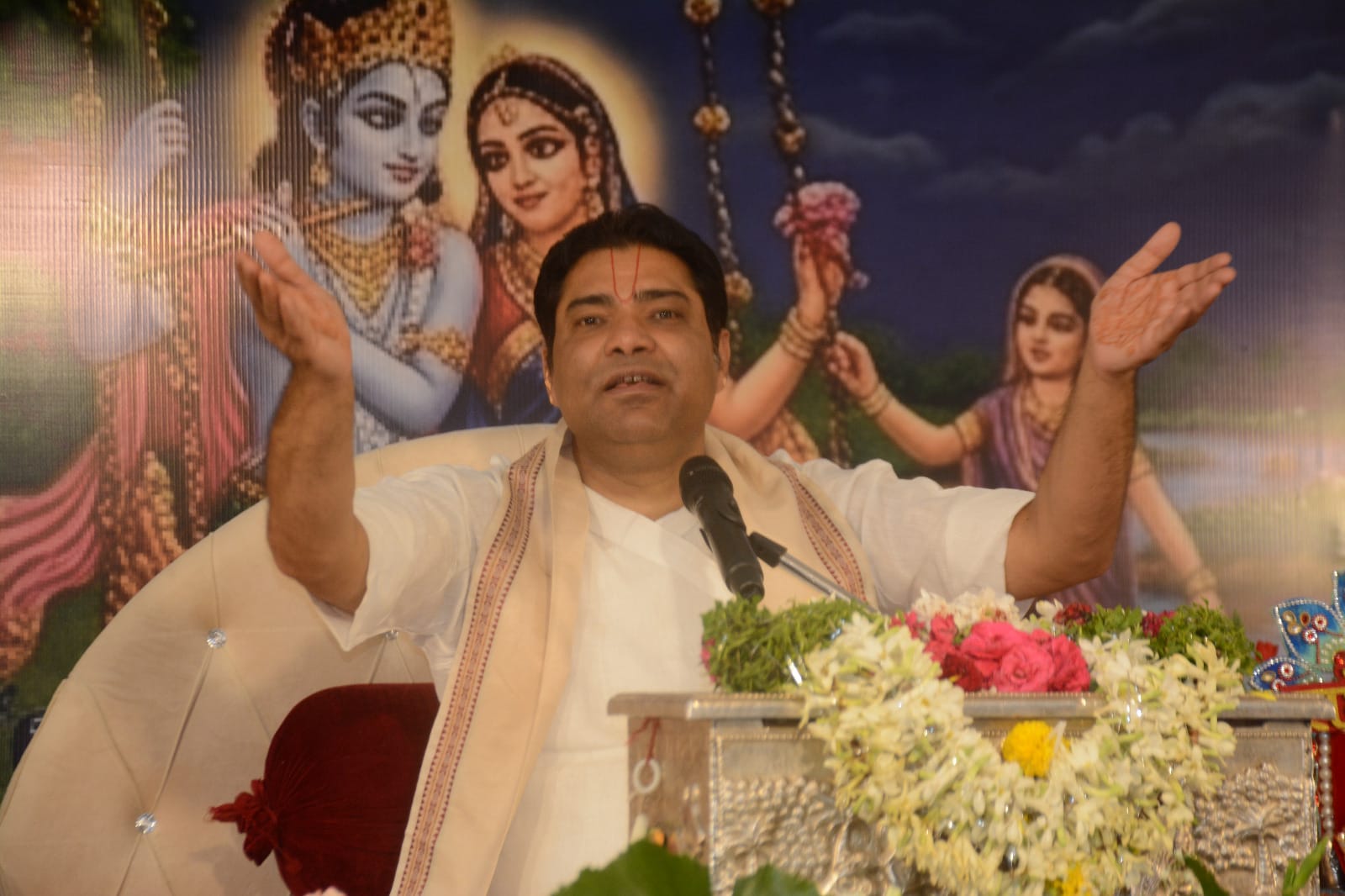
These words were expressed by the storyteller Rasia Baba, while explaining the significance of the Shrimad Bhagavat Katha on its first day, organized by the Satkarma Seva Mission, Hyderabad, at the Haryana Bhavan in Secunderabad during the Purushottam month. Baba said that the mission that performs good deeds is an institution of virtuous actions, a mission council. When people come together to help the poor, celebrate the festival of Thakurji, undertake pilgrimages, joyfully observe the swings of Sawan, and celebrate the festival of Radha Krishna, that is true good deed (satkarma).
According to the scriptures, satkarma means the scripture we sit down to listen to is known as the Shrimad Bhagavat Mahapurana. Just as a person has two names—one for society and another for home. The name commonly used among people is for everyone, but the name of endearment is given by parents or close relatives. Similarly, Shrimad Bhagavat Mahapurana is one name, while its other dear name is satkarma.
Rasia Baba said that the verses describing the glory of the Shrimad Bhagavat Katha are mentioned in two Puranas: the Padma Purana and the Skanda Purana. According to the Padma Purana, when Narada was wandering, he saw Bhakti Maharani, who was youthful, but with her were two elderly figures. When Narada asked about them, Bhakti Maharani explained that these two were her sons, Jnana (Knowledge) and Vairagya (Detachment), who were in a state of unconsciousness. She was trying to revive them.
Consciousness not awakened even after Veda-Purana knowledge
Narada imparted the knowledge of the Vedas, Puranas, and Upanishads to both, but they did not regain consciousness. Then a celestial voice said to have them listen to the Shrimad Bhagavat Katha. Thus, through listening to the Shrimad Bhagavat Katha, Jnana and Vairagya became youthful. The glory of the Shrimad Bhagavat Katha is that it transforms the unconscious into the conscious. Rasia Baba said that by striving to incorporate the Bhagavat into one’s life, the Lord manifests in the heart. Therefore, if one listens to the Katha with a sincere mind, it will certainly lead to the welfare of one’s life.
The more sincerely one listens to the Katha, the sooner one will approach the Lord. The Katha alone brings the devotee close to the Lord. The Katha is not a means of entertainment, but food for the soul, which every devotee should partake. The joy of the world is only momentary, but the bliss of the Katha lasts forever, and such divine joy cannot be found elsewhere.
Read also…
On the occasion, chief patrons Gopu Bihani, Jogiram-Manju Agarwal, Raunak Dhanania, Archana-Ramkishore Jhanwar, Bina Suresh Tandon, the Dhanuka family, daily patrons Kavita Dinesh Gupta, Archana Ramkishore Jhanwar, Bharati Dhaval Damani, Babita Praveen Dhanuka, and others provided their support.
<
Shrimad Bhagavat
“Shrimad Bhagavat,” also known as the Bhagavata Purana, is a revered Hindu scripture composed in Sanskrit around the 9th to 10th century CE. It primarily narrates the life and divine exploits of Lord Krishna, emphasizing devotion (bhakti) as the path to spiritual liberation. The text is considered a cornerstone of Vaishnavism and has deeply influenced Indian culture, art, and philosophy.
Haryana Bhavan
Haryana Bhavan is the official state guest house and liaison office for the Indian state of Haryana, located in New Delhi. It serves as a hub for government officials and visitors from Haryana, providing accommodation and facilitating administrative work. The building reflects the cultural identity of Haryana and plays a key role in state-center relations since its establishment.
Secunderabad
Secunderabad is a major city in the Indian state of Telangana, located adjacent to its twin city, Hyderabad. Founded in 1806 as a British cantonment, it was named after Sikandar Jah, the third Nizam of Hyderabad, and served as a key military base during the British Raj. Today, it is known for its colonial-era architecture, bustling markets, and as a commercial and railway hub.
Padma Purana
The Padma Purana is one of the major eighteen Puranas in Hindu literature, named after the lotus (padma) which is associated with the creator god Brahma. It is traditionally divided into five sections, covering cosmology, mythology, and the importance of sacred places and rituals. The text is believed to have been composed between the 4th and 15th centuries CE, with later additions, and it emphasizes devotion (bhakti) to the god Vishnu.
Skanda Purana
The Skanda Purana is one of the eighteen major Puranas in Hinduism, dedicated primarily to the god Kartikeya (also known as Skanda or Murugan). Its composition is believed to date from the 4th to the 15th centuries CE, containing a vast collection of legends, cosmology, and pilgrimage guides, particularly focusing on sacred sites in India. The text is notable for its encyclopedic scope, blending mythology with detailed descriptions of temples and religious practices.
Vedas
The Vedas are a large body of ancient sacred texts originating in the Indian subcontinent, composed in Vedic Sanskrit around 1500–500 BCE. They are the foundational scriptures of Hinduism, consisting of four main collections—Rigveda, Samaveda, Yajurveda, and Atharvaveda—containing hymns, rituals, and philosophical teachings. Passed down through oral tradition for centuries, the Vedas profoundly influenced Indian culture, religion, and later philosophical schools like the Upanishads.
Puranas
The Puranas are a genre of ancient Indian literature consisting of mythological stories, legends, and religious teachings. Composed primarily in Sanskrit between the 3rd and 16th centuries CE, they serve as important texts in Hinduism, detailing the histories of the universe, gods, kings, and sages. Their name means “ancient” or “old,” and they are considered key sources for understanding Hindu cosmology and cultural traditions.
Upanishads
The Upanishads are a collection of ancient Indian philosophical texts that form the theoretical basis for Hinduism, composed between 800 and 200 BCE. They explore profound concepts such as the nature of ultimate reality (Brahman), the individual self (Atman), and the path to spiritual liberation (Moksha). As the concluding part of the Vedas, they mark a shift from ritualistic practices to introspective meditation and metaphysical inquiry.