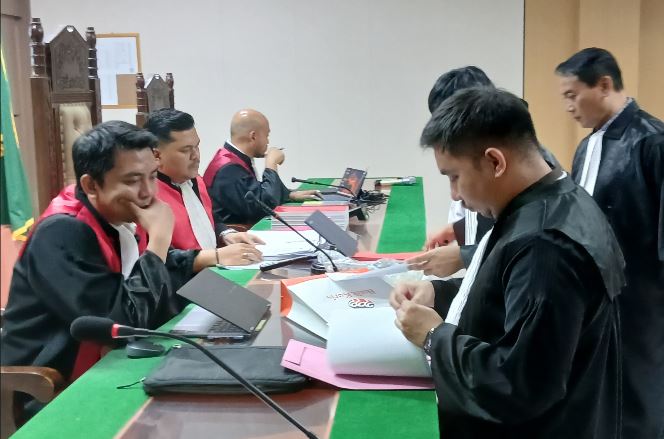
INDRAMAYU- The Indramayu District Court continued the trial of the tragic murder case that killed a family of five in Paoman Village, Indramayu, on Monday (25/5).
This trial session became a crucial turning point after the Public Prosecutor presented several new pieces of evidence and brought witnesses from the investigation team and the Indonesian Automatic Fingerprint Identification System (INAFIS) of the National Police.
Before the panel of judges, Prosecutor Yudi submitted and played digital evidence in the form of CCTV footage taken from three strategic points around the crime scene.
These three points included the workshop area next to the victims’ shop, the area of the house to the right of the crime scene, and the area near a photocopy shop. In addition to the visual recordings, the prosecutor also presented physical evidence in the form of a hammer strongly suspected to have been used to execute the victims, a video of the hammer’s discovery in the field, and the results of a digital forensic examination of the defendant’s mobile phone.
Investigation witness Prasetyo explained in court that the CCTV footage chronologically recorded the activities of the defendants, starting on Thursday night, August 28, 2025. In the footage, two defendants, Ririn Rifanto and Priyo, were seen approaching the home of a victim named Budi.
Shortly after, Budi was seen walking to the shop with Ririn, followed by Priyo who was riding a motorcycle. Several hours later, the surveillance cameras only captured Ririn and Priyo returning from the direction of the shop without the victim Budi.
The investigator also revealed shocking recordings from the same night, where the two defendants briefly took out the victim’s pickup truck, which was strongly suspected to be used for moving the body. However, the plan was abandoned, and the vehicle was put back into the garage. The pickup truck only left the garage area and stopped in front of the victim’s shop the following night, Friday, August 29, 2025, to transport Budi’s body.
Trial facts from the testimony of the INAFIS team also clarified technical details in the field, where the hammer evidence was found by officers lying about 50 meters from the murder location.
All the CCTV visualizations and the discovery of this evidence were considered consistent with the statements given by defendant Priyo during the investigation process. The investigation team also asserted before the judges that the process of creating the investigation report was conducted purely without any pressure, intimidation, or physical violence against the defendants.
Through this confrontation of digital evidence, the mystery of the use of a tarpaulin during the murder was finally clearly revealed. Furthermore, the investigator’s testimony in the official court session refuted wild speculation regarding the involvement of other parties.
The police authority confirmed that in the initial investigation report, there was never any mention of the names or existence of four other suspects, thus this narrative was confirmed to be invalid and purely a fabrication from defendant Ririn just before the first trial.
On the other hand, Priyo’s legal counsel, Ruslandi, assessed that the playback of the CCTV footage actually strengthened his client’s position. Ruslandi asserted that the visuals proved the murder was indeed committed by only two people and emphasized that Ririn was the main executor, while Priyo only acted as an assistant under pressure.
Priyo strongly denied Ririn’s accusations that he participated in the beatings or was involved in the heinous act of drowning the victim’s baby in a bathtub. The legal counsel claimed that all violent acts were purely committed by Ririn.
This premeditated murder case previously shocked the public after five family members were found dead and decomposing in their home at Jalan Siliwangi Number 52, Paoman Village, Indramayu, on Monday, September 1, 2025.
The victims were H Sahroni (75), Budi (45), Euis (40), RK (7), and an eight-month-old baby with the initial B. The two perpetrators were finally arrested by police in Kedokan Bunder District on September 8, 2025, with the motive being resentment over a car rental fee of Rp750,000. The trial will continue next week to explore material evidence more deeply.