Bandung –
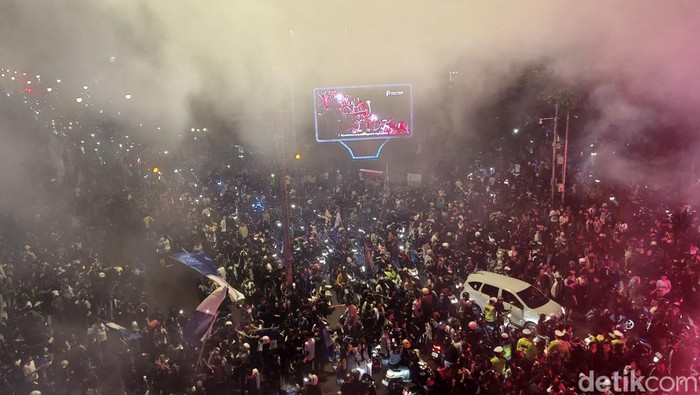
The Environmental Agency (DLH) recorded that waste after the Persib championship celebration night in Bandung City reached 7 trucks. The waste generation was estimated to reach tens of tons at that time.
The head of the Bandung City DLH, Darto, stated that after the championship celebration night, officers were immediately deployed to handle the waste generation. Since early Sunday (5/25/2026), based on field sweeps, one of the most prominent points was in the Cikapayang area, which became a gathering point for bobotoh.
“Around 5:30 AM local time, in the Cikapayang area alone, six sacks of bottle waste were found. This is an anomaly because the amount is quite large,” said Darto.
The dominant types of waste were plastic bottles and food packaging. However, officers also found other concerning types of waste, such as used flares and pieces of firecrackers.
“We collected three large sacks of used flares just in Cikapayang. Not to mention the leftover firecrackers scattered around,” he said.
Similar conditions were also found on several main roads traversed by the convoy. Such as on Jalan Ir. H. Djuanda (Dago), Pasupati Flyover, and the area around Gedung Sate towards Sukajadi.
“Along Pasupati from Gedung Sate towards Sukajadi, it was very dirty. Meanwhile, towards Pasteur, it was relatively cleaner,” he revealed.
To handle this condition, the DLH deployed 69 sweeping officers who started working from 4:00 AM local time. The cleaning was also supported by a fleet consisting of two garbage motorcycles, five pickup trucks, one truck, and one compactor truck.
However, he admitted that the cleaning process did not run optimally. Darto explained that the movement of officers was often hindered by the large number of people still staying at the location until the morning.
“When the crowd was still gathered, we had difficulty moving. For example, in Cikapayang, even in the morning, many had not dispersed,” he explained.
The DLH recorded six main points of crowd accumulation that contributed to the high volume of waste. These points include the Pendopo area, Cikapayang, Pasupati Flyover, Gedung Sate, Islamic Center (Pusdai), the Graha Persib and Taman Radio area, and along Jalan Dago.
Based on a temporary estimate, the volume of waste generated from one day of convoy activities reached about seven trucks. This amount has the potential to increase as the series of celebrations continues.
The DLH adjusted cleaning efforts according to field conditions. Maximum cleaning could only be carried out after the crowds began to thin out.
“We estimate the crowd will only start moving around 3:00 PM local time. After that, cleaning can be more optimal,” he said.
Darto urged the bobotoh to maintain cleanliness while celebrating the victory of their pride team. He highlighted the habit of discarding and breaking bottles, which worsened the waste condition. He hopes the euphoria of Persib’s victory will be accompanied by awareness of environmental preservation so that Bandung City remains clean and comfortable for all residents.
“Feel free to celebrate the victory, but don’t break bottles. Whole bottles are already difficult to handle, let alone broken ones, because they have to be picked up one by one,” he concluded.
Cikapayang
Cikapayang is a historic area in Bandung, Indonesia, best known for its traditional market, Pasar Cikapayang, which has been a bustling hub of local commerce for decades. The name “Cikapayang” is derived from the Sundanese words “ci” (water) and “kapayang” (a type of tree), reflecting the area’s past as a riverside settlement surrounded by kapayang trees. Today, it remains a vibrant cultural site where visitors can experience authentic Sundanese cuisine and daily life.
Jalan Ir. H. Djuanda (Dago)
Jalan Ir. H. Djuanda, commonly known as Dago, is a historic and iconic street in Bandung, Indonesia. Originally developed during the Dutch colonial era, it was a favored residential area for wealthy plantation owners and officials, featuring grand Art Deco and Indo-European style villas. Today, Dago is a bustling commercial and cultural hub, known for its mix of heritage buildings, trendy cafes, restaurants, and shops, while still retaining its colonial-era charm.
Pasupati Flyover
The Pasupati Flyover is a major elevated roadway in Kathmandu, Nepal, that connects key areas of the city, including the Ring Road and the vicinity of the Pashupatinath Temple, from which it derives its name. Officially opened in 2017, it was built to alleviate chronic traffic congestion in the capital, significantly reducing travel time across the city. The flyover is named after the nearby sacred Hindu temple complex, reflecting its location in a culturally and historically significant area.
Gedung Sate
Gedung Sate is a historic building in Bandung, Indonesia, known for its distinctive satay-like ornament on its rooftop. Constructed between 1920 and 1924 under Dutch colonial rule, it originally served as the headquarters for the Department of Government Enterprises. Today, it stands as the seat of the West Java provincial government and is a prominent architectural landmark.
Sukajadi
Sukajadi is a district in Bandung, West Java, Indonesia, known for its blend of residential areas, shopping centers, and cultural landmarks. Its history traces back to the colonial era, when it developed as a suburban area for Dutch officials, featuring classic architecture and tree-lined streets. Today, Sukajadi remains a vibrant part of Bandung, hosting attractions like the Cihampelas Walk and the historic Villa Isola.
Pasteur
Pasteur refers to the Pasteur Institute, a renowned private, non-profit research center founded in 1887 by Louis Pasteur in Paris, France. Established to advance the study of infectious diseases and microbiology, it has played a pivotal role in developing vaccines, including the first rabies vaccine. Today, the institute continues to be a global leader in biomedical research, public health, and disease prevention.
Islamic Center (Pusdai)
The Islamic Center (Pusdai) in Bandung, Indonesia, is a prominent mosque and cultural complex established in the 1970s. It was built as a symbol of Islamic unity and development, funded by the Indonesian government and public donations. The center serves as a hub for religious activities, education, and community events, reflecting the region’s deep Islamic heritage.
Taman Radio
Taman Radio is a public park in Jakarta, Indonesia, that was built on the site of a former radio station during the Dutch colonial era. The area was originally part of the Buitenzorg (Bogor) radio communication network, established in the early 20th century. Today, it serves as a green space for recreation and community activities, preserving a small piece of the city’s broadcasting history.