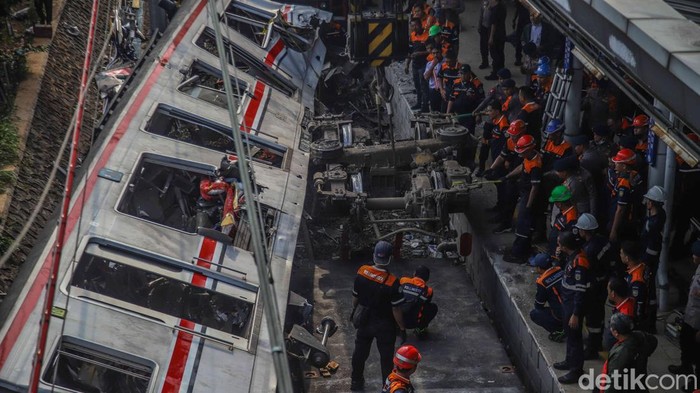
Jakarta – The Chairman of the National Transportation Safety Committee (KNKT), Soerjanto Tjahjono, stated that his team is still investigating the cause of the collision between the Argo Bromo Anggrek long-distance train and the KRL in East Bekasi. The investigation results are expected within 2 to 3 months.
“We hope that if everything goes smoothly, it will take about 2 to 3 months,” said Soerjanto at the parliamentary complex in Senayan, Jakarta, on Thursday (21/5/2026).
“Yes, hopefully we can draw a conclusion,” he continued.
On the same occasion, Soerjanto also explained the moments before the Argo Bromo Anggrek train hit the KRL at East Bekasi Station. KNKT stated that the train operations control center (Pusdal) in Manggarai had asked the Argo Bromo train driver to brake gradually before the accident occurred.
“I mentioned earlier that from a distance of 1,300 meters, after receiving news of an obstacle ahead, the driver had already applied the brakes. However, because the control center did not know the actual situation—since communication was only via voice—they were unaware of the field conditions,” he explained.
Soerjanto noted that the Pusdal in Manggarai instructed the driver to brake gradually and sound whistle signal 35 (horn). The Argo Bromo driver followed these instructions.
“They only informed that there was an obstacle ahead, to brake gradually, and to frequently sound whistle signal 35. That was all that was conveyed, so the driver responded to what the operations controller in Manggarai had said,” he revealed.
KNKT is still investigating the cause of the collision between the Argo Bromo Anggrek train and the KRL. Soerjanto stated that the Pusdal in Manggarai asked the driver to brake gradually based on positive assumptions.
Stasiun Bekasi Timur
Stasiun Bekasi Timur is a railway station located in Bekasi, West Java, Indonesia, serving as a key stop on the Jakarta Commuter Line’s Blue Line. Built as part of efforts to expand commuter rail services in the greater Jakarta area, the station began operations in the 2010s to accommodate the city’s growing population and improve connectivity between Bekasi and Jakarta. Its establishment reflects the ongoing development of Bekasi as a suburban hub, though it lacks the deep historical roots of older Indonesian stations.
Stasiun Bekasi Timur
Stasiun Bekasi Timur is a railway station located in Bekasi, West Java, Indonesia. It was opened in 2012 as part of the expansion of the KRL Commuterline network, serving the growing population in the eastern part of Bekasi. The station helps connect residents to Jakarta and surrounding areas, improving daily commutes and regional transportation.
Stasiun Bekasi Timur
Stasiun Bekasi Timur (East Bekasi Station) is a railway station in Bekasi, West Java, Indonesia, serving the commuter line network in the Greater Jakarta area. Originally built as part of the expansion of railway services to accommodate the city’s rapid urbanization, it plays a key role in connecting eastern Bekasi residents to Jakarta and surrounding areas. The station reflects the region’s development from a suburban area into a densely populated satellite city.
Senayan
Senayan is a district in Central Jakarta, Indonesia, best known for the Gelora Bung Karno sports complex, which was built in the early 1960s to host the 1962 Asian Games. The area was originally a swampy area transformed under President Sukarno’s vision, and it now serves as a major hub for sports, entertainment, and cultural events. Today, Senayan is also a prominent business and commercial district, home to shopping malls, offices, and the MRT station.
Manggarai
Manggarai is both a bustling district in South Jakarta, Indonesia, and a traditional region on the island of Flores in East Nusa Tenggara. In Jakarta, it is known for the historic Manggarai Railway Station, built in the early 20th century during the Dutch colonial era, which serves as a major transportation hub. Meanwhile, the Flores region of Manggarai is culturally significant for its unique traditional villages, such as Wae Rebo, and the distinct Manggarai language and customs.