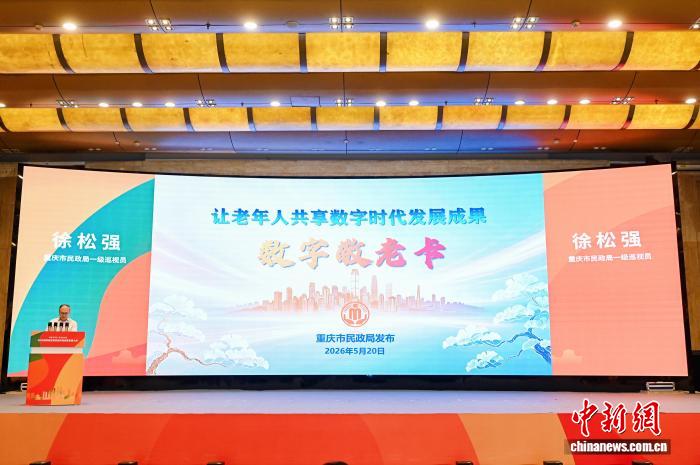
On May 20, the 2026 Western Region Silver Economy High-Quality Development Conference was held in Chongqing. At the conference, the launch of the “Digital Senior Card” was announced. This card breaks the limitations of traditional physical cards, allowing citizens to “scan a code and enjoy worry-free elderly care,” marking a new phase in Chongqing’s smart elderly care services.
According to reports, the Digital Senior Card is the only electronic identity credential for seniors on the “Yuyue Elderly Care” application platform. Centered on digitalization, convenience, and inclusiveness, it integrates multiple functions such as identity recognition, rights certification, convenient payment, and subsidy distribution, allowing seniors to bypass complex operations and enjoy intelligent services.
Specifically, the Digital Senior Card has three core capabilities:
First, welfare subsidies are “directly accessible through one card.” Old-age allowances, elderly care service subsidies, nursing subsidies, and consumption subsidies are all directly distributed to the Digital Senior Card, ensuring accurate, efficient, and timely disbursement of funds for the elderly.
Second, identity and rights are “accessible through one code.” The Digital Senior Card will be gradually applied in 11 scenarios, including institutional care, community care, home-based care, medical services, elderly care consumption, travel-based care, and senior learning centers, continuously improving the user experience for seniors.
Third, convenient payment is “quickly made through one code.” Payment scenarios for elderly services, such as admission to care facilities and dining at community canteens, are streamlined. Scanning a code enables real-name registration, information association, and convenient payment, supporting the linkage of government subsidies, consumption vouchers, discount coupons, and personal payments. Funds are secure, consumption details are available for review at any time, and spending is more transparent.
In addition to online application channels, seniors aged 60 and above who are registered residents or live in Chongqing can apply at township (street) government service centers, village (community) convenience service centers, or elderly care service institutions. Seniors with mobility issues can also schedule home visits for application.
The launch of the Digital Senior Card is a new starting point for Chongqing’s smart elderly care services, an important measure to improve the precision and comfort of elderly care, and a vivid practice of upholding the traditional virtue of respecting and caring for the elderly while addressing their urgent needs and concerns.
Chongqing
Chongqing Civil Affairs Bureau
Yuyue Elderly Care application platform
Chongqing
Related news
Chongqing-Taiwan Industrial Collaboration Event Held in Chongqing, Expanding Cross-Strait Exchange and Cooperation in Multiple Fields
Motorcycle production in Chongqing surges 23.1% in first half of the year, showing rapid growth momentum.
Since the comprehensive administrative law enforcement reform in Chongqing’s towns and streets, related administrative law enforcement complaints and reports have dropped by over 30%.