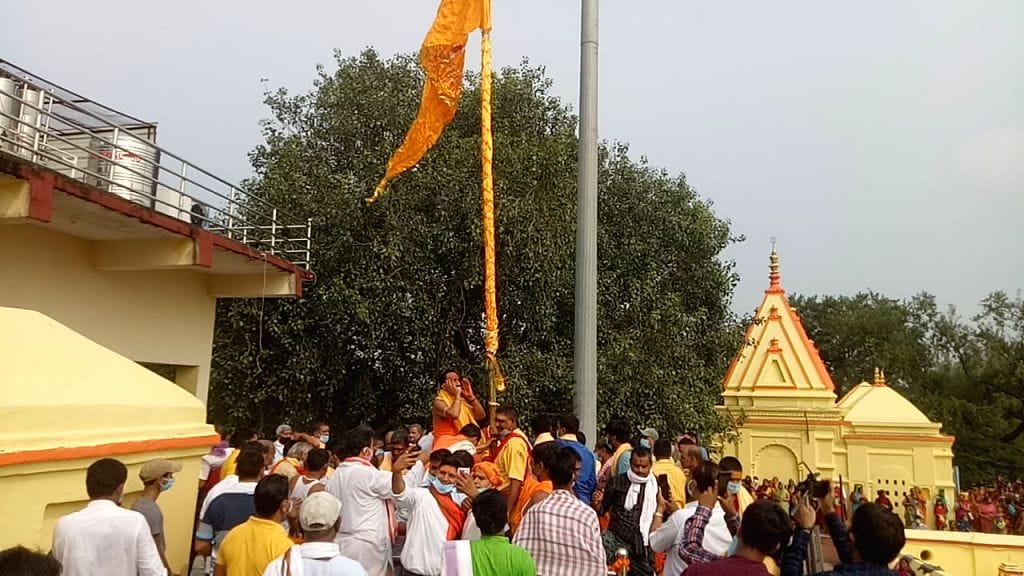
Crows are said to avoid Rajgir during the month of Malmas.
Currently, the month of Jyeshtha Adhik Maas is ongoing. During this month, it is prescribed to worship Lord Vishnu. In the Adhik Maas, a fair is organized in the Rajgir area of Bihar. It is believed that during the period of Malmas, not a single crow is seen here. According to belief, once King Vasu, the mind-born son of Lord Brahma, organized a yajna at the Brahmakund complex in Rajgir, to which he invited all 33 crore deities.
All of them arrived at the yajna, but King Vasu forgot to invite the black crow. Angered by this, the crow did not appear anywhere in Rajgir for the entire duration of Malmas. It is said that since then, to this day, not a single crow is seen in Rajgir, Bihar, during Malmas. The pond present in Rajgir also holds special significance. According to mythological stories and folk beliefs, Lord Brahma had 22 ponds and 52 water streams constructed in Rajgir for the yajna.
Religious significance of Brahmakund and Patal Ganga
It is said that during the yajna, when the deities faced difficulty bathing in a single pond, Lord Brahma had these ponds constructed. On the steps of Vaibhagiri mountain, among the temples, there are several springs whose water remains hot. Water flows here from the Saptakarni caves. Among these, Brahmakund is described as highly significant and is also called Patal Ganga. It is believed that during the Malmas fair, all 33 crore deities reside here.
At this place, Lord Vishnu is worshipped in the form of Shaligram. This is the reason why the Malmas fair is organized in Rajgir. Devotees come from far and wide to take a holy dip in the ponds of Rajgir. It is believed that bathing in these ponds of Rajgir during Malmas destroys all sins of a person. Performing acts of worship, charity, and other meritorious deeds here yields highly auspicious results.
Rajgir
Rajgir, located in Bihar, India, served as the ancient capital of the Magadha kingdom and is deeply associated with the lives of both Lord Buddha and Lord Mahavira. Historically, it was the site of the First Buddhist Council and features significant ruins, including cyclopean walls and hot springs. Today, it remains a major pilgrimage destination for Buddhists and Jains, with landmarks like the Vishwa Shanti Stupa and Griddhakuta Hill.
Brahmakund
Brahmakund is a sacred water tank located in Bithoor, Uttar Pradesh, India, deeply connected to Hindu mythology. According to legend, it was created by Lord Brahma during a yagna (sacrificial ritual) and is also associated with the epic Ramayana, where it is believed to be the site where Sita, the wife of Lord Rama, lived during her exile. Today, it remains a significant pilgrimage site, especially during the Kartik Purnima festival, when devotees bathe in its holy waters.
Patal Ganga
Patal Ganga is a sacred
Rajgir
Rajgir, located in the Indian state of Bihar, is an ancient city that served as the first capital of the Magadha kingdom and is deeply associated with both Buddhism and Jainism. It was here that Gautama Buddha spent several months meditating and delivering sermons, while Mahavira, the 24th Tirthankara of Jainism, also spent significant time in the area. The site features historic landmarks such as the Cyclopean Wall, the Venuvana monastery, and the Griddhakuta Hill (Vulture’s Peak), making it a key pilgrimage destination.
Brahmakund
Brahmakund is a sacred water tank located in Bithoor, Uttar Pradesh, India, believed to be the site where the sage Valmiki wrote the Hindu epic Ramayana. According to legend, it was also where Sita, the wife of Lord Rama, lived in exile and where her twin sons, Luv and Kush, were born. The site holds deep religious significance for Hindus and is a popular pilgrimage destination.
Patal Ganga
Patal Ganga is a sacred water body located in the ancient city of Mandu, Madhya Pradesh, India, known for its religious and historical significance. According to legend, it is believed to be a subterranean stream connected to the holy Ganges River, and its name translates to “the Ganges of the underworld.” The site features a deep, stone-lined tank and was likely used for ritual bathing and as a water source during the rule of the Malwa Sultanate in the medieval period.
Vaibhagiri mountain
Vaibhagiri Mountain, located in the Rajgir hills of Bihar, India, is a historically and spiritually significant site associated with Jainism and Buddhism. According to Jain tradition, it is believed to be the place where Lord Mahavira, the 24th Tirthankara, spent several monsoon seasons and delivered sermons to his disciples. The mountain also features ancient caves and ruins, reflecting its importance as a center for meditation and religious discourse in ancient times.
Saptakarni caves
The Saptakarni caves, located in the Nashik district of Maharashtra, India, are a group of ancient Buddhist rock-cut caves dating back to the 1st century BCE to the 3rd century CE. They are historically significant for their intricate chaitya (prayer hall) and vihara (monastery) structures, as well as inscriptions that reveal patronage from local rulers and merchants. The caves showcase early Buddhist art and architecture, serving as a key example of the region’s rich cultural and religious heritage.
Bihar
Bihar, located in eastern India, is one of the oldest inhabited places in the world with a rich history dating back to ancient kingdoms like Magadha. It was the center of powerful empires such as the Maurya and Gupta, and is the birthplace of Buddhism, where Buddha attained enlightenment in Bodh Gaya. Today, it is known for its cultural heritage, including sites like Nalanda University, a major ancient center of learning.
Magadha kingdom
The Magadha kingdom was an ancient Indian realm located in the region of present-day Bihar, flourishing from around 600 BCE. It became the most powerful state in India under rulers like Bimbisara and later the Mauryan emperor Chandragupta Maurya, who founded the first pan-Indian empire. Magadha is historically significant as the heartland of Buddhism and Jainism, with the Buddha and Mahavira both teaching extensively there.
Griddhakuta Hill
Griddhakuta Hill, also known as Vulture’s Peak, is a sacred Buddhist site located near Rajgir in Bihar, India. It is famously associated with the historical Buddha, who is said to have delivered many important teachings and sutras there, including the Lotus Sutra. The hill has been a pilgrimage destination for centuries, featuring ruins of ancient monasteries and stupas that reflect its significance in early Buddhist history.