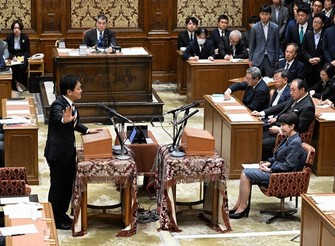
The first Diet debate between Prime Minister Sanae Takaichi and opposition party leaders since the February House of Representatives election was held on May 20. While the question time serves as an opportunity for both ruling and opposition party leaders to engage in a direct debate over the future vision and course of the nation, discussions failed to deepen.
The U.S. attack on Iran has choked crude oil shipments, sparking growing concerns among companies and consumers about the supply of petroleum-related products. A vision for overcoming Japan’s resource procurement vulnerability is essential.
However, the discussion primarily focused on immediate livelihood support. Yuichiro Tamaki, leader of the Democratic Party for the People, who was the first to speak, proposed that the government implement economic stimulus measures worth around 3 trillion yen (approx. $18.89 billion), including extending gasoline subsidies, as advocated by his party. He also spoke against any new government bond issuances in compiling a supplementary budget bill.
Takaichi, in response, did not elaborate on the scale and details of the extra budget bill. Even amid widening market concerns about Japan’s worsening public finances, she merely said of the budget’s funding sources, “I think it will be fine.”
Until mid-May, Takaichi had repeatedly stated in the Diet that she was “not thinking about” drafting a supplementary budget proposal. Yet on this day, she revealed that she had instructed bureaucrats to consider the matter ahead of the late April start of the Golden Week holidays. Junya Ogawa, head of the Centrist Reform Alliance, slammed the prime minister, saying, “That’s dishonest.”
What stood out was that each party was allotted so little speaking time, resulting in fragmented exchanges and a lack of focus on the key points of contention. Although the leaders of six opposition parties — the most since the debates began in 2000 — participated, the total time given remained unchanged at 45 minutes. Even Tamaki, who spoke the longest, was allocated only 12 minutes, resulting in just three rounds of exchanges with the prime minister.
While the Centrist Reform Alliance seeks to merge with the Constitutional Democratic Party of Japan and Komeito in the House of Councillors, they did not combine their time slots and spoke separately, giving the impression that the three parties lack unity.
The party leader deliberation was modeled after prime minister’s questions in the U.K. Parliament, where two parties tend to dominate. Initially, it was positioned as an opportunity for the prime minister and the leader of the largest opposition party to compete on their ability to govern. Since the second Shinzo Abe administration launched in 2012, however, opposition parties have become weaker and more diverse, and this trend has intensified under the Takaichi administration, now a massive ruling coalition.
It is crystal clear that going on like this will not produce truly functioning debate. Under the preceding Shigeru Ishiba administration, the ruling and opposition parties agreed to hold these debates once a month after budget passage. To ensure that these deliberations will help dispel the public’s worries about the future, the system needs to be reviewed, including extending the assigned speaking time.
Diet
House of Representatives
Diet
House of Representatives
U.K. Parliament
Related news
The mayor of Ogasawara Village has agreed to allow the national government to conduct a literature survey on “nuclear waste” at Minamitorishima.
The village mayor of Ogasawara to express views on literature survey for nuclear waste disposal site; challenges of Minamitorishima proposal.

During inspection at Tokyo Dome City, a fatal accident occurred possibly due to oil leaking from a hydraulic device on an amusement ride.
Kenichi Yoshida wins Nerima Ward election, defeating former Tokyo Metropolitan Assembly member Ojima and other Liberal Democratic Party-backed candidates.