People endure hardships while listening to Modi’s tune: Kharge
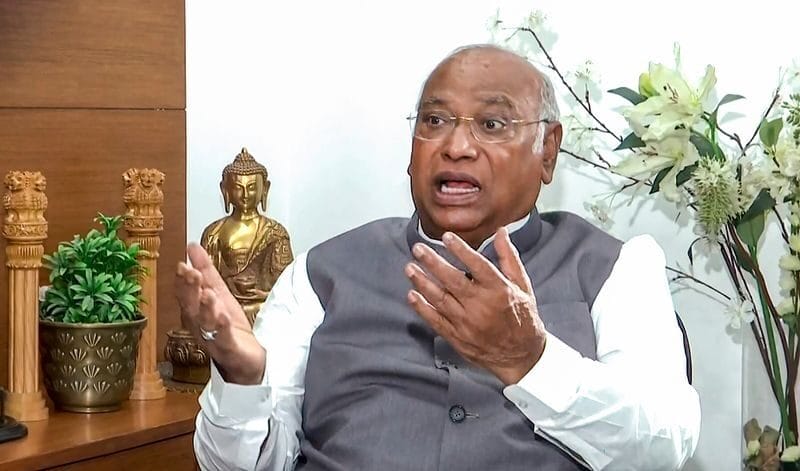
New Delhi – Congress President Mallikarjun Kharge on Wednesday took aim at Prime Minister Narendra Modi over issues such as inflation, unemployment, exam paper leaks, declining investment, and the rupee’s fall against the dollar, saying Modi continues his election campaigning while the economy faces a crisis.
The Leader of the Opposition in the Rajya Sabha also claimed that Prime Minister Modi wants the public to enjoy the “melody” of his speeches while trying to avoid the “hardship” caused by his government’s loot. Kharge posted on X that in the last 11 years under the Modi government, the average debt per Indian has increased 11 times, while the total wealth of billionaires has exceeded Rs 97.50 lakh crore.
Kharge attacks rising unemployment among youth
Kharge said that the price of domestic LPG has increased by 121 percent, rising from Rs 414 in 2014 to Rs 915.5 in 2026. He said that the price of commercial cylinders has increased by about 154 percent, now rising from Rs 1,241 to Rs 3,152. Kharge said, “With the recent fuel price hike, government oil companies earned about Rs 12,400 crore in just a few hours, while people are suffocating under the pressure of continuously rising prices.”
Alleging widespread unemployment and paper leaks under BJP rule, the Congress President said that in March 2026, youth unemployment (ages 15 to 29) rose to 15.2 percent, a nine-month high, reflecting the deepening economic crisis. He claimed, “In 10 years under BJP rule, paper leaks of 90 exams have destroyed the credibility of recruitment and ruined the future of about nine crore youth.”
New Delhi
New Delhi is the capital of India, designed and built by British architect Edwin Lutyens in the early 20th century to serve as the seat of British imperial power. It was officially inaugurated in 1931, replacing Calcutta as the capital of British India. Today, it stands as a vibrant metropolis that blends colonial-era architecture, such as the Rashtrapati Bhavan and India Gate, with the bustling energy of modern Indian life.
Rajya Sabha
The Rajya Sabha, or Council of States, is the upper house of India’s bicameral Parliament, established in 1952 under the Constitution of India. It represents the states and union territories, with members indirectly elected by state legislatures, and serves as a revising chamber for legislation. Unlike the Lok Sabha, it is a permanent body not subject to dissolution, with one-third of its members retiring every two years.
New Delhi
New Delhi is the capital of India, officially inaugurated in 1931 as the new administrative center of British India, designed by British architects Edwin Lutyens and Herbert Baker. It replaced Kolkata (then Calcutta) as the capital in 1911 and was built to the south of the historic walled city of Old Delhi, incorporating grand boulevards and imperial buildings like the Rashtrapati Bhavan and India Gate. Today, it stands as a vibrant metropolis that blends modern governance with a rich colonial and ancient heritage.
Rashtrapati Bhavan
Rashtrapati Bhavan is the official residence of the President of India, located in New Delhi. Designed by British architect Edwin Lutyens, it was originally built as the Viceroy’s House during British rule, with construction completed in 1929. After India gained independence in 1947, it became the home of India’s head of state and stands as a symbol of the nation’s democratic heritage and architectural grandeur.
India Gate
India Gate is a prominent war memorial located in New Delhi, India, built in 1931 to honor the 70,000 Indian soldiers who died in World War I and the Third Anglo-Afghan War. Designed by Sir Edwin Lutyens, it features an archway with the names of fallen soldiers inscribed on its walls. Today, it stands as a symbol of national pride and is a popular gathering spot for locals and tourists alike.
Rajya Sabha
The Rajya Sabha, or Council of States, is the upper house of India’s bicameral Parliament, established in 1952 under the Constitution of India. It represents the states and union territories, with members elected by state legislatures rather than directly by the public, ensuring federal balance. Unlike the Lok Sabha, it is a permanent body not subject to dissolution, with one-third of its members retiring every two years.