Beijing has achieved “tax refund upon purchase, refundable anywhere in the city.”
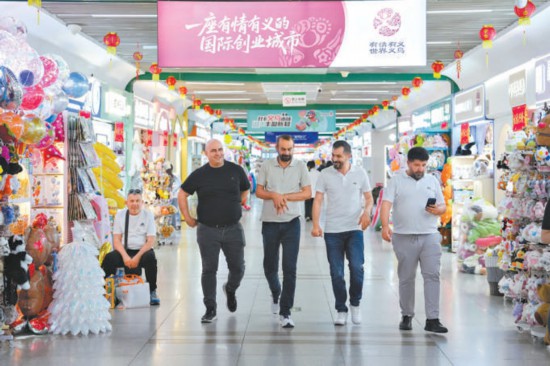
On May 15, foreign merchants selected goods at the Yiwu International Trade Market. As the 2026 World Cup in the United States, Canada, and Mexico approaches, World Cup-related products are popular in Yiwu, Zhejiang, known as the “world’s supermarket.”
Yesterday afternoon, a press conference was held to introduce measures to optimize departure tax refund policies and expand inbound consumption. In 2025, national departure tax refund sales increased by nearly double year-on-year. To date, the number of tax refund stores has reached 14,000. Beijing is building a world-class international consumption service system, pioneering the “citywide tax refund, one-stop processing” model, achieving “tax refund upon purchase, refundable anywhere in the city.”
In April 2025, six departments issued a notice to further optimize departure tax refund policies and expand inbound consumption, marking version 1.0 of the policy, which accelerated development. This year, version 2.0 was issued, proposing eight specific measures to make tax refunds more convenient, time-saving, and hassle-free for travelers.
Since version 1.0 was introduced, departure tax refund transactions have increased significantly. To improve efficiency, version 2.0 adopts international practices by conducting random inspections on refund applications under 10,000 yuan, with only selected travelers needing customs verification, greatly reducing queue times at ports. Some travelers lost paper refund forms and sales invoices, preventing refunds. To address this, version 2.0 proposes paperless refund processing. These two measures will take effect from July 1 this year.
Data shows that in 2025, national departure tax refund sales nearly doubled year-on-year, with sales in one year roughly equaling the total from 2015 to 2024. The number of travelers receiving refunds reached 270,000, a threefold increase from 2024. Currently, there are 14,000 tax refund stores, about four times the number at the end of 2024.
As the capital and international exchange center, Beijing has unique advantages in expanding inbound consumption. It is building a world-class international consumption service system, focusing on first-stop convenience to open the “first mile” of inbound consumption, pioneering innovation in departure tax refund models, and showcasing the charm of a mega-city consumption experience.
Through the “GOBEIJING” platform, Beijing launched a travel wallet function nationwide, allowing foreign visitors to order food, buy coffee, and take the subway without linking a bank card, meeting small, frequent payment needs. It also established a friendly payment system covering seven major card organizations and connecting over 200 wallets from 37 countries.
Beijing pioneered the “citywide tax refund, one-stop processing” model, achieving “tax refund upon purchase, refundable anywhere in the city,” with each transaction completed in under two minutes. In 2025, Beijing’s departure tax refund consumption increased by 66% year-on-year, and in the first quarter of this year, it grew by 50% year-on-year.
Yiwu International Trade Market
Beijing
Yiwu International Trade Market
Beijing
Forbidden City
Great Wall
Temple of Heaven
Related news

From Yujiajie Village to Beijing: A Shandong Family’s Spring Festival Journey
Today’s Tibet is thriving and full of vitality.
News tip email: 67106710@bjnews.com.cn
“Excessive Requests for Instructions” Need to Be Corrected