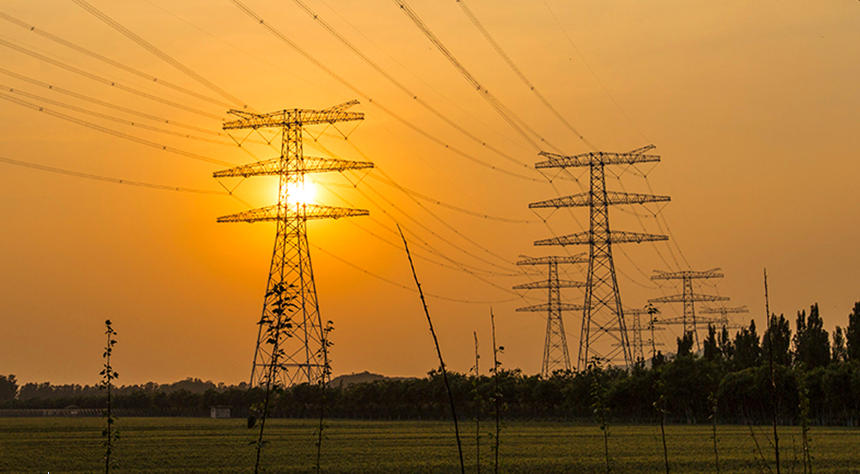
Beijing-Tianjin-Hebei power transmission corridor.
From January to April this year, the Beijing green electricity market direct trading reached 18.8 billion kilowatt-hours, an increase of 82.54% year-on-year, cumulatively reducing carbon dioxide emissions by about 15 million tons. In the first four months of this year, green electricity accounted for 63.63% of the total volume of direct market electricity trading, surpassing thermal power trading for the first time.
Since the beginning of this year, the capital’s power trading center has continuously optimized the green electricity trading mechanism, expanded the scale of green electricity users, enhanced trading flexibility, and consistently broadened market-based green electricity supply channels while optimizing the supply structure. Market-based green electricity cross-provincial and cross-regional trading accounted for approximately 99.97%, consuming wind and solar green electricity from regions such as the northwest, north, and northeast, involving 14 provinces and autonomous regions including Xinjiang, Tibet, Shanxi, and Jilin.
In March this year, market-based green electricity from four cities in Hebei Province—Shijiazhuang, Baoding, Hengshui, and Cangzhou—entered Beijing for the first time.
This cross-regional green electricity transaction was jointly completed by the Beijing Power Trading Center, the capital’s power trading center, and the Hebei Power Trading Center. A total of 19 new energy enterprises from Shijiazhuang, Baoding, Hengshui, and Cangzhou in Hebei supplied green electricity to Beijing for the first time, with a cumulative supply of 19.19 million kilowatt-hours. The green electricity types were solar and wind power. A total of 17 power users in Beijing participated in the green electricity purchase, covering key sectors such as urban public transport, static transportation, high-end manufacturing, pharmaceutical manufacturing, and ecological scenic area operations. This trading model achieved precise alignment between high-quality new energy from southern Hebei and Beijing’s green energy demand, accumulating valuable experience for the integrated development of “source-grid-load-storage” in the Beijing-Tianjin-Hebei region and the market-based allocation of green electricity. It also provided a practical example for the construction of a unified national power market.
Green electricity trading not only effectively reduces fossil energy consumption and pollutant emissions but also achieves a dual enhancement of ecological and social benefits, promoting coordinated development between clean energy and rural revitalization and local economies. From an economic perspective, this transaction both broadens the power consumption channels for Hebei’s new energy enterprises, enhancing their profitability, and provides stable, clean power supply for Beijing’s electricity users, reducing the cost of green transformation for enterprises, achieving resource complementarity and mutual benefits between the two regions.
Expanding green electricity consumption is a key measure to promote the green and low-carbon transformation of energy, support the achievement of the “dual carbon” goals, and empower high-quality green economic development. The capital’s power trading center is relying on the construction of a unified national power market to conduct high-proportion signing of medium- and long-term transactions, continuously expand channels for green electricity to enter Beijing, and increase the scale of green electricity trading, promoting Beijing’s clean, low-carbon, and high-quality development through market-based methods. The power trading institutions of the Beijing-Tianjin-Hebei region are also deepening cooperation in the electricity market, optimizing green electricity trading procedures, expanding trading scale and coverage, and promoting more green electricity from Hebei to enter Beijing, helping Beijing build a green and low-carbon city and contributing to the coordinated development of the Beijing-Tianjin-Hebei region and the construction of a new national power system.
Beijing
Beijing, the capital of China, is a city with a history spanning over 3,000 years, serving as the nation’s political and cultural center for centuries. It is home to iconic landmarks such as the Forbidden City, the Great Wall, and the Temple of Heaven, which reflect its imperial past under the Ming and Qing dynasties. Today, Beijing blends ancient traditions with modern development, hosting major events like the 2008 Summer Olympics and serving as a global hub for innovation and diplomacy.
T
Beijing
Beijing, the capital of China, is one of the world’s oldest continuously inhabited cities, with a history spanning over 3,000 years. It served as the imperial capital for much of the Ming and Qing dynasties, leaving behind iconic landmarks like the Forbidden City and the Great Wall. Today, it stands as a vibrant modern metropolis, blending ancient cultural heritage with rapid contemporary development.
Tianjin
Tianjin is a major port city in northern China with a rich history as a gateway to Beijing, shaped by foreign concessions in the 19th and early 20th centuries. It served as a key treaty port after the Opium Wars, leaving behind a unique blend of European-style architecture and Chinese culture. Today, Tianjin is known for its vibrant food scene, modern development, and cultural landmarks like the Ancient Culture Street and the Tianjin Eye Ferris wheel.
Hebei
Hebei is a province in northern China that surrounds the capital, Beijing, and has been historically significant as the site of the ancient state of Yan and the later Zhili region during the Ming and Qing dynasties. It is home to the Chengde Mountain Resort, a UNESCO World Heritage site built in the 18th century as a summer retreat for Qing emperors, blending Han, Tibetan, and Mongolian architectural styles. Today, Hebei is known for its cultural landmarks, including the Eastern Qing Tombs and the Great Wall sections at Shanhaiguan, reflecting its rich imperial and strategic history.
Xinjiang
Xinjiang, an autonomous region in northwest China, has a rich history as a key hub along the ancient Silk Road, facilitating trade and cultural exchange between East and West for centuries. It is home to diverse ethnic groups, including the Uyghur and Han peoples, and features stunning landscapes like the Taklamakan Desert and Tianshan Mountains. Today, Xinjiang is known for its unique cultural heritage, including traditional music, dance, and crafts, as well as its growing role in China’s modern economy.
Tibet
Tibet, often called the “Roof of the World,” is a high-altitude region in Central Asia known for its stunning Himalayan landscapes and deep Buddhist heritage. Historically, it was an independent kingdom and later a theocracy under the Dalai Lamas, with Lhasa’s Potala Palace serving as its spiritual and political center. Since the mid-20th century, Tibet has been under Chinese administration, a status that remains a subject of international debate.
Shanxi
Shanxi is a province in northern China known for its rich historical and cultural heritage, including the ancient city of Pingyao, a well-preserved walled town from the Ming and Qing dynasties. It is also home to the Yungang Grottoes, a UNESCO World Heritage site featuring over 50,000 Buddhist statues carved during the 5th and 6th centuries. Historically, Shanxi was a key center for trade and banking, with its merchants dominating China’s financial industry during the Qing dynasty.
Jilin
Jilin is a province in northeastern China, historically known as a key region of the ancient Goguryeo kingdom and later a center of Manchu culture. Its capital, Changchun, was a major industrial hub during the Japanese occupation in the early 20th century. Today, Jilin is famous for its natural landscapes, including the stunning Rime Ice on the Songhua River and the volcanic Heaven Lake on the border with North Korea.
Shijiazhuang
Shijiazhuang is the capital of Hebei Province in northern China, a city that grew rapidly in the 20th century due to its development as a railway hub. Originally a small village, it expanded significantly after the construction of the Beijing–Hankou and Shijiazhuang–Taiyuan railways. Today, it is a major industrial and transportation center, though it is less known for ancient cultural sites compared to other Chinese cities.