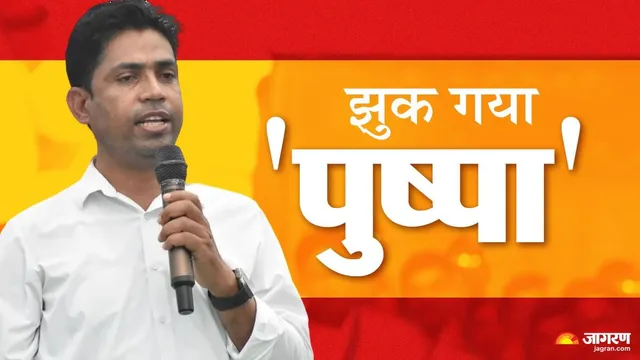
Jahangir Khan, the Trinamool Congress candidate from the Falta assembly seat, has refused to contest the election. This comes as a major setback for TMC ahead of the re-vote scheduled for May 21.
Just two days before the by-election in Bengal’s Falta assembly seat, a very surprising turn has occurred in the state’s politics.
Jahangir Khan, known as ‘Pushpa’ and the Trinamool Congress candidate who found himself alone in this battle, has suddenly withdrawn from the electoral race.
On Tuesday, the last day of election campaigning, Jahangir announced, “I am not contesting this election anymore.”
In a press conference, Jahangir Khan said, “Chief Minister Shubhendu Adhikari has announced a ‘special package’ for the development of Falta. I am pulling out of this election.”
However, he did not clarify whether this decision was taken on the instructions of Abhishek Banerjee or the top TMC leadership.
What does the rule say?
Since the deadline for withdrawing nominations has already passed, Jahangir Khan’s name and election symbol will remain on the EVM, but he has personally withdrawn from the race.
Amid this dramatic development, BJP workers celebrated by throwing saffron gulal during Chief Minister Shubhendu Adhikari’s roadshow in Falta.
Falta assembly seat
Falta Assembly Seat is a legislative constituency in the South 24 Parganas district of West Bengal, India. Historically, it has been a significant political arena in the region, with its boundaries and representation evolving through various delimitation processes. The seat has seen competitive electoral contests, reflecting the diverse socio-political dynamics of the area.
Falta
Falta is a town in the South 24 Parganas district of West Bengal, India, with a history tied to the colonial-era Diamond Harbour region. It is known for the historic Falta Railway Station, which was part of the first railway line in eastern India, opened in 1854, connecting Calcutta to the port. Today, Falta is a small but notable site for its industrial area and proximity to the Hooghly River.
EVM
The acronym “EVM” most commonly refers to the **Electronic Voting Machine**, a device used to record and count votes in elections. In India, EVMs were first introduced experimentally in the 1980s and have since been deployed nationwide, replacing paper ballots to streamline the voting process and reduce fraud. Their adoption has been a significant milestone in modernizing democratic elections, though they have also sparked debates over security and transparency.
Falta
Falta is a census town in the South 24 Parganas district of West Bengal, India, located near the Hooghly River. Historically, it is known for the Falta Export Processing Zone (FEPZ), one of India’s first special economic zones established in the 1980s to promote industrial growth and foreign trade. The area also has a notable colonial past, having been a site of early European settlement and trade during the British era.
Falta Railway Station
Falta Railway Station is a historic station located in the South 24 Parganas district of West Bengal, India, on the Sealdah–Diamond Harbour line. Originally built during the British colonial era, it served as an important stop along the suburban railway network connecting Kolkata to the southern reaches of the region. The station retains its old-world charm and remains a key transit point for local commuters, reflecting the enduring legacy of British-era railway infrastructure in India.
Diamond Harbour
Diamond Harbour is a historic town and port located on the eastern bank of the Hooghly River in West Bengal, India, about 50 kilometers south of Kolkata. Its name is believed to derive from the 18th-century diamond trade conducted by the British East India Company in the region, though the area also served as a key naval base and trading post during the colonial era. Today, it is a popular tourist destination known for its scenic river views, colonial-era remnants, and as a gateway to the Sundarbans mangrove forest.
Hooghly River
The Hooghly River, a distributary of the Ganges in West Bengal, India, has been a vital waterway for centuries, serving as the lifeline for trade and settlement in the region. Historically, it was the key route for European colonial powers, particularly the British East India Company, who established the city of Calcutta (now Kolkata) on its eastern bank in the late 17th century. Today, the river remains culturally and economically significant, lined with historic ghats, temples, and the iconic Howrah Bridge.