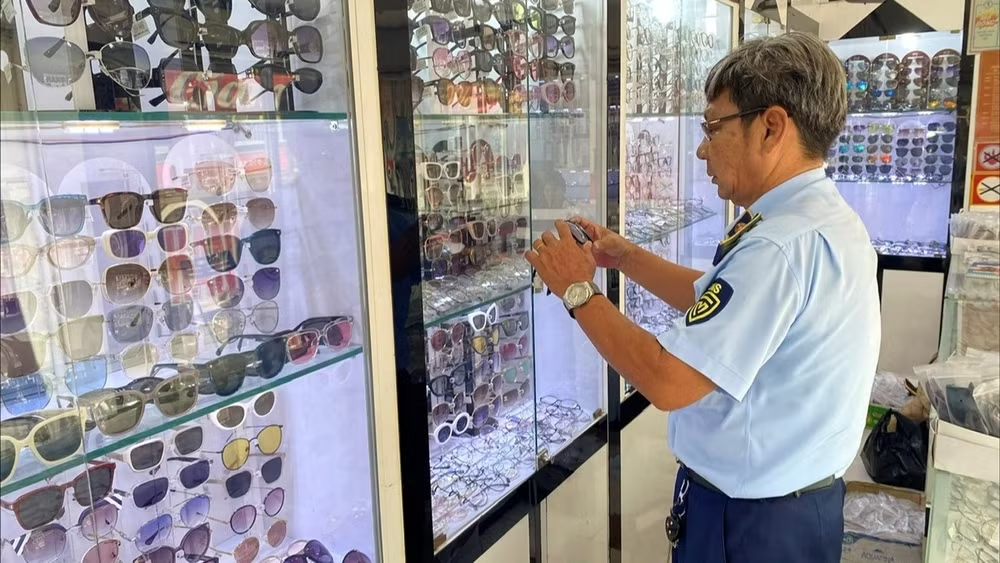
Accordingly, from now until May 30, 2026, departments, sectors, functional forces, and local authorities will simultaneously implement a peak period of inspections to detect and strictly handle acts of producing and trading counterfeit goods, goods that counterfeit trademarks and geographical indications; infringing on copyright and related rights; violations in the digital environment and e-commerce.
The city requires the implementation to be synchronized, decisive, with no forbidden zones and no exceptions.
The City Police are assigned to lead a comprehensive review of routes, areas, warehouses, websites, applications, digital platforms, e-commerce platforms, livestream sales activities, and “online warehouse” models that pose risks of intellectual property rights violations.
At the same time, focus on dismantling organized production and consumption chains of counterfeit and copyright-infringing goods that operate inter-provincially or transnationally.
The Department of Industry and Trade directs enhanced inspections at wholesale markets, shopping malls, supermarkets, warehouses, production and business establishments, transport units, and e-commerce platforms; aiming for at least a 20% increase in the number of violation cases handled compared to May 2025.
The Department of Science and Technology is assigned to strengthen guidance and support for businesses in registering patents, trademarks, geographical indications, and applying traceability and product authentication technologies to prevent counterfeiting and intellectual property rights infringement.
The Department of Finance guides individuals and organizations to review and search for trade name information before registering for Business Registration Certificates or household business registrations to reduce the situation of infringement on trademarks and trade names when registering businesses or household businesses.
At the same time, strictly control bidding and public procurement activities, preventing the use of counterfeit goods, goods of unclear origin, unlicensed software, or products violating intellectual property rights in agencies and units using the state budget.
In addition, other departments and sectors such as: Culture and Sports, Customs, Health, Agriculture and Environment, Justice, City Tax… are also assigned to strengthen inspection, supervision, and handling of violations in their management fields; promote propaganda to raise awareness among businesses and the public about protecting intellectual property rights.
Ho Chi Minh City
Ho Chi Minh City, formerly known as Saigon, is Vietnam’s largest city and economic hub. It served as the capital of French Indochina and later of South Vietnam, playing a central role in the Vietnam War before being renamed in 1976 after the communist leader Ho Chi Minh. Today, it blends modern skyscrapers with historic landmarks like the Notre-Dame Cathedral and the War Remnants Museum, reflecting its complex history.
Ho Chi Minh City
Ho Chi Minh City, formerly known as Saigon, is Vietnam’s largest city and economic hub. Originally a small fishing village, it grew under French colonial rule and later became the capital of South Vietnam until the end of the Vietnam War in 1975, when it was renamed after the communist leader Ho Chi Minh. Today, the city is known for its dynamic blend of modern skyscrapers, French colonial architecture, and historic sites like the War Remnants Museum.
Saigon
Saigon, now officially known as Ho Chi Minh City, is Vietnam’s largest city and economic hub. Originally a small fishing village, it grew into a major trading port under French colonial rule in the 19th century. The city played a pivotal role in the Vietnam War, serving as the capital of South Vietnam until 1975, and today blends historic French architecture with modern skyscrapers.
French Indochina
French Indochina was a colonial federation established by France in 1887, comprising modern-day Vietnam, Laos, and Cambodia. It was formed through a series of military conquests and treaties, and the French imposed their political, economic, and cultural systems on the region until their defeat at Dien Bien Phu in 1954. This colonial period profoundly shaped the modern history and national identities of the three Indochinese countries.
South Vietnam
South Vietnam was a state that existed from 1954 to 1975, officially known as the Republic of Vietnam, after the Geneva Accords divided Vietnam along the 17th parallel. It was a key battleground during the Vietnam War, supported by the United States against communist North Vietnam. The state collapsed in 1975 when North Vietnamese forces captured Saigon, leading to the reunification of Vietnam under communist rule.
Notre-Dame Cathedral
Notre-Dame Cathedral is a medieval Catholic cathedral located on the Île de la Cité in Paris, France, renowned for its French Gothic architecture. Construction began in 1163 under King Louis VII and was largely completed by 1345, making it a symbol of Parisian heritage and a site of major historical events, such as the coronation of Napoleon Bonaparte. After a devastating fire in April 2019 destroyed its spire and roof, extensive restoration efforts are underway to reopen the cathedral by December 2024.
War Remnants Museum
The War Remnants Museum in Ho Chi Minh City, Vietnam, is a poignant museum that documents the devastating effects of the Vietnam War (known locally as the American War) on the Vietnamese people. Originally opened in 1975, it focuses on war atrocities, the impact of chemical defoliants like Agent Orange, and the global peace movement. Through photographs, military equipment, and personal accounts, the museum serves as a powerful reminder of the human cost of conflict.