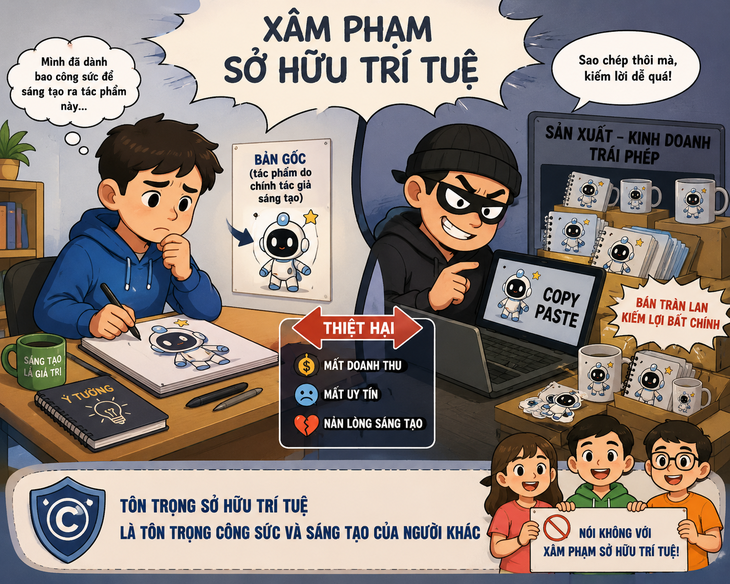
A series of copyright and related rights infringement cases have just been prosecuted by the Ministry of Public Security, not only shocking the entertainment industry but also marking an important turning point in how Vietnam views the issue of copyright.
From being seen as a “civil dispute” or “just using it a little, no big deal,” violations have now crossed a different line – potentially leading to criminal prosecution.
For many years, a widespread “free-riding culture” has existed in Vietnam’s cyberspace. A newly released song is immediately “reposted” everywhere, an exciting football match is illegally broadcast publicly, a movie just in theaters appears on free websites, a newly printed book already has scanned copies…
Thieves make money off the hard work of others so naturally that many people no longer see it as wrongdoing.
More dangerously, copyright infringement in the digital age is no longer small-scale or spontaneous but has become an “underground economy” with massive revenue.
Many platforms survive on advertising from stolen content, and quite a few units exploit music, videos, and entertainment programs like a “gold mine,” while the real authors receive nothing.
What is worth pondering is that for many years, many people still viewed copyright as something very vague.
They are willing to spend money on phones, cars, and branded clothes but think that music, movies, or digital content can be “used for free.” That mentality makes society lenient toward the theft of intellectual labor compared to other types of property.
In reality, in the creative economy, intellectual labor is the most valuable asset. Therefore, if everyone illegally broadcasts and copies recklessly, those who do things properly will die first. Clearly, there can be no talk of a “cultural industry” if the creative environment is destroyed by content theft.
Vietnam is talking a lot about digital transformation, the digital economy, and the creative industry, and to go the long haul, it must build a culture of copyright respect. Today’s world competes not just with resources or cheap labor, but with knowledge and intellectual property.
Consequently, a country that allows this situation to happen openly will find it very difficult to build trust with international investors. No one wants to bring content, technology, or intellectual products to a market where their assets can be easily stolen.
It can be said that the proposal by authorities to re-establish a “rapid response team” to block and remove copyright-infringing content online is a survival requirement for Vietnam’s digital content environment today.
Of course, criminal prosecution is necessary, but what is more important is building social awareness about copyright.
That is the awareness of not watching pirated movies, not playing illegal music, not posting stolen content, and being willing to pay for intellectual property… Individuals and organizations that can do this will create a true digital civilization.
Respecting copyright is not just about complying with the law; it is also a way for a society to show respect for creative labor, decency in business, and the honor of a country wanting to step onto the global stage.
The case of bolero singer Quang Lap along with the owners of BH Media, Lululola, May Sai Gon companies… being prosecuted to investigate acts of infringing copyright and related rights is attracting great attention in the entertainment industry and the digital content creation community.