Focus on Monsoon Preparedness, Infrastructure Projects, and Increasing Zone Revenue
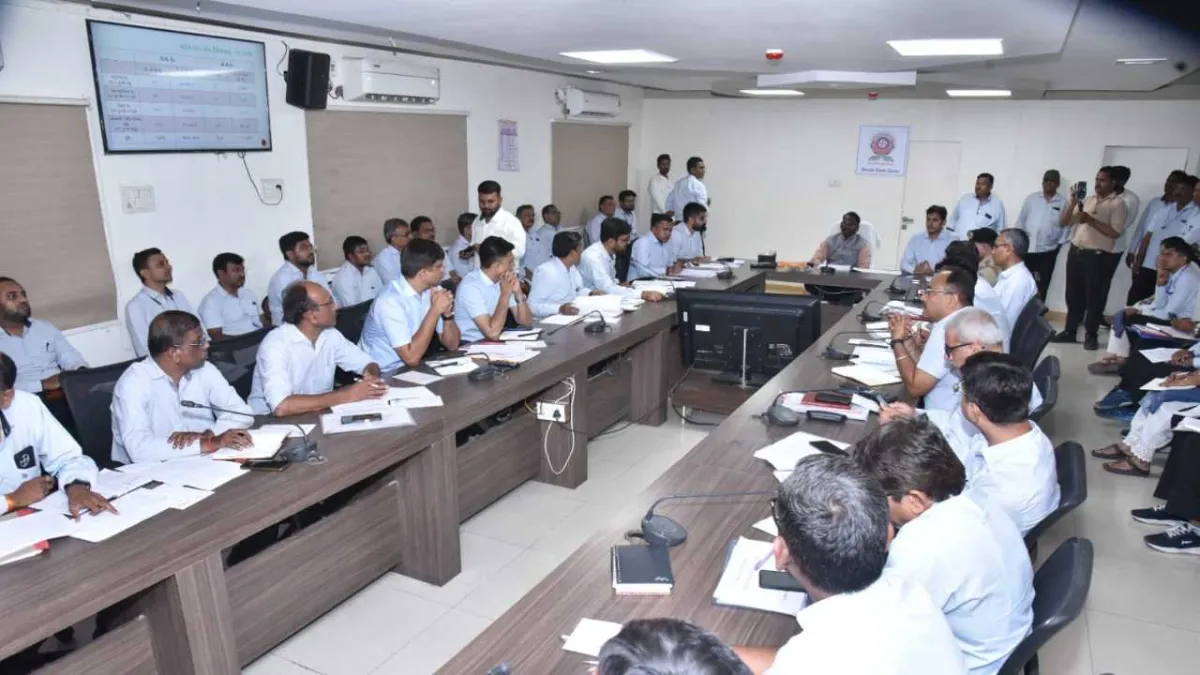
Surat. A review meeting was held at the Limbayat Zone office of the Surat Municipal Corporation, chaired by Municipal Commissioner M. Nagarajan. The meeting included a detailed review of various development works underway at the zone level, pre-monsoon preparations, and administrative procedures.
During the meeting, zone officials presented the work of various departments. The Commissioner reviewed in detail the work of the Bridge, Drainage, Hydraulic, Health, Roads, Garden, Public Infrastructure Cell, Lighting, and Traffic departments.
Additionally, the progress of development works such as community halls, schools, reading rooms, gardens, and yoga studios, as well as completed projects, was discussed. Keeping the upcoming monsoon in mind, the cleaning of creeks passing through the zone area and the status of pre-monsoon works were also assessed.
Officers from the technical, non-technical, and health departments of the Limbayat Zone were present at the meeting.
During the review meeting, the Municipal Commissioner instructed officials to increase the zone’s revenue and cut unnecessary expenses. He emphasized paying special attention to developing facilities like cycle tracks, increasing the use of the online system for administrative approvals, and strengthening security arrangements at the zone premises.
The Commissioner also gave instructions to ensure the quality of road construction works and to complete all work within the timeframe through a project monitoring system. At the end of the meeting, he conveyed a message to officials and employees to work with mutual coordination and teamwork, prioritizing the convenience and public interest of citizens.
Limbayat Zone
Limbayat Zone is a residential and industrial area located in Surat, Gujarat, India. Historically, it developed as part of Surat’s urban expansion during the late 20th century, transforming from agricultural land into a densely populated neighborhood. Today, it is known for its textile and diamond processing industries, as well as for being a multicultural community with various religious sites.
Surat Municipal Corporation
The Surat Municipal Corporation (SMC) is the governing civic body responsible for the administration and infrastructure of Surat, a major city in the Indian state of Gujarat. Established in 1966, it succeeded the earlier Surat Municipality, which had been formed during British rule in 1852. Today, the SMC is known for its effective management of the city’s rapid urbanization and for its role in making Surat one of India’s cleanest and most efficiently run cities.
Bridge
A bridge is a structure built to span physical obstacles like rivers, valleys, or roads, providing passage over them. Historically, bridges date back to ancient times, with early examples like the Arkadiko Bridge in Greece from around 1300 BCE using stone arches. They have since evolved from simple logs and stones to modern engineering marvels like suspension and cable-stayed bridges, playing a crucial role in trade, travel, and cultural exchange.
Drainage
The Drainage, also known as the Great Drainage System, is an ancient water management network in the Indus Valley Civilization, particularly prominent at sites like Mohenjo-Daro (c. 2500 BCE). It featured sophisticated covered brick channels and soak pits that carried wastewater away from homes, demonstrating one of the world’s earliest and most advanced urban sanitation systems. This engineering marvel highlights the civilization’s remarkable focus on public health and urban planning.
Roads
Roads are engineered pathways that have connected human communities for millennia, evolving from ancient dirt tracks to modern highways. Their history dates back to early civilizations like the Romans, who built extensive networks for trade and military movement, and later innovations like the asphalt roads of the 19th century revolutionized travel and commerce. Today, roads remain vital infrastructure, shaping economic development and cultural exchange across the globe.
Garden
A garden is a deliberately cultivated outdoor space, often planted with flowers, trees, and shrubs for aesthetic or practical purposes. Historically, gardens have served as places of relaxation, spiritual reflection, and food production, with notable examples like the Hanging Gardens of Babylon and the formal gardens of Versailles. They reflect cultural values and horticultural practices, evolving from ancient monastic herb gardens to modern public parks and private landscapes.
Creeks
Creeks, often referring to small, narrow waterways, have played a vital role in human history as sources of fresh water, transportation routes, and sites for early settlements. Many creeks were used by Indigenous peoples and later by European settlers for trade, irrigation, and powering mills, shaping the development of surrounding communities. Today, they remain important ecological corridors and are often preserved as natural or recreational areas within parks and urban landscapes.
Cycle tracks
Cycle tracks are dedicated pathways designed for bicycles, separate from motor vehicle traffic and pedestrian walkways. Their origins trace back to the late 19th century, with early examples like the Brooklyn Cycle Path in New York (1894) and Europe’s first separated cycle paths in the Netherlands, which emerged to improve safety for the growing number of cyclists. Today, cycle tracks are a key feature of modern urban planning, promoting eco-friendly transportation and reducing traffic congestion.