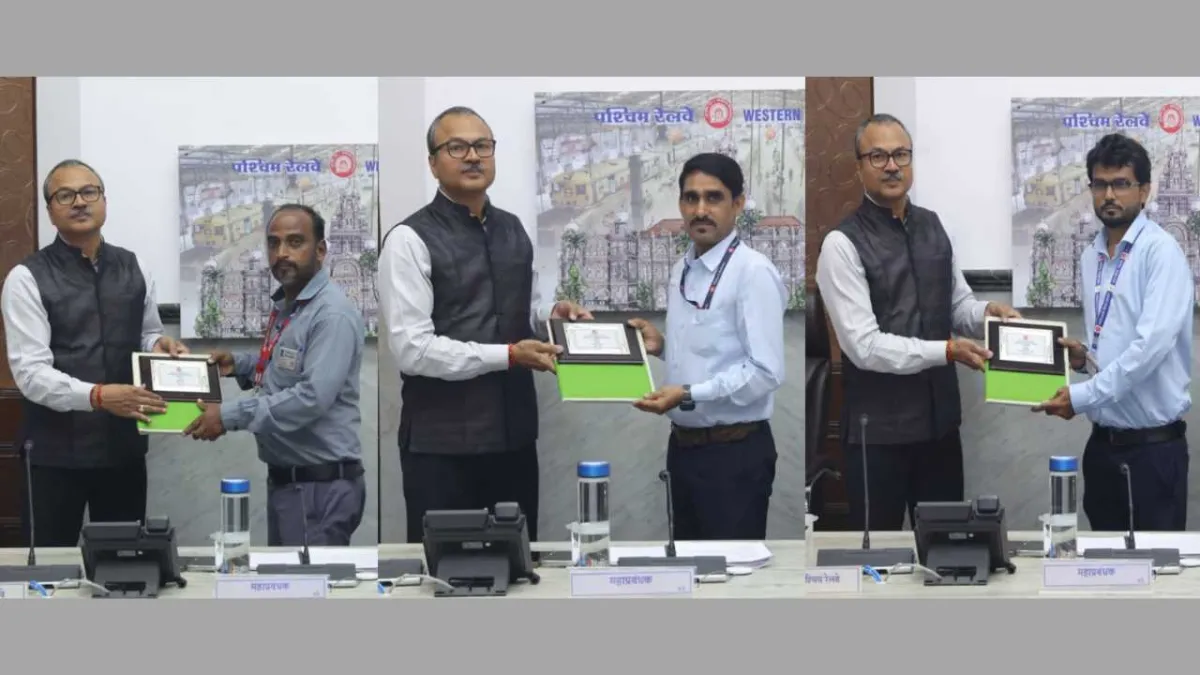
This award was given for showing vigilance and playing a key role in preventing potential accidents in time while on duty during March 2026.
Safety is paramount in railway operations, and the alertness and vigilance of every employee play a crucial role in ensuring it. The General Manager of Western Railway awarded safety prizes to railway employees of the Vadodara division for their excellent work. These awards were given for showing vigilance while on duty during March 2026 and for playing a key role in averting potential accidents in time.
According to a press release, the employees who received the awards are as follows. Sanjay Kumar works as a pointsman at Kharsalia in the Vadodara division of Western Railway. On March 23, 2026, a goods train with wagons was passing through Kharsalia station in the Kharsalia yard. While exchanging the “All Right” signal, off-side pointsman Sanjay Kumar noticed that the auxiliary reservoir of the second wagon from the engine of the MKPP train was shaking abnormally. Sensing the potential danger to the train, he immediately informed the station master of Kharsalia, who then provided a “Stop and Examine” signal to the station master of Godhra. Upon inspection by carriage and wagon staff at Godhra, it was found that all fittings of the auxiliary reservoir of the relevant wagon were broken and it was in a very unsafe condition, which could fall or hang at any time. By promptly removing the defective part, the possibility of a serious accident was averted. Due to his vigilance and timely information, a potential major danger was avoided, and the safety of rail operations was ensured.
Suresh Farshwal works as an assistant loco pilot at the Vadodara lobby in the Vadodara division of Western Railway. On March 3, 2026, during a guard driver report (GDR) inspection at MMB (Sabarmati guard), a gap was found between the PU pads of the front and rear trolleys in a wagon. Understanding the seriousness of the situation, the assistant loco pilot immediately informed the loco pilot/CTO/CTLC-ADI. Subsequently, the carriage and wagon department inspected the relevant wagon and found it unfit for further travel. The wagon was promptly detached in the Sabarmati yard, thus averting the possibility of a potential accident. As a result of the quick and alert action of the assistant loco pilot, a potential untoward incident on the line was prevented, ensuring the safety of the railway structure.
Asib Husen A. Malek works as a senior technician in the Vadodara division of Western Railway. On February 26, 2026, Asib Husen A. Malek demonstrated extraordinary vigilance and alertness during the primary maintenance of wagon VVNH-1. During inspection, he found that the wheel flange was severely rubbing against the solebar frame of the upper part of the milk tank, which was an extremely dangerous condition. Understanding the seriousness of the situation, he immediately marked the relevant wagon as sick for repair. As a result of his quick and thoughtful action, a potential derailment incident was averted, and the safety of the railway structure was ensured.
Due to their vigilance, alertness, and quick decision-making ability, potential serious accidents were avoided, and the safety of rolling stock, employees, passengers, and railway property was ensured. This incident reflects their conscientiousness towards railway work, safety, vigilance, and dedication to duty.