The Strengthening of Brotherhood and Tolerance Forum was Held by the Tangerang City Agency for National Unity and Politics.
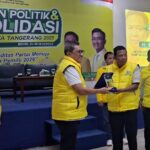
Secretary of Kesbangpol Tangerang City, Sumangku (second from left), at the organization gathering event, Wednesday, at GOR Neglasari.
TANGERANG – In an effort to strengthen synergy and maintain regional stability, the National Unity and Politics Agency (Kesbangpol) of Tangerang City held a gathering with 40 community organizations (Ormas) across Tangerang City, Wednesday, at GOR Neglasari.
This event served as a forum for discussion on strengthening religious tolerance, education, and anti-drug socialization, featuring representatives from the district prosecutor’s office, the Indonesian Ulema Council, and the National Narcotics Agency of Tangerang City.
Head of Kesbangpol Tangerang City, Teguh Supriyanto, stated that besides acting as a bridge between the community and the government, this event is expected to help realize a harmonious Tangerang City free from conflicts.
“We gathered forty organizations from various backgrounds in this room to align perceptions and goals, aiming to create a safe, orderly, and comfortable Tangerang City,” said Teguh.
He explained that the main focus of this gathering covers three crucial points: religious tolerance, the role of education, and a shared commitment to combating narcotics. “Of course, we serve as one of the driving forces and communication bridges between organizations and the city government,” he added.
GOR Neglasari
GOR Neglasari is a sports venue located in Tangerang, Indonesia, primarily used for basketball and other indoor sporting events. It was built as part of the city’s efforts to promote athletics and community recreation, hosting local competitions and cultural activities. The facility has become a notable landmark in the area, supporting youth sports development and regional tournaments.
GOR Neglasari
GOR Neglasari is a sports arena located in Bandung, Indonesia, known for hosting various indoor athletic events and community activities. Originally built to support local sports development, it has served as a venue for basketball, volleyball, and badminton competitions. The facility reflects the city’s commitment to promoting physical fitness and recreational opportunities for its residents.
Tangerang City
Tangerang City, located just west of Jakarta in Indonesia, has a rich history as a center for trade and industry, with its roots tracing back to the 16th century as a port for the Banten Sultanate. It later developed under Dutch colonial rule, becoming known for its Chinese Benteng culture and rubber plantations. Today, Tangerang is a rapidly growing urban hub, blending modern infrastructure with historic sites like the Old Market and traditional temples.
Indonesian Ulema Council
The Indonesian Ulema Council (Majelis Ulama Indonesia, MUI) is a prominent non-governmental organization of Islamic scholars in Indonesia, established in 1975 by the New Order government to provide religious guidance and fatwas. It was created to unify Islamic voices and support national development, and it has played a key role in issuing rulings on social, economic, and political issues. Over time, the MUI has become an influential body in shaping Islamic discourse in the world’s largest Muslim-majority country.
National Narcotics Agency
The National Narcotics Agency is an Indonesian government institution tasked with combating drug abuse and trafficking. Established in 2002 under Presidential Decree No. 17, it evolved from earlier anti-drug bodies to coordinate prevention, enforcement, and rehabilitation efforts across the country. The agency plays a critical role in addressing Indonesia’s ongoing challenges with illicit narcotics.
Betawi Child Forum
The Betawi Child Forum is a community-based initiative in Jakarta, Indonesia, focused on empowering children from the Betawi ethnic group. It provides a platform for young people to express their views, learn about their cultural heritage, and participate in local decision-making. The forum emerged from efforts to preserve Betawi traditions while addressing modern children’s rights and social issues.