Mexico Makes History: Defeating Argentina, Garuda Baru Wins SCWC 2026 Championship Title
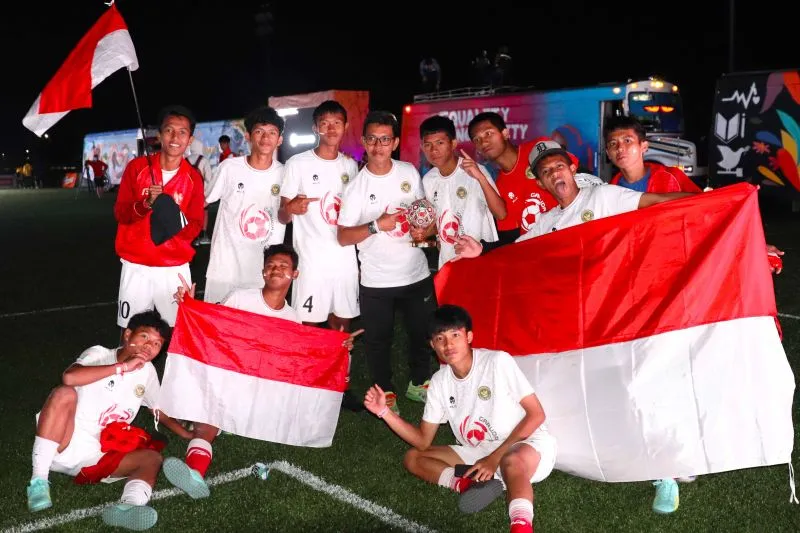
Depok (15/05/2026) – The national anthem of Indonesia, Indonesia Raya, echoed in the heart of Mexico City after the Garuda Baru team officially crowned themselves champions of the Street Child World Cup (SCWC) 2026 Boys Shield category. In a dramatic final match on Thursday night local time, Indonesia successfully defeated the tough Argentine team through a thrilling penalty shootout.
This achievement is a golden milestone for Indonesia, surpassing the semifinal record achieved in the 2018 edition in Russia.
Final Drama: Dominance, Comeback, and Mental Battle
The decisive match took place under high tension with two halves of eight minutes each.
Early Lead: Indonesia struck first through Raehan Alfarezi, who scored the opening goal in the sixth minute of the first half.
Last-Minute Equalizer: With victory in sight, Argentina managed to level the score in the eighth minute of the second half, forcing the game into a penalty shootout.
Samuel’s Solid Wall: In the penalty shootout, three Indonesian kickers—Raehan Alfarezi, Aryo Topan Artha Gading, and Deno Mazra Rasyid—stayed calm and successfully scored. The highlight came when goalkeeper Samuel Steven Siagian became the hero by saving the final Argentine kick, securing a 3-2 win for the Red and White.
Champion Squad Composition
The coach fielded the best formation to counter the physical play of the Argentine team. In defense, the duo of Deno Mazra Rasyid and Aryo Topan Artha Gading disciplinedly guarded goalkeeper Samuel Steven. The midfield was entrusted to the trio of Danar Saputra, Dino Siswanto, and Izul Hamid, while Raehan Alfarezi stood as the sole striker.
This victory was also supported by a ready bench consisting of Rizki Firmansyah, Javasha, and Mohamad Azriel Aliansyah.
Diplomacy Through Football and Government Support
The departure of these young talents to the international stage received full support from the Ministry of Defense of the Republic of Indonesia. Participation in SCWC 2026 was not just about winning a trophy, but part of a humanitarian mission and the future defense of the nation’s generation.
Government support underscores that street football is a strategic tool for:
Future Access: Opening pathways for marginalized children to obtain proper education.
Character Building: Instilling values of discipline and a winning mentality from an early age.
National Representation: Proving that Indonesian children can compete at the global level despite starting from limitations.
This championship title is expected to ignite the spirit of youth development programs in Indonesia, ensuring children continue to have space to grow through sports and education.
Mexico City
Mexico City, originally founded as Tenochtitlán by the Aztecs in 1325, is one of the oldest and largest cities in the Americas. It served as the capital of the Aztec Empire until the Spanish conquest in 1521, after which it was rebuilt as the capital of New Spain. Today, it is a vibrant metropolis blending ancient indigenous heritage with colonial and modern influences.
Indonesia Raya
“Indonesia Raya” is the national anthem of Indonesia, composed by Wage Rudolf Supratman and first played publicly during the Youth Pledge in 1928, when Indonesian nationalists declared their unity. The song became a powerful symbol of the independence movement and was officially adopted as the national anthem upon Indonesia’s proclamation of independence on August 17, 1945. Its title means “Great Indonesia,” reflecting the nation’s aspirations for unity and sovereignty.
Garuda Baru
Garuda Baru is a large, modern statue of the mythical Garuda bird located in the Garuda Wisnu Kencana Cultural Park in Bali, Indonesia. Completed in 2018, it stands as part of a monumental sculpture of the Hindu god Vishnu riding the Garuda, designed by artist Nyoman Nuarta. The site reflects Balinese Hindu mythology and serves as a cultural landmark, symbolizing protection and wisdom.
Street Child World Cup (SCWC)
The Street Child World Cup (SCWC) is a global sporting and cultural event that unites street-connected children from around the world to play football and advocate for their rights. Founded in 2014, the tournament uses the power of sport to challenge negative stereotypes and give a platform for these children to share their stories, calling for better protection and opportunities. The event has been held in countries like Brazil, Russia, and South Africa, and has helped influence policy changes and increased support for street children globally.
Russia
Russia is the largest country in the world, spanning Eastern Europe and northern Asia, with a rich history that includes the rise of the Kievan Rus’, the Mongol invasion, the Tsardom of Russia, and the Soviet Union era. Its cultural sites, such as the Kremlin and Red Square in Moscow, and the Hermitage Museum in St. Petersburg, reflect centuries of imperial grandeur, revolutionary change, and artistic achievement. Today, Russia remains a global power with a diverse cultural heritage shaped by its vast geography and complex past.
Indonesia
Indonesia is a vast archipelago nation in Southeast Asia, consisting of over 17,000 islands. Its history is shaped by powerful Hindu-Buddhist kingdoms like Srivijaya and Majapahit, followed by centuries of Dutch colonial rule and a struggle for independence declared in 1945. Today, it is the world’s largest Muslim-majority country, known for its rich cultural diversity, including iconic sites like Borobudur temple and the island of Bali.
Argentina
Argentina, officially the Argentine Republic, is a South American country known for its rich cultural heritage, including tango music and dance, and its diverse landscapes from the Andes mountains to the Pampas grasslands. Its history includes Spanish colonization beginning in the 16th century, followed by independence in 1816, and a period of significant European immigration that shaped its modern identity. Today, Argentina is famous for its vibrant capital Buenos Aires, the passionate sport of football, and icons like Eva Perón and the gaucho cowboy tradition.
Ministry of Defense of the Republic of Indonesia
The Ministry of Defense of the Republic of Indonesia, located in central Jakarta, is the government department responsible for the nation’s defense policy and military affairs. Its headquarters, often associated with the historic Wisma Antara building, has played a key role in coordinating Indonesia’s defense strategies since the country’s independence. The ministry oversees the Indonesian National Armed Forces and works to safeguard national sovereignty, with its history deeply tied to Indonesia’s struggle for independence and ongoing modernization efforts.