-
World Floating Village: India is the country with the largest number of villages in the world. According to one estimate, there are about 600,000 small and large villages in India. Millions of people live in them and make a living through various occupations. But do you know about a unique village in India that is located in a lake spread over 250 square kilometers? The houses in this village are built on thick grass that grows in the lake. If you place even one foot wrong, you could sink into the infinite depths of the lake.
The world’s only floating village
The special thing is that this is not only India’s but also the world’s unique floating village. If you are thinking that we are talking about a village located in Dal Lake in Kashmir, then your guess is wrong. 99 percent of the country’s people may not have even heard about this beautiful village. Let us take you on a journey to this interesting village and tell you where this unique village is located.
The lake spreads over 250 square kilometers
We are talking about India’s only floating village. Its name is Champu Khangpok. This village is located in Loktak Lake in Manipur. It is considered the world’s unique floating village. Loktak Lake is located in the Imphal Valley, the capital of Manipur. Spread over about 250 square kilometers, it is the largest freshwater lake in Northeast India. Due to rising water levels during the monsoon, the area of this lake expands to about 500 square kilometers.
Houses built on tall grass floating in the water
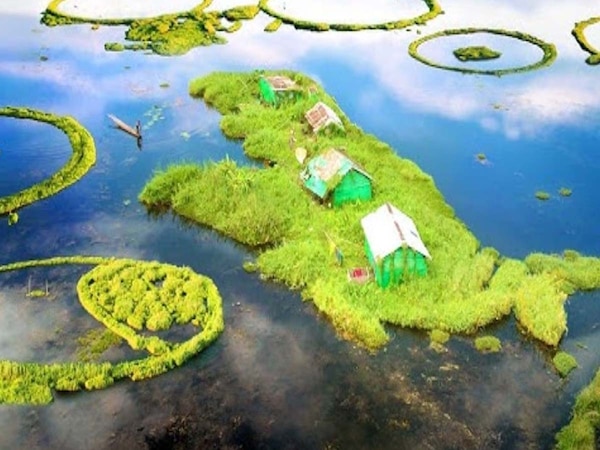
In this lake, there are many small natural floating islands. These floating islands are called Phumdi. They are made of decaying plants, soil, tall grasses, organic matter, and roots. The surface of these Phumdis is spongy (like a trampoline) and they move with the water. They are so thick and strong that houses, schools, and even an entire village can be built on them.
On these same floating islands is located India’s only floating village, Champu Khangpok. Most of the people living in this village belong to the Meitei community. They live in bamboo huts called Phumsang, built on the Phumdis. This bamboo does not sink in water and does not rot quickly. Because of this, it lasts for years in the water easily.
They make a living by fishing
The main occupation of the people living in this village is fishing. They make circular fishing enclosures in the lake. After that, they catch large fish and take them by boat to nearby markets to sell, and on their way back, they buy the things they need. This village also has a floating school and a community hall.
The world’s floating national park
In this same lake is the Keibul Lamjao National Park. It is the world’s only floating national park, located on the largest Phumdi in this lake. This national park is home to the endangered Sangai deer (Dancing Deer).
This lake provides irrigation, fish, drinking water, and livelihood to the people, so it is also called the lifeline of Manipur. If you ever go to visit Manipur, do not forget to visit this lake and the Loktak village. It will be such an unforgettable experience of your life that you will remember it forever.
Champu Khangpok
Champu Khangpok is a scenic lake located in the Kangpokpi district of Manipur, India, known for its serene beauty and cultural significance. Historically, it is associated with the folklore of the Meitei community, where it is believed to be a sacred site connected to ancient traditions and local legends. The lake remains a popular destination for visitors seeking tranquility and a glimpse into the region’s rich cultural heritage.Loktak Lake
Loktak Lake, located in Manipur, India, is the largest freshwater lake in the northeastern region, renowned for its unique floating islands called phumdis. Historically, it has been vital to the local economy and culture, supporting fishing and agriculture, and is home to the Keibul Lamjao National Park, the world’s only floating national park and the last natural habitat of the endangered Sangai deer. The lake faces environmental threats from pollution and hydropower projects, but remains a crucial ecological and cultural landmark.Imphal Valley
The Imphal Valley, located in the northeastern Indian state of Manipur, is a fertile, oval-shaped basin surrounded by hills and known for its scenic beauty and cultural significance. Historically, it was the seat of the Manipur Kingdom, with a rich legacy of dynastic rule, and it became a major theater of conflict during World War II, where the Battle of Imphal in 1944 marked a turning point against Japanese forces. Today, the valley remains the cultural and political heart of Manipur, home to the state capital and a blend of Meitei traditions and diverse communities.Keibul Lamjao National Park
Keibul Lamjao National Park is the world’s only floating national park, located in Loktak Lake in the Indian state of Manipur. It was established in 1977 to protect the endangered Eld’s deer, known locally as the sangai, and features unique floating vegetation called phumdis. The park’s history is tied to the conservation of the sangai, which was once thought extinct until its rediscovery in the 1950s.Phumdi
Phumdi is a unique and fragile ecosystem of floating islands found in Loktak Lake, Manipur, India, composed of decomposed plant matter, soil, and organic debris. These heterogeneous masses support a rich biodiversity and are home to the Keibul Lamjao National Park, the world’s only floating national park and the last natural habitat of the endangered Sangai deer. Historically, phumdis have been used by local communities for fishing, farming, and habitation, shaping the traditional livelihoods and culture of the region for centuries.Phumsang
Phumsang is a traditional village in the Yunnan province of China, known for its well-preserved Naxi ethnic culture and ancient architecture. Its history dates back several centuries, serving as a key stop on the ancient Tea Horse Road, a historic trade route connecting Yunnan to Tibet. Today, the village offers visitors a glimpse into the traditional lifestyle, featuring stone-paved paths, wooden houses, and local customs.Meitei community
The Meitei community is the predominant ethnic group in the Indian state of Manipur, with a rich history dating back to ancient kingdoms. They are known for their distinct language, Meiteilon, and cultural traditions, including the classical dance form of Manipuri and the celebration of festivals like Lai Haraoba. Historically, the Meitei kingdom maintained independence for centuries before being annexed by the British in the 19th century and later integrating into modern India.Sangai deer
The Sangai deer, also known as the “dancing deer,” is a rare and endangered subspecies of brow-antlered deer found only in the floating wetlands of Loktak Lake in Manipur, India. Its distinctive antlers and graceful gait, which appears as if it is dancing on the soft, floating vegetation, have made it a cultural icon for the region. Historically, the deer faced near extinction due to habitat loss and hunting, but conservation efforts, including the establishment of the Keibul Lamjao National Park, have helped stabilize its population.