-
Now we will analyze Prime Minister Narendra Modi’s ‘one day, one country’ foreign visit. PM Modi was in the UAE yesterday and from today his Europe tour has begun. The PM started his 4-country Europe tour from the Netherlands. Just as during the PM’s only 4-hour Abu Dhabi visit, 7 important agreements were signed between India and the UAE. Similarly, PM Modi’s 35 hours in the Netherlands are crucial for several sectors, including semiconductors. Apart from the Netherlands, the agenda of the PM’s visit to the remaining 3 countries in Europe is also important. Before understanding how this tour is set to be a game-changer for India-Europe relations, you should see what is happening during the Netherlands visit.
This is Prime Minister Modi’s second visit to the Netherlands. Earlier, he visited the Netherlands in 2017. Before bilateral talks and trade agreements in the Netherlands, he addressed the Indian community living there. After the UK, the largest number of people of Indian origin in Europe live in the Netherlands. About 250,000 people of Indian origin work in the IT, engineering, and high-skill sectors in the Netherlands. Among them, PM Modi felt at home today.
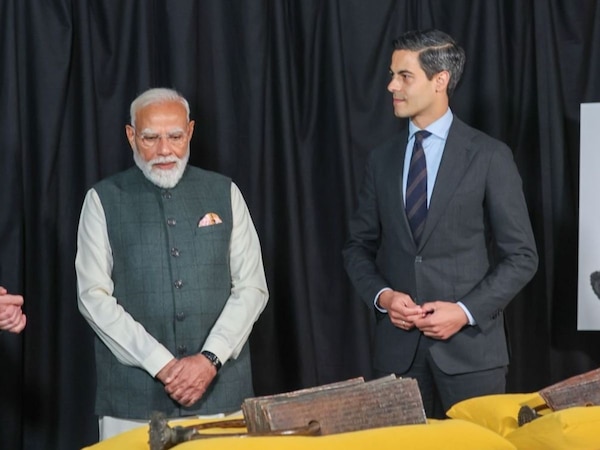
Historical Chola dynasty copper plates returned to India
This visit by the Prime Minister also brought a success related to cultural heritage. The Dutch government returned historical copper plates of the Chola dynasty to India. These 11th-century copper plates had been kept in the Leiden University library for the past 300 years. A Dutch missionary took them from India in the 17th century. The government had been trying to bring these historical plates back to the country since 2012. Success has now been achieved. That is, after almost 400 years, India has regained this historical heritage.
Deals expected on semiconductors, AI, and many other issues
Agreements are expected between India and the Netherlands in several sectors, including semiconductors, artificial intelligence, water management, and clean energy. Among these, the agreement on semiconductors is the most important for India. Some time ago, in the presence of the prime ministers of both countries, a memorandum of understanding was signed between Tata Electronics and the Dutch company ASML. The Netherlands is one of the few countries in the world that has the entire semiconductor value chain, from designing to manufacturing machines.
-
The Netherlands is considered the powerhouse of semiconductor manufacturing equipment in the world.
-
85% of the chips made in the world use Dutch technology at some level.
-
ASML is the only company in the world that makes extreme ultraviolet lithography machines.
-
This machine is essential for making the most advanced chips.
-
Without ASML’s machines, major companies in the world cannot make high-performance AI chips.
The Netherlands is cooperating with India
Considering this importance of the Netherlands, India is forming a strategic partnership with it to advance its semiconductor mission. This is also a profitable deal for the Netherlands. Due to the tech war between the US and China, the US has told the Netherlands to stop selling semiconductor machines to China. In such a situation, India will become an alternative market for it. The Netherlands is one of India’s largest trading partners in Europe.
-
Bilateral trade between the two countries was about $28 billion in 2024-25.
-
Additionally, the Netherlands is the fourth largest investor in India.
-
The Netherlands has invested about $56 billion in the Indian economy.
-
More than 300 Dutch companies are in India, while about the same number of Indian companies operate in the Netherlands.
Free trade
Chola dynasty copper plates
The Chola dynasty copper plates are ancient Indian inscriptions etched onto copper sheets, primarily used to record land grants, royal decrees, and donations to temples. Dating from the 9th to 13th centuries, these plates provide invaluable historical insights into the administrative, economic, and cultural life of the Chola Empire, one of South India’s longest-ruling dynasties. They are highly prized by historians for their detailed accounts of medieval Tamil society and governance.Leiden University library
The Leiden University Library, established in 1575 alongside the university itself, is one of the oldest and most renowned academic libraries in the Netherlands. Its rich history includes housing significant collections, such as the personal papers of scholars like Desiderius Erasmus and the famous “Leiden Jar” used in early electricity experiments. Today, it serves as a vital resource for research and study, blending historic manuscripts with modern digital archives. -