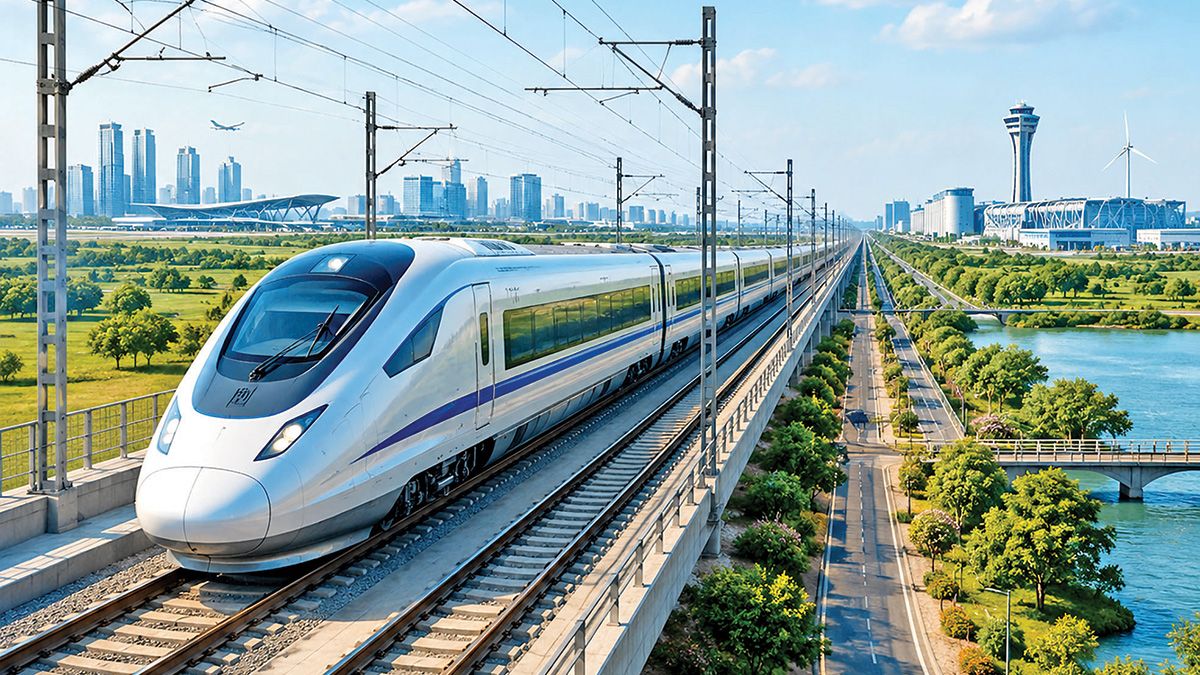
Ahmedabad-Dholera rail line to be connected to Bhavnagar.
Project to use indigenous advanced Kavach safety system; to get connected to Bullet Train and Dedicated Freight corridors
ai-generated image
Ahmedabad’s ambitious Rs 20,667 high-speed rail corridor to Dholera is now being planned for a future extension up to Bhavnagar, a move expected to significantly enhance connectivity across the Saurashtra region while strengthening Gujarat’s industrial backbone.
Ahmedabad DRM Ved Prakash told that the railway corridor would be developed on a new alignment parallel to the expressway and most of the required land had already been secured. “About 80 per cent land acquisition has been done for the project,” he said, adding that the remaining land would be acquired soon.
He further said this would be the world’s first broad gauge semi high-speed rail corridor with trains operating at 220 kmph. Most semi high-speed rail systems globally currently run on standard gauge tracks. Advanced Kavach 5.0 technology will also be deployed for automatic train protection and enhanced passenger safety.
The corridor will connect Ahmedabad with the Dholera Special Investment Region (SIR), the upcoming Dholera International Airport and the National Maritime Heritage Complex at Lothal. A total of 13 stations are planned along the route. Officials added that there are long-term plans to extend the corridor further up to Bhavnagar.
The project will also be integrated with Ahmedabad Metro at Sabarmati, Gandhigram and Vastrapur stations. Sabarmati station will additionally connect with the Mumbai-Ahmedabad Bullet Train corridor, while Moriya near Sanand will link with the Dedicated Freight Corridor.
Gujarat Chief Secretary Manoj Kumar Das said the corridor would strengthen industrial and economic growth in the state by improving connectivity between Sabarmati, Dholera SIR, Dholera airport and Lothal.
The total track length will be around 293 km and the Railways has set a target of completing the project within four years.
Officials said around 284 villages and more than five lakh people are expected to benefit directly from the corridor. The project is also expected to add nearly 20 lakh tonnes of freight transport capacity annually, generate around 91 lakh human-days of employment during construction and significantly reduce fuel consumption and carbon emissions.
Ahmedabad
Ahmedabad, located in the western Indian state of Gujarat, is a historic city founded in 1411 by Sultan Ahmed Shah. It served as the capital of the Gujarat Sultanate and later became a key center of India’s independence movement, famously hosting Mahatma Gandhi’s Sabarmati Ashram. Today, it is a UNESCO World Heritage City, renowned for its blend of Hindu, Islamic, and Jain architecture, as well as its vibrant textile industry and rich cultural heritage.
Dholera
Dholera is a historic port city in Gujarat, India, with roots dating back to the ancient Indus Valley Civilization, as evidenced by nearby archaeological sites. In modern times, it has been developed as India’s first Greenfield smart city under the Delhi-Mumbai Industrial Corridor project. The city aims to blend its ancient heritage with cutting-edge urban infrastructure and sustainable technology.
Bhavnagar
Bhavnagar is a city in the Indian state of Gujarat, founded in 1724 by Maharaja Bhavsinhji I Gohil. It was once the capital of the princely state of Bhavnagar and served as a major port for trade with East Africa and the Middle East. Today, it is known for its rich cultural heritage, historic architecture, and as a gateway to the nearby Saurashtra region.
Saurashtra
Saurashtra is a historical and cultural region in western India, located in the present-day state of Gujarat. It is a peninsular region known for its ancient ports, temples, and vibrant traditions, and it was once home to several powerful kingdoms, including the Solanki dynasty. The area holds deep religious significance in Hinduism, with sites like Dwarka (associated with Lord Krishna) and the Somnath Temple, which has a history of repeated destruction and rebuilding.
Lothal
Lothal is an ancient Harappan (Indus Valley Civilization) site located in present-day Gujarat, India, dating back to around 2400 BCE. It is renowned for having one of the world’s earliest known dockyards, suggesting it was a major maritime trade center connecting the Indus Valley with Mesopotamia and other regions. Excavations have revealed advanced urban planning, a bead-making industry, and a sophisticated drainage system, highlighting the city’s economic and cultural significance.
Sabarmati
Sabarmati is most famous for the Sabarmati Ashram in Ahmedabad, India, which served as the residence of Mahatma Gandhi from 1917 to 1930. It was from this ashram that Gandhi launched the historic Dandi Salt March in 1930, a pivotal event in India’s struggle for independence. Today, the ashram is a museum dedicated to Gandhi’s life and teachings, standing as a symbol of nonviolent resistance.
Gandhigram
Gandhigram, located in the Dindigul district of Tamil Nadu, India, is a historic village founded in 1947 by Dr. G. Ramachandran and his wife, inspired by Mahatma Gandhi’s vision of rural development and self-reliance. It emerged as a center for Gandhian philosophy, promoting khadi, village industries, and education through institutions like the Gandhigram Rural Institute. The site remains a living tribute to Gandhi’s ideals, focusing on sustainable community development and non-violent social change.
Vastrapur
Vastrapur is a prominent neighborhood in Ahmedabad, India, historically known as an ancient settlement with roots dating back to the Indus Valley Civilization, as evidenced by nearby archaeological discoveries. Today, it is best known for Vastrapur Lake, a popular recreational spot that was renovated and beautified in the early 2000s, surrounded by modern urban development and landmarks like the Gujarat Science City. The area blends its historical significance with contemporary life, serving as a cultural and social hub for locals and visitors.