Traffic Challenge Expected for Next 2-3 Years Due to SITCO Project; Separate Lanes, One-Way System, and Airport Model to Be Implemented
Surat. Traffic congestion is becoming a serious problem in the busiest area of the city due to the modernization and redevelopment project of Surat Railway Station.
The Surat Integrated Transportation Development Corporation Limited (SITCO) is carrying out large-scale construction work at the railway station, due to which heavy traffic pressure is being seen daily from Sahara Darwaja to Varachha Poddar Arcade.
In view of the situation, the Surat Municipal Corporation and police administration have become active. In this regard, an important meeting was held at the Police Commissioner’s office under the chairmanship of Municipal Commissioner M. Nagarajan and Police Commissioner Anupam Singh Gehlot. Experts from SVNIT, SITCO officials, and senior traffic police officers were present in the meeting.
Pressure of over one lakh vehicles daily
According to the traffic survey report presented by SVNIT, approximately one lakh cars, in addition to thousands of auto rickshaws, buses, and other vehicles, arrive daily in the western part of the railway station. This results in continuous traffic congestion throughout the station area.
Experts warned that the situation could become more serious in the coming days after the construction of pillars for the elevated bridge in front of the railway station begins. Keeping this in mind, the administration has decided to implement a phased traffic management plan.
Separate lanes to be created for different vehicles
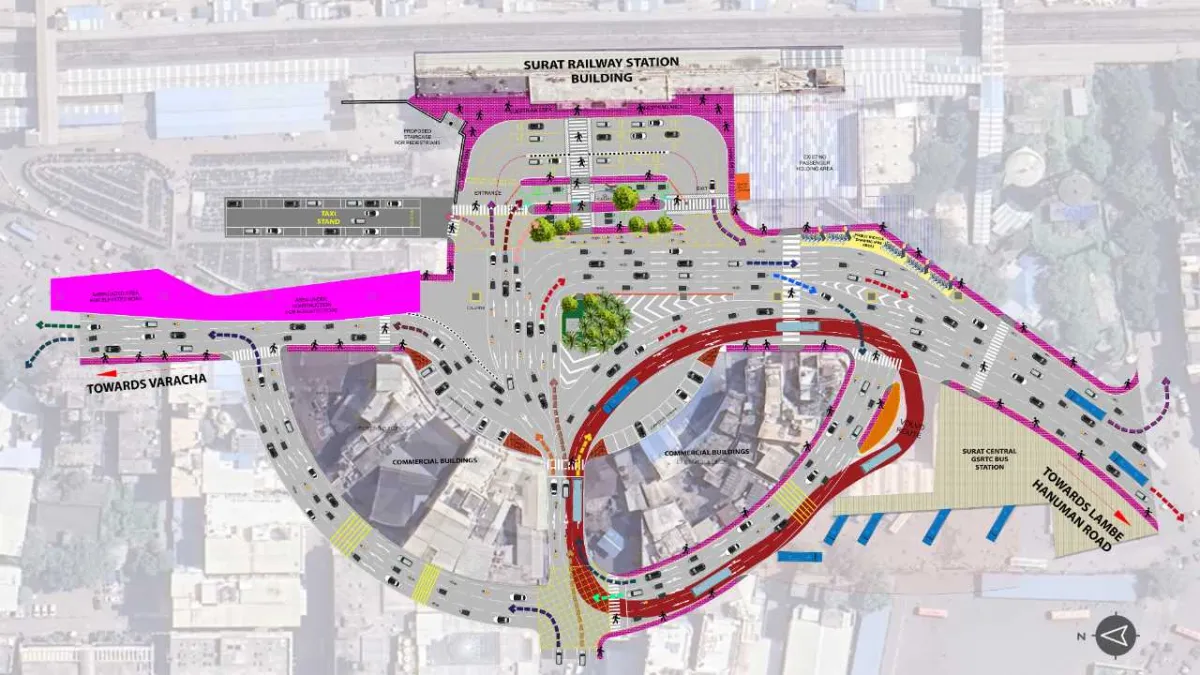
To improve traffic management, separate lanes will be created for cars, buses, and auto rickshaws in the railway station area. Additionally, a separate route for pedestrians is planned, so that passengers coming and going from the station can have safe and smooth movement.
Strict action will also be taken to remove illegal parking and uncontrolled parking within the railway station premises.
‘Pick-up and Drop’ system based on airport model
The administration has decided to implement a new traffic system on the lines of an airport in the railway station premises. Under this, private vehicles will only be allowed entry to drop off and pick up passengers. Long-term parking will not be permitted.
Officials believe that this system will provide significant relief from uncontrolled parking and traffic pressure in the station premises.
Boundary wall to be removed for elevated bridge
The existing boundary wall of the station is becoming an obstacle in the construction of pillars for the elevated bridge to be built in front of the railway station. In such a situation, the administration has also decided to remove the boundary wall of the railway station so that construction work is not hindered.
Taxi and auto stands to be shifted
The taxi and auto stands operating outside the railway station create heavy pressure on the main road. To solve this problem, it has been decided to shift the taxi stand to land owned by the district panchayat.
Additionally, a ‘single lane system’ will be strictly implemented for rickshaws, buses, and cars, so that no vehicle enters another lane and disrupts traffic.
One-way system to be implemented for ST buses
The continuous movement of buses from the ST bus stand located in front of the railway station is also increasing the problem of congestion. On the advice of SVNIT experts, a special one-way system will now be implemented for ST buses.
Furthermore, the administration will ensure that buses do not stop on public roads outside the designated bus stand to pick up or drop off passengers. Strict action will be taken against those who violate the rules.
The administration says that the railway station redevelopment work will continue for the next two to three years, so a long-term and systematic plan is being worked on for traffic management.